All species › Passerines › Honeyeaters › Scarlet Myzomela
Scarlet Myzomela | Myzomela sanguinolenta
Scharlaken dwerghoningeter | Mielero escarlata
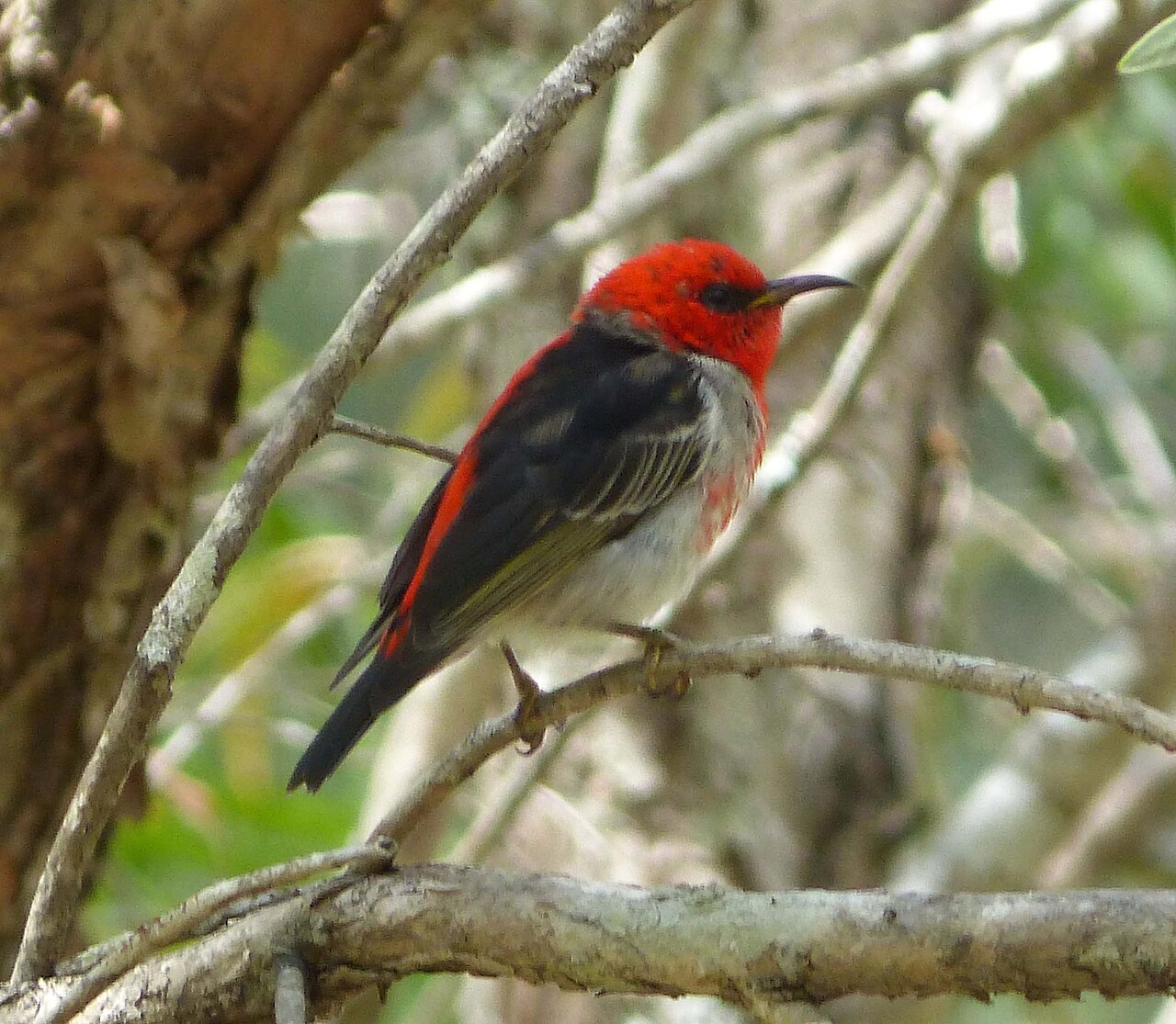
The Scarlet Myzomela is Australia's smallest honeyeater: nine to eleven centimetres and barely eight grams, with a fine decurved bill and a restless way of moving. The male is one of the most striking birds of the east coast — head, neck, upper breast, back and rump forming one continuous scarlet field, broken by a black mantle and black wings. The female is a plain brown bird and is rarely noticed. You almost always hear the species before you see it, because it keeps to the upper canopy and travels with the flowering.
Voice
For so small a bird the repertoire is surprisingly wide, wider than that of most honeyeaters. The main song is a clear, tinkling phrase of sets of about six notes rising or falling in tone, often likened to cork rubbed on glass. Males sing far more than females, which chiefly give a squeaking note and chirp while hopping through the foliage. Both sexes use a short chiew-chiew as a contact call. Since the bird itself stays a speck in the canopy, that tinkling is usually all you get to identify it by.
No freely licensed recording has been found for this species yet; what to listen for is described below.
Identification
A tiny honeyeater of nine to eleven centimetres with a slender decurved bill. The male is unmistakable: head, neck and upper breast scarlet, with the red carried on in a narrow band over back and rump, so that a good view shows one continuous red field; between these lie a black mantle and black scapulars. Towards belly and flanks the red fades into grey and greyish white. The wings are dull black with white edges to the coverts, the tail black. A narrow black line runs from bill to eye, with a thin black eye-ring. The female is quite different: brown head and neck, greyer on the sides of the head, pale grey-brown throat, brown upperparts, sometimes with scarlet uppertail coverts and often a pink or rufous facial patch; the bill base is yellowish brown. Juveniles resemble the female but are more rufous; both sexes reach adult plumage only after two moults.
Confusion species
The male can be confused only with the other two Australian myzomelas. Red-headed Myzomela (Myzomela erythrocephala) is larger, has a blackish-brown back interrupting the red of head and rump, and lives almost wholly in tidal mangrove in the tropical north — where M. sanguinolenta takes dry eucalypt forest; the two ranges meet only in north-eastern Queensland. Dusky Myzomela (Myzomela obscura) lacks red altogether. With females it is harder: those of all three species are small plain brown birds and are barely separable in the field — be honest about this and leave a lone brown female unnamed if there is no accompanying male and no clear habitat pointer. Eastern Spinebill (Acanthorhynchus tenuirostris) shares the forest and is likewise small, but has a far longer, strongly curved bill and a black, white and chestnut head pattern with no red.
Habitat
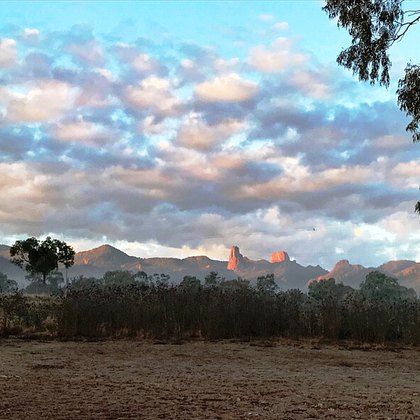
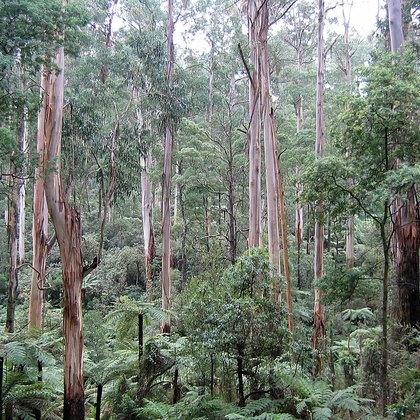
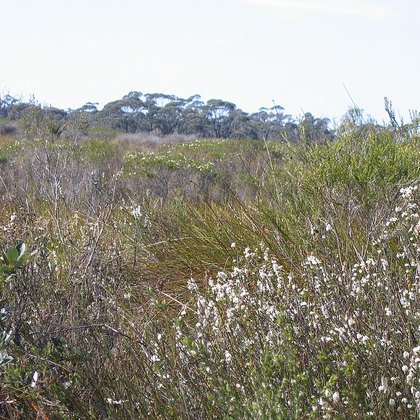
Dry sclerophyll forest and woodland with a eucalypt canopy and little understorey form its core country, along with melaleuca swamp forest, coastal heath, rainforest margins, mangrove and gardens with native plantings. It forages almost entirely in the upper canopy, alone, in pairs or in small parties. The diet is nectar and insects: it darts flower to flower, at times hovering in front of a blossom, and hunts beetles, flies, bugs and caterpillars in the canopy. Favoured food trees are turpentine, paperbark and banksia. The nest is a minute cup of shredded bark bound with spider web, about five centimetres across, built in eight days and slung high in densely foliaged trees or in a mistletoe clump. The clutch is two, occasionally three, eggs; young fledge after eleven to twelve days and up to three broods may follow in a season.
Where the bird is most often found, arranged by main group and formation.


Range and movements
The east coast of Australia, from Cooktown in Far North Queensland south to Gippsland in Victoria. South of the Hacking River in New South Wales it becomes scarce, and towards Melbourne it is no more than a rare vagrant. Inland it reaches Charters Towers, Carnarvon Gorge and Inglewood in Queensland and the Warrumbungles in New South Wales. In the south of its range it is a genuine migrant, shifting north along the coast in winter; in the north it is far more sedentary. On top of that comes a strongly nomadic element: the birds follow the flowering, so the species may be numerous in a district one year and wholly absent the next. It does not occur in New Zealand.
- Resident
- dark = core range, pale = thinly spread
Where and when to look
Do not look for the bird, look for the blossom. In spring and early summer walk past a flowering turpentine, banksia or paperbark and stand still until you hear the tinkling phrase; then put the binoculars on the topmost branches and watch for movement, not for colour — against the light even the male reads as black. Walk round the tree if you must until the sun is behind you: only then does the scarlet leap out. In east-coast gardens the species can appear in numbers after years of absence when there is heavy flowering across a wide area; such irruptions are well documented around Sydney and in southern Victoria.
Conservation
Least Concern (LC) on the strength of a range of nearly two million square kilometres and a stable population with no evidence of significant decline. The species nonetheless depends on continuous forest with flowering canopy trees, and fragmentation and loss of dry sclerophyll forest along the settled east coast thin out the network of flowering patches on which its nomadic movements rely. Because it wanders widely and responds fast to blossom, it generally absorbs local setbacks well. The highest recorded age is just over ten years.
Scientific name
Myzomela sanguinolenta | (Latham, 1801)
The English ornithologist John Latham described the species in 1801 as Certhia sanguinolenta; the parentheses around author and year record that it has since changed genus and now stands in Myzomela. The epithet sanguinolenta goes back to Latin sanguineus, 'blood-red'. The nomenclatural history is untidy: Latham worked from Watling drawings and described one species three times — as sanguinolenta (an immature male), as dibapha and as erythropygia. John Gould recognised in 1843 that these were one bird and adopted the first-written name. A 1990 proposal to give Myzomela dibapha priority was rebutted in 1992, so M. sanguinolenta remained the valid name. The Dutch scharlaken dwerghoningeter, the English Scarlet Myzomela and the Spanish mielero escarlata all point at the same colour. No subspecies are recognised; colour differences between birds come from wear after the moult.