All species › Passerines › Australasian robins › Scarlet Robin
Scarlet Robin | Petroica boodang
Karmijnvliegenvanger | Petroica escarlata
The Scarlet Robin is the best-known red robin of southern Australia and for many people the bird that defines the genus: jet black above, with a large, conspicuously white forehead patch and a deep scarlet breast over a white belly. It likes to sit low and still on a post or a dead branch, looking down and dropping onto prey in the grass. It is also one of the few species in this group that regularly comes into gardens and parks along the forest edge.

Voice
A soft, rhythmic little song of three to six clear, slightly rolling notes, often described as a small friendly ditty delivered from a low branch and not carrying far. There is also a hard, short tick as contact and warning call. The song is heard most in late winter and early spring, when pairs take up territory; outside that period the bird is often silent and gives itself away only by the tick and by its movement.
No freely licensed recording has been found for this species yet; what to listen for is described below.
Identification
The male is unmistakable: head, throat and upperparts black, with a large, pure white forehead patch reaching above the eye, a broad white wing bar, white outer tail feathers and a deep scarlet breast set sharply against both the black throat and the white belly. The female is grey-brown with a dull white to buff forehead spot, pale wing bars and a washed orange-red suffusion on the breast — in her the red is much weaker but usually still present. The posture is characteristic: upright on a low lookout, with brief tail flicks.
Confusion species
Flame Robin (Petroica phoenicea) is the chief confusion species and overlaps in range. In that species the orange-red runs up over the throat and chin, so there is no black throat, and the forehead spot is small and inconspicuous rather than large and white; P. phoenicea is also slightly larger and longer-winged, sits more often in open treeless country and forms parties in winter, which this species does not. Red-capped Robin (Petroica goodenovii) is clearly smaller, has a red crown instead of a white forehead patch, and lives in dry inland scrub. Rose Robin (Petroica rosea) and Pink Robin (Petroica rodinogaster) are pink rather than red and keep to wet, closed forest. Outside Australia there is also Norfolk Robin (Petroica multicolor), treated as the same species until 1999, but that bird occurs only on Norfolk Island and is the sole robin there. The most threatened member of the genus, Black Robin (Petroica traversi), is entirely black and lives only on the Chatham Islands.
Habitat
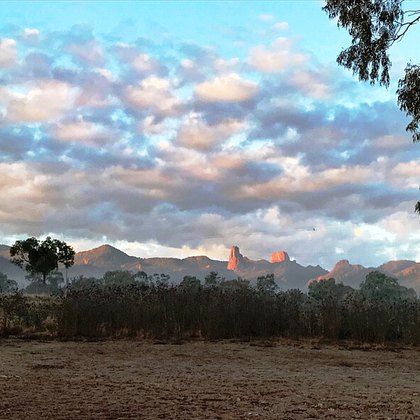
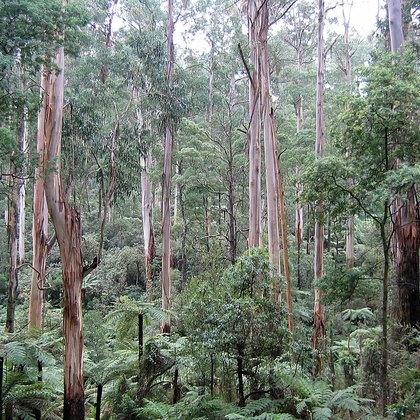
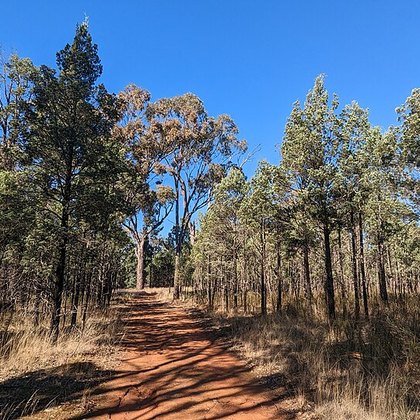
Dry eucalypt forest and open woodland with a varied understorey, and beyond that wetter eucalypt forest and forest edges. The species needs lookouts — dead branches, fallen trunks, fence posts — and open ground or short grass beneath them, because it hunts by dropping from such a perch onto insects. Where forest adjoins gardens and parks it comes in as well, especially in winter, and that makes it one of the few robins many people see around the house.
Where the bird is most often found, arranged by main group and formation.

Range and movements
South-eastern and south-western Australia, including Tasmania; the type specimen comes from Sydney. The western and eastern populations are separated by the arid Nullarbor. The bird is largely resident, but many pairs leave the higher, denser forest in winter and shift into lower, more open country — farmland, roadsides, gardens — returning in spring.
- Resident
- Winter
- dark = core range, pale = thinly spread
Where and when to look
Check low lookouts in open woodland: fence posts, dead lower branches, fallen trunks. The bird sits still and long in one place and so is noticed by its sharp white-and-red rather than by movement. Always check the throat — black in this species, red in Flame Robin — and then the size of the forehead patch. In winter it pays to work the edges of paddock and woodland, where the birds move to.
Conservation
Globally Least Concern (LC), but in south-eastern Australia the species has declined appreciably and is on regional threatened-species lists in several states and territories. The causes cited are the loss and fragmentation of woodland, the tidying away of dead wood and fallen timber — the very lookouts and shelter the species lives by — and the loss of understorey to grazing. Restoring untidy, layered woodland with dead wood on the ground is the measure most often pointed to in management.
Scientific name
Petroica boodang | (Lesson, 1837)
René Primevère Lesson described the species in 1837 as Muscicapa boodang, from a specimen taken at Sydney. The genus Petroica combines Ancient Greek petros ('rock') with oikos ('dwelling'). The epithet boodang is taken from a name for the bird in the language of the original inhabitants of the Sydney district — one of the few Australian bird names in which such a word survives in the scientific name. The English name Scarlet Robin and the Spanish petroica escarlata name the colour of the breast, and the Dutch karmijnvliegenvanger does the same.