All species › Tubenoses › Petrels, shearwaters and diving petrels › Short-tailed Shearwater
Short-tailed Shearwater | Ardenna tenuirostris
Dunbekpijlstormvogel | Pardela cola corta
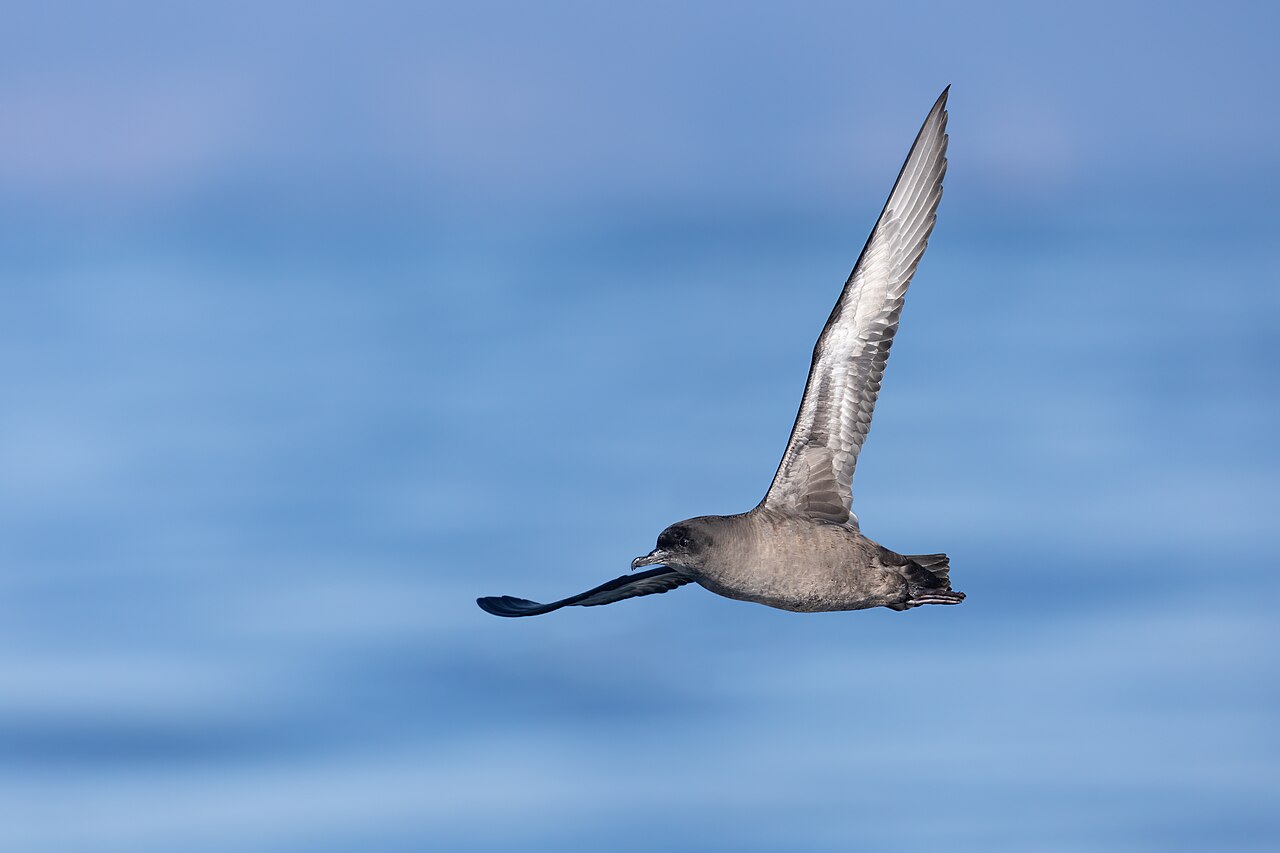
The Short-tailed Shearwater is Australia's most numerous seabird and the bird behind the word muttonbird: a medium-sized, uniformly dark brown shearwater that passes the east coast in millions in the southern summer, in ribbons that keep coming for hours. It breeds only in Australia and flies each year to the Bering Sea and back.
Voice
At sea it is silent. In the colony at night it is deafening: a throaty, rapidly repeated kooka-rooka-rah from the burrow or from the ground, rising higher and shriller in excited display. On a dark evening a large Bass Strait colony fills the whole island with that churring, while incoming birds thud down among the tussock.
No freely licensed recording has been found for this species yet; what to listen for is described below.
Identification
Forty-two centimetres and about five hundred and fifty grams, so smaller and more compact than Sooty Shearwater, with a small head and a domed forehead that gives a gentle, dove-like profile. The plumage is even dark sooty brown; the underwing is dull grey with at most a vague paler wash, never a sharp silver panel. The bill is short and slender, lead-grey, thirty-two millimetres long and eleven deep. The legs are dark grey and project just beyond the short tail in flight. Flight is fast and agile, stiff quick beats alternating with shearing glides close to the water.
Confusion species
Sooty Shearwater (Ardenna grisea) is the classic problem, and the two partly travel together: it is larger and longer-winged, with a clearly longer bill, a flatter forehead and above all a silver-grey flash in the middle of the underwing, and its feet do not reach past the tail. Flesh-footed Shearwater (Ardenna carneipes) is much bulkier, with a pale pink dark-tipped bill and flesh-coloured legs. Wedge-tailed Shearwater (Ardenna pacifica) has a longer wedge-shaped tail, pale legs and a lighter, dancing flight. In poor light the separation from Sooty Shearwater stays hard; anyone who has not seen the underwing does well to stop at 'dark shearwater'.
Habitat
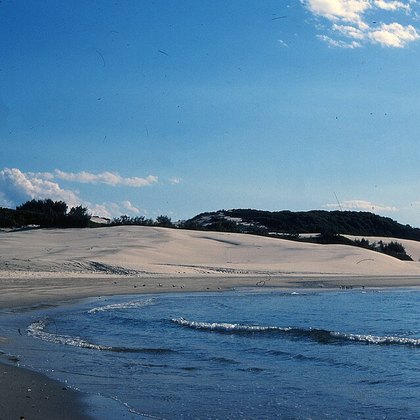
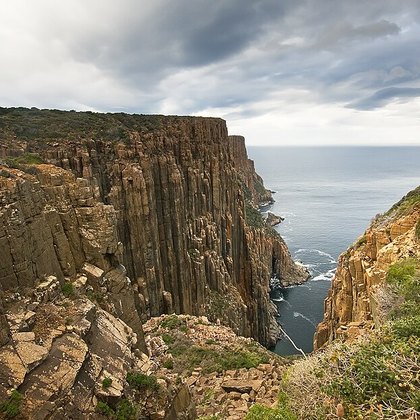
Sea over the continental shelf and beyond, on passage often right along the surf line and within a few hundred metres of the beach. Outside the breeding season its southern loops take it into cold water as far as the Antarctic ice edge. It breeds in dense colonies of self-dug burrows in sandy or peaty ground under tussock grass and low coastal scrub, on islands and a few mainland headlands.
Where the bird is most often found, arranged by main group and formation.


Range and movements
It breeds only in Australia, concentrated in Bass Strait and around Tasmania: Tasmania alone holds a hundred and sixty-seven colonies, and Babel Island has an estimated three million burrows. Further north there are colonies off Victoria, South Australia and New South Wales. The world population is put at about twenty-three million birds. It does not breed in New Zealand but is seen regularly at sea there, mainly off the west and south coasts. From late September to April it can be watched from land all along the southern and eastern coasts of Australia; after that it leaves the map window, moving through the western Pacific to the Sea of Okhotsk and the Bering Sea.
- Breeding (summer)
- dark = core range, pale = thinly spread
Where and when to look
Sit on a coastal headland in October or November with an onshore wind — Cape Solander near Sydney, Point Lonsdale, or a cape in northern Tasmania — and count the ribbons going past; it is the easiest mass seabird experience in Australia, and no boat is needed. At the Bass Strait colonies you can watch the birds pour in in dense clouds at sunset. On every bird check the short lead-grey bill and the dull underwing to separate it from Sooty Shearwater.
Conservation
Least Concern (LC), with a world population in the tens of millions, but the trend points down. The harvest of chicks is centuries old and continues: about two hundred thousand chicks are taken commercially each year on the Bass Strait islands, alongside the traditional harvest by Tasmanian Aboriginal communities. More worrying are the mass strandings that have become steadily more frequent along the east coast in recent years: exhausted, underweight birds that do not complete the return leg, linked to marine heatwaves and to changes in the food supply in the North Pacific. Plastic ingestion and fisheries bycatch weigh in as well.
Scientific name
Ardenna tenuirostris | (Temminck, 1836)
Temminck described the species in 1836 as Procellaria tenuirostris, 'slender-billed', after the narrow bill that separates it from its relatives; because it was later placed in another genus, author and year go in parentheses. The genus Ardenna was set up by Reichenbach in 1853. The type locality lies in the seas north of Japan and off the coast of Korea — the wintering grounds, that is, far from the Australian breeding islands where the bird belongs. The Dutch name follows the Latin, the English name looks at the short tail, and in Australia it is known in everyday speech simply as the muttonbird.