All species › Tubenoses › Petrels, shearwaters and diving petrels › Wedge-tailed Shearwater
Wedge-tailed Shearwater | Ardenna pacifica
Wigstaartpijlstormvogel | Pardela del Pacífico
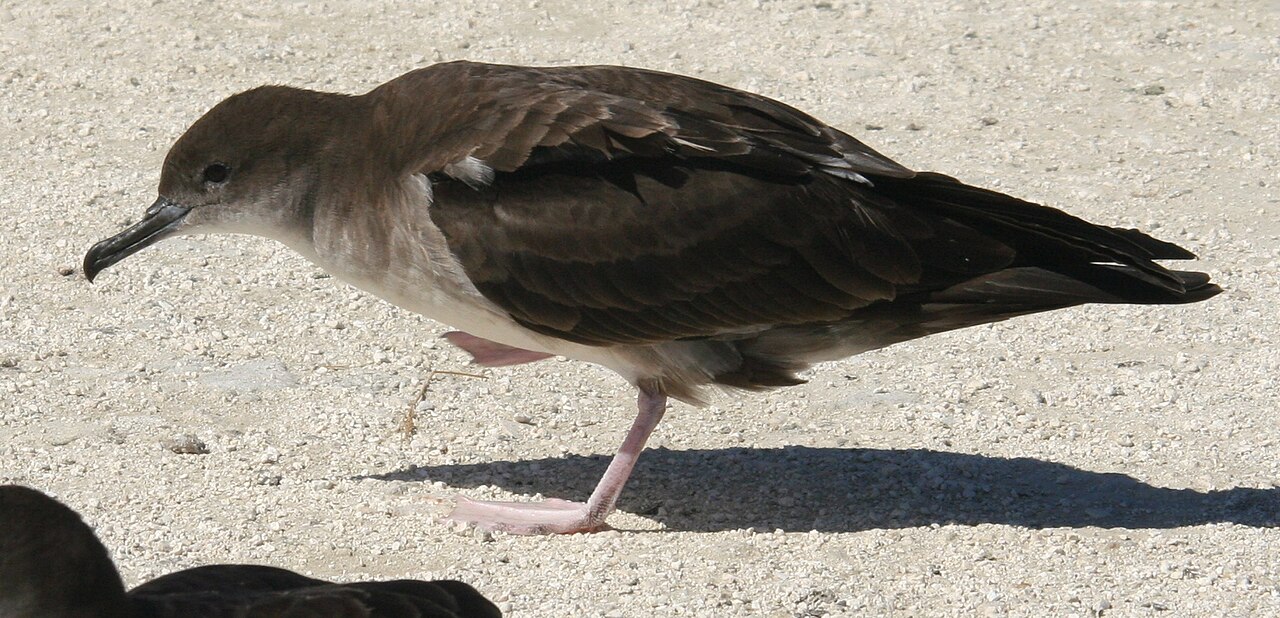
The Wedge-tailed Shearwater is the shearwater of this region's warm seas: slim, long-tailed and with a light, almost dancing flight, swinging low over the swell on strongly bowed wings. The name refers to the long wedge-shaped tail that tapers in flight, and that separates it from every other dark shearwater here.
Voice
At sea it is silent. The colonies at night are the opposite: a wailing, drawn-out ka-whooo-ahh that starts with a held-in sigh and runs out into a moan, repeated a thousandfold until the whole island hums with it. That sound, which visitors often compare to a crying child, carries until late at night on Lord Howe and on Muttonbird Island at Coffs Harbour.
Recording: Kathryn Hodder — CC BY-NC-SA 4.0 · Round Island, Mauritius · xeno-canto
Identification
Thirty-eight to forty-six centimetres at three to nearly six hundred grams, so medium-sized and lightly built, with long narrow wings held clearly bowed in a glide, and with the long wedge-shaped tail that gives the species its name. The birds of the south-west Pacific are dark without exception: blackish brown above and dusky brown below, with no pale belly. The bill is slender and slate-grey, the legs pale flesh-coloured. Flight is slow and swinging, with few beats and much sailing, and looks lighter and looser than that of the bulkier dark shearwaters.
Confusion species
Flesh-footed Shearwater (Ardenna carneipes) is bulkier and heavier, with a shorter tail, a heavier flight and above all a pale pink bill with a sharply defined dark tip — slate bill here, pink bill there. Sooty Shearwater (Ardenna grisea) has a silver panel on the underwing, an all-black slender bill and dark grey feet. Short-tailed Shearwater (Ardenna tenuirostris) is more compact, with a short tail and a domed forehead. Note that outside this region, mainly in the North Pacific, there is also a pale-bellied form of this species, with white underparts and grey-brown mottling on breast sides, flanks and undertail coverts; it hardly occurs in the south-west Pacific, so a large pale-bellied shearwater here is more likely to be Streaked Shearwater (Calonectris leucomelas).
Habitat
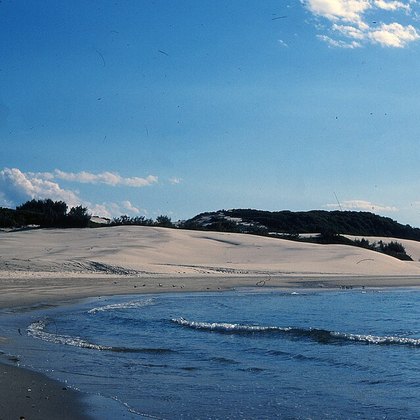
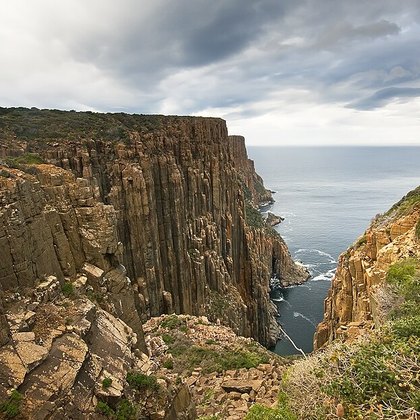
Warm and subtropical sea, mainly over the continental shelf and around coral reefs and oceanic islands, and regularly within sight of land. It breeds in colonies of self-dug burrows under forest, scrub or grassland on islands and a few mainland headlands, from the coral cays (low sand islet on a coral reef) of the Great Barrier Reef to the wooded slopes of Lord Howe.
Where the bird is most often found, arranged by main group and formation.

Range and movements
Within this map window it breeds along the whole east and west coast of Australia: on the islands of the Great Barrier Reef, on Lord Howe and Norfolk Island, on Muttonbird Island at Coffs Harbour and on many islets off Western Australia. In New Zealand it is restricted to the Kermadecs — Raoul, the Meyer Islets, the Herald Islets, Macauley, Curtis, Cheeseman and L'Esperance Rock — and at sea it is scarce outside those waters. It is present in the region from about September to May; after that it moves out into the tropical Pacific and the colonies stand empty.
- Breeding (summer)
- dark = core range, pale = thinly spread
Where and when to look
The easiest site of all is Muttonbird Island at Coffs Harbour: a breakwater takes you onto the island on foot, and between November and April you can watch the birds pour in by the hundred at sunset and hear the wailing come up out of the burrows under your feet. The same spectacle can be had on Heron Island and Lady Elliot Island on the Great Barrier Reef and on Lord Howe. At sea it is known by the long pointed tail and the bowed wings, before bill colour can be judged at all.
Conservation
Least Concern (LC) and still numerous, although in New Zealand the label 'Relict' applies because it holds less than a tenth of its original range there. The sensitivities are on land: introduced rats and cats on the breeding islands, trampling of colonies that collapses burrows, and at colonies near settlement light pollution, which grounds fledglings on roads and in gardens. At sea plastic ingestion and bycatch weigh in, and warming of the tropical ocean is shifting the food supply around the colonies.
Scientific name
Ardenna pacifica | (Gmelin, 1789)
Gmelin described the species in 1789 as Procellaria pacifica, after the Pacific Ocean in which he found it; because the species was later placed in another genus, author and year go in parentheses. The genus Ardenna was set up by Reichenbach in 1853, with Great Shearwater as its type species. The type locality was restricted by Mathews in 1912 to the Kermadec Islands, north-east of New Zealand — precisely the only place where the species breeds in New Zealand.