All species › Tubenoses › Albatrosses › Shy Albatross
Shy Albatross | Thalassarche cauta
Witkapalbatros | Albatros cauto
The Shy Albatross is the largest of the mollymawks and the only albatross breeding on islands close to the Australian mainland: a solid, broad-winged seabird with a snow-white crown, a pale grey face and a grey-blue bill with a yellow tip. This guide follows AviList 2025b and keeps the New Zealand white-capped birds (Thalassarche steadi) within this species, so the name covers both the Tasmanian and the Auckland Islands population.

Voice
At sea it is all but mute, apart from harsh croaking when birds squabble over offal. At the colony a series of braying, croaking and wailing notes goes with display, along with bill clattering and a low growl between birds sitting side by side. Chicks call with a thin, repeated piping that carries up the cliff.
No freely licensed recording has been found for this species yet; what to listen for is described below.
Identification
At ninety to a hundred centimetres and three and a half to over four kilos it is the largest mollymawk, with a wingspan above two and a half metres and strikingly broad, straight wings. The head is white with a pale grey cheek and a small dark mark right in front of the eye; back and upperwing are blackish grey, but the lower back and rump are white. The underwing is almost wholly white with a very narrow black margin and a small black thumbprint in the armpit — that mark identifies the whole shy group. The bill is blue-grey to grey-green with a yellow tip; Tasmanian birds also show yellow at the base of the upper bill ridge, but that needs a close view. Young birds have a greyer head and a grey bill with a dark tip, and lack the yellow.
Confusion species
Salvin's Albatross (Thalassarche salvini) is the hard one: it has an extensive pale grey hood over head, throat and nape where the Shy is white, and a black spot on the tip of the lower mandible. In good light and at close range that is decisive; against the light or at distance the two are honestly often not separable, because head and bill colour both flatten out. Chatham Albatross (T. eremita) has the same thumbprint and a grey hood, but a bright yellow to orange bill with a dark tip to the lower mandible, and breeds only on The Pyramid. Black-browed Albatross (T. melanophris) is smaller, with an orange-yellow bill and broad black underwing margins. Snowy Albatross (Diomedea exulans) and Southern Royal Albatross (D. epomophora) are clearly bigger, with a pink bill and a white or whitening upperwing. The sooty albatrosses (Phoebetria palpebrata, P. fusca) are wholly dark with a wedge tail and offer no confusion.
Habitat
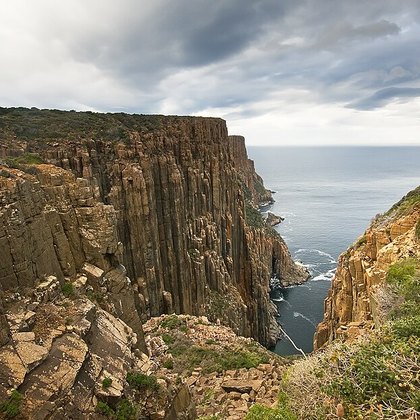
Continental shelf and shelf break off southern Australia, Tasmania and New Zealand, where it takes fish and squid from the surface and by diving; it is one of the few albatrosses that will go several metres under. Trawlers and longliners draw it in. Breeding colonies sit on bare, steep rock islands and cliffs: in Tasmania on unvegetated granite tops, in New Zealand on tussock slopes of subantarctic islands.
Where the bird is most often found, arranged by main group and formation.


Range and movements
The Tasmanian birds breed on just three islands — Albatross Island in Bass Strait, The Mewstone and Pedra Branca south of Tasmania — some fifteen thousand breeding pairs a year in all, making this the only albatross breeding nowhere but Australia. The New Zealand white-capped birds breed mainly on Disappointment Island in the Aucklands, holding around ninety-one thousand pairs, with smaller numbers on Bollons Island in the Antipodes and on the Forty-Fours in the Chathams. Outside the breeding season it is the commonest large albatross off southern Australia and right around New Zealand, with birds travelling as far as South Africa.
- Resident
- Winter
- dark = core range, pale = thinly spread
Where and when to look
From land it can be seen from the cliffs at Eaglehawk Neck and Bicheno in Tasmania and from the headlands near Portland in Victoria; at sea it is on nearly every winter pelagic out of Wollongong, Port Fairy, Kaikoura or Stewart Island. Note the exceptionally white underwing and look for the black thumbprint in the armpit; then check the bill for yellow at tip and base, and the head for grey. A bird that reads as a Shy but has a clear grey hood is a Salvin's until proven otherwise.
Conservation
Near Threatened (NT) globally, but Australia raised the status of the Tasmanian birds to Endangered in June 2020. Bycatch in longline and trawl fisheries is the leading cause of death, with thousands of birds a year across the Southern Ocean; for New Zealand white-capped birds the South African longline fleet alone accounts for an estimated seven to eleven thousand annually. On Pedra Branca breeding success is falling through displacement and a changing climate, and hot summers kill chicks on the Tasmanian islands. Pigs and feral cats formerly damaged colonies in the Aucklands.
Scientific name
Thalassarche cauta | (Gould, 1841)
Gould described the species in 1841 as Diomedea cauta from Bass Strait material; author and year stand in parentheses because it has moved to Thalassarche. cauta is Latin for 'cautious, shy', for the behaviour that also gives the English name. The New Zealand white-capped birds were described by Falla in 1933 as Thalassarche cauta steadi, for the New Zealand ornithologist Edgar Stead; some checklists treat that as a species of its own, this guide does not. The Maori name toroa covers albatrosses in general.