All species › Tubenoses › Albatrosses › Atlantic Yellow-nosed Albatross
Atlantic Yellow-nosed Albatross | Thalassarche chlororhynchos
Atlantische geelneusalbatros | Albatros picofino
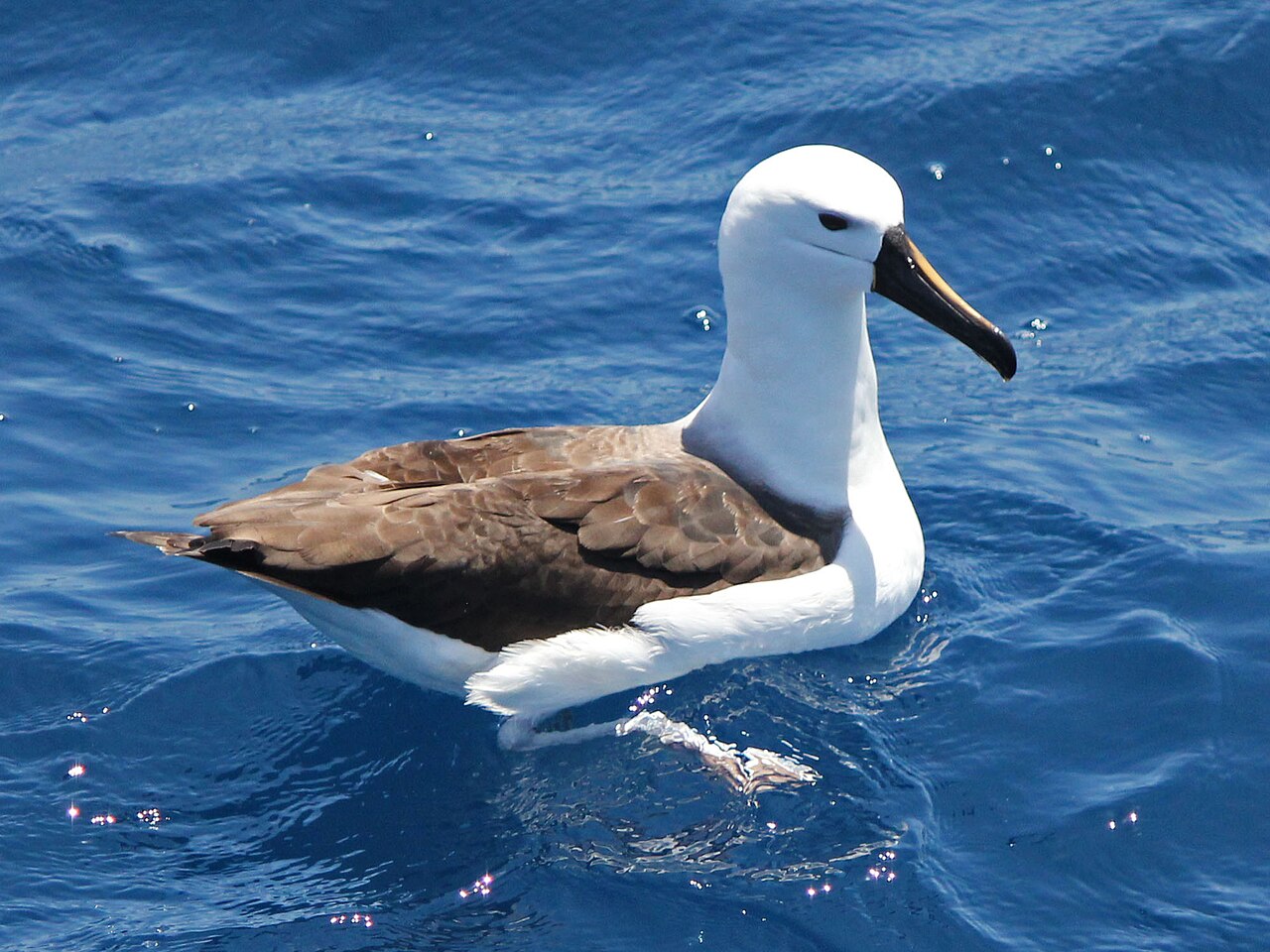
The Atlantic Yellow-nosed Albatross is a slim, small mollymawk of the South Atlantic that appears in Australian and New Zealand waters only as a vagrant. It has a grey head with a white forehead, a black triangle in front of the eye and a long black bill with a thin yellow ridge line that turns cherry-red at the tip.
Voice
A vagrant in the southern hemisphere is almost always silent; at most it gives a low growl when fighting other seabirds over offal. In the colonies on Tristan da Cunha and Gough, display consists of hoarse moaning, high plaintive notes and bill clattering between partners. That sound is not heard within this guide's area, because it does not breed here.
No freely licensed recording has been found for this species yet; what to listen for is described below.
Identification
Some seventy-five centimetres and two to nearly three kilos, which makes it, with the Indian Yellow-nosed Albatross, the smallest albatross of all; the wings are strikingly narrow and the flight light and undulating. Head and neck are pale grey with a white forehead, a sharp triangular black patch in front of the eye and a narrow white crescent behind it. The bill is long, slender and black with a thin yellow ridge along the top that turns cherry-pink towards the hook; the yellow stripe is broad and round-ended at its base. Mantle, upperwing and tail are greyish black, the underparts white, and the underwing white with a narrow black margin. Young birds have a white head and an entirely black bill.
Confusion species
Indian Yellow-nosed Albatross (Thalassarche carteri) is the species it is nearly always confused with in this region, and the two are the same size and equally slim. Check the head: pale grey here with a large dark triangle in front of the eye, mainly white in the Indian with at most a small dark wedge. Then check the base of the yellow bill stripe: broad and round-ended in this species, tapering to a point in the Indian. Be honest about the limits of that distinction — on a bird flying past, against the light, or on a juvenile with an all-black bill, a yellow-nosed albatross in these waters often stays unnameable. Buller's Albatross (T. bulleri) has yellow above and below on the bill and a white forehead cap on a dark grey face; Grey-headed Albatross (T. chrysostoma) has an evenly dark grey head, yellow above and below and a broad black leading edge to the underwing. Black-browed Albatross (T. melanophris) is heavier with an orange-yellow bill, and Shy Albatross (T. cauta), Salvin's Albatross (T. salvini) and Chatham Albatross (T. eremita) are all much larger. The great albatrosses (Diomedea exulans, D. epomophora) and the sooty albatrosses (Phoebetria palpebrata, P. fusca) are not in question.
Habitat
Open ocean from subtropical to cool temperate water, far from land, where it picks fish, squid and crustaceans from the surface and comes in for offal behind fishing vessels. It avoids shallow inshore water and surf; only weakened or storm-driven birds turn up close to the coast. Its colonies are on steep slopes of fern and tussock on Atlantic islands — outside this guide's window.
Where the bird is most often found, arranged by main group and formation.


Range and movements
It breeds only on Gough and on the islands of the Tristan da Cunha group — Nightingale, Inaccessible, Middle and Stoltenhoff — and belongs to the South Atlantic. In Australian waters it is a vagrant with some twenty-five accepted records, nearly all in the south-east and south-west on pelagic trips. For New Zealand there are about seven records: the first three at Little Sister Island in the Chathams (1975, 1976 and 1996), then off Kaikoura in 2016, at the Forty-Fours in 2016 and 2022 and at the Snares in 2019. It does not breed within this area and there is no place where it can be expected with any regularity.
- Winter
- dark = core range, pale = thinly spread
Where and when to look
Do not count on it: this is a bird you stumble on among the other mollymawks on an ordinary winter pelagic out of Wollongong, Port Fairy or Kaikoura. So take every slim, narrow-winged albatross with a black bill seriously, and check the head for grey and the area in front of the eye for a clear dark triangle. Photograph head and bill base whatever happens, because without images a claim of this kind is rarely accepted by a rarities committee.
Conservation
Endangered (EN), with a world population of roughly fifty-five to over eighty thousand adult birds on a handful of islands and a calculated decline of about fifty per cent over seventy-two years. Longline bycatch is the heaviest cause of death at sea. On Gough, the largest colony, chicks fall prey to introduced house mice that attack the nests, and on Nightingale and Inaccessible breeding numbers are falling. None of that bears directly on Australia and New Zealand, but it explains why the chance of a vagrant is shrinking rather than growing.
Scientific name
Thalassarche chlororhynchos | (Gmelin, 1789)
Gmelin described the species in 1789 as Diomedea chlororhynchos, on the basis of Latham's work of 1785, with the sea off the Cape of Good Hope as type locality; author and year stand in parentheses because it has moved to Thalassarche. The epithet is from Greek khloros ('yellow-green') and rhunkhos ('bill'), for the yellow stripe along the bill ridge. Until the end of the twentieth century it was treated together with the Indian Yellow-nosed Albatross (T. carteri) as a single species.