All species › Passerines › White-eyes and allies › Silvereye
Silvereye | Zosterops lateralis
Grijsrugbrilvogel | Anteojitos dorsigrís
The Silvereye is the smallest everyday songbird of Australia and New Zealand, and a garden bird in both: a green bird of some eleven centimetres with a thick white ring around the eye and a thin, plaintive call. It colonised New Zealand under its own power in the 1850s, and that is what the Maori name tauhou, 'new arrival', records.

Voice
The contact note is a thin, persistent psip given continually by a party, and in flight a short cli-cli. There is also a plaintive rising creee that carries across a garden. The song is a quiet, long-drawn liquid warble with tumbling transitions, best heard early on August to November mornings; it recalls a Dunnock and is surprisingly long-winded for so small a bird.
Recording: Richard Fuller — CC0 · Carindale, Brisbane City, Queensland, Australia · xeno-canto
Identification
A bird of ten to twelve centimetres with olive-green head and wing, a fine dark bill and a broad ring of white feathers around the eye. Plumage varies by region: eastern and New Zealand birds have a grey back between green head and wing, southwestern Australian birds are green throughout. Tasmanian birds have chestnut flanks and a grey throat, east coast breeders a yellow throat and pale buff flanks. The sexes are alike; young birds are duller with a narrower eye-ring.
Confusion species
Ashy-bellied White-eye (Zosterops citrinella) of the reef islands and Torres Strait is white-grey on breast and belly and has no brown on the flank. Canary White-eye (Zosterops luteus) of the north and west coast is wholly yellow below. Norfolk Island holds Slender-billed White-eye (Zosterops tenuirostris), bulkier and with a longer, finer bill. In doubt the flank decides: chestnut or buff means Silvereye.
Habitat
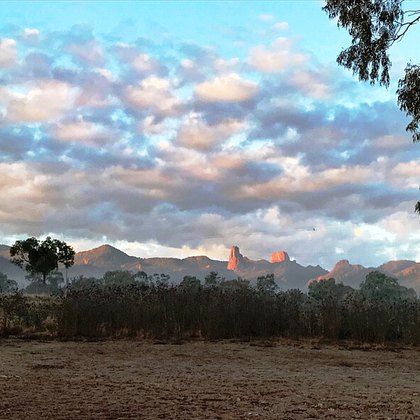
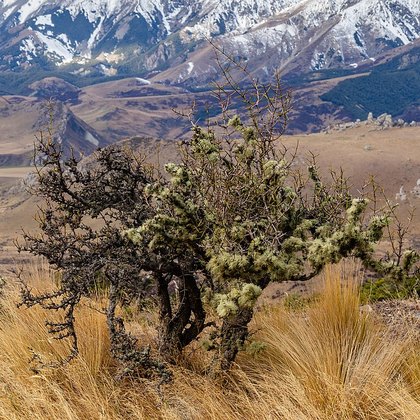
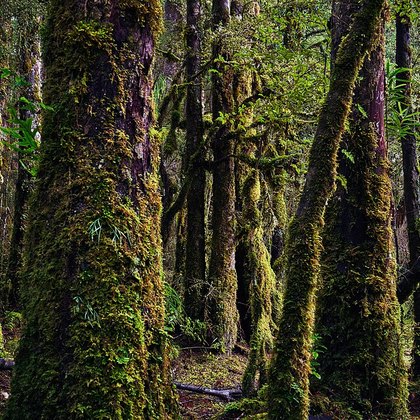
Almost any vegetated ground: gardens, city parks and orchards, dry eucalypt forest, manuka and matagouri scrub, and podocarp-broadleaf forest in New Zealand. All it needs is a shrub layer and plants in flower or fruit, and it follows those through the year. In winter it comes into the inner city and to the feeding table.
Where the bird is most often found, arranged by main group and formation.


Range and movements
In Australia from Cape York south along the east coast, through Tasmania and along the south coast to Shark Bay in Western Australia; in New Zealand on both main islands and on virtually every vegetated island around them, from the Kermadecs to Campbell Island, and on Norfolk and the Chathams. Most Tasmanian birds cross Bass Strait in March and April and winter on the mainland as far as Queensland, returning in spring.
- Resident
- dark = core range, pale = thinly spread
Where and when to look
In winter put out a dish of apple pieces or a sugar-water feeder and wait: the party arrives within a day and keeps coming. In forest you hear it before you see it; follow the thin psip upward and look for movement in the outermost twigs. Check back and flank on every bird, because those two panels say which region it came from.
Conservation
Least Concern (LC), and in New Zealand it is ranked Not Threatened with native status, because it reached the country on its own wings. It is among the commonest birds of both countries and profits from gardens, hedges and exotic fruit trees. In vineyards and orchards it damages grapes and soft fruit; there the answer is netting rather than control.
Scientific name
Zosterops lateralis | (Latham, 1801)
Latham described the bird in 1801 as Sylvia lateralis; because it later moved to another genus, author and year stand in parentheses. The genus Zosterops was introduced by Vigors and Horsfield in 1827, from Greek zoster, 'girdle', and ops, 'eye'. lateralis is Latin for 'of the side', after the coloured flank. The type locality is New South Wales. The Maori name tauhou means 'stranger' or 'new arrival'.