All species › Passerines › White-eyes and allies › Canary White-eye
Canary White-eye | Zosterops luteus
Mangrovebrilvogel | Anteojito australiano
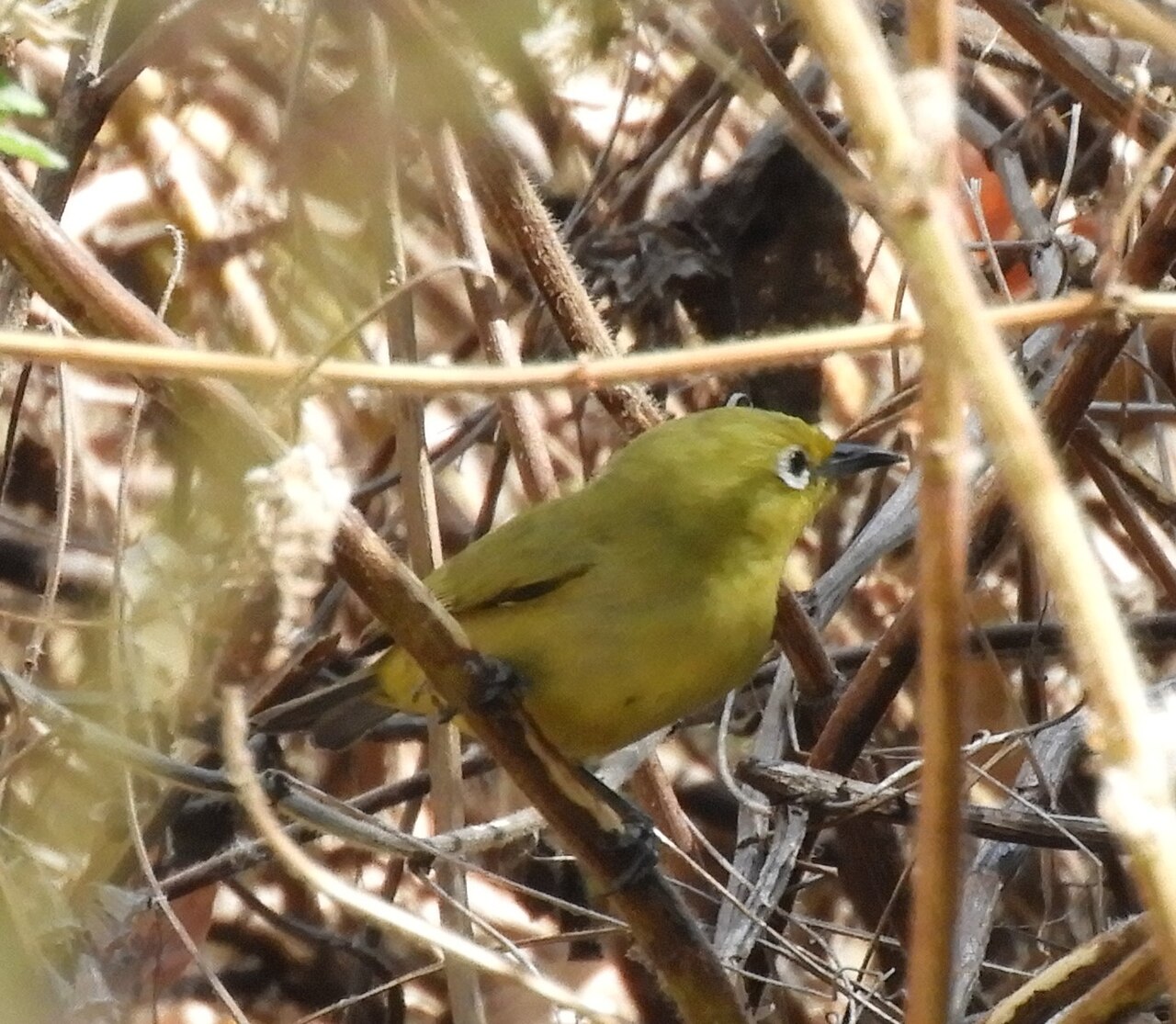
The Canary White-eye is the yellow speck of the northern tidal forests: yellow from chin to undertail, with a white ring round the eye, and hardly ever more than a few hundred metres from the mangrove to which its Dutch name ties it. It is the smallest and lightest white-eye in this guide, and within its habitat it can be confused with nothing else — provided one takes in that the yellow runs over the whole underside and does not sit on the throat alone.
Voice
A high, fine, reedy tsee as a contact note, repeated without pause while a party of five to twenty birds works through the mangrove canopy; that continuous piping is usually the first sign of the species, for it gives the party away long before a bird is seen. The song is a soft, fast, somewhat hurried twittering of thin notes, heard in the early morning and at close range; it carries poorly and vanishes entirely beneath the honeyeaters that share the same mangrove. In alarm there is a sharper, harder tsheet. Because the species almost always moves in parties, its voice is more often a chorus than a single bird.
No freely licensed recording has been found for this species yet; what to listen for is described below.
Identification
A tiny, short, compact bird of eleven to twelve centimetres and under ten grams, with a fine pointed dark bill and grey legs. The upperparts are bright yellow-green; the underparts are plain saturated yellow from throat across breast and belly to the undertail coverts, with no white or grey central panel and no brown on the flank. Round the eye lies a narrow sharp ring of short white feathers, standing out clearly against the yellow face. Male and female are alike; young birds are duller yellow with a narrower eye-ring. The bird moves fast and restlessly through the canopy, hangs regularly upside down from a leaf, and seldom stays more than a few seconds on the same twig.
Confusion species
Silvereye (Zosterops lateralis) is the first to consider where the ranges touch: it has a grey back between green head and wing, a white to dirty grey central panel on the belly and buff to chestnut flanks, and so is never wholly yellow below. Ashy-bellied White-eye (Zosterops citrinella) of the reef islands and Torres Strait does have a yellow throat but a white to dirty grey breast and belly; in that species the yellow stops halfway, and that is exactly the distinction. Slender-billed White-eye (Zosterops tenuirostris) lives only on Norfolk Island and does not occur here. Within the mangrove itself, Mangrove Gerygone (Gerygone levigaster) is grey with a white brow and no eye-ring, and Mangrove Golden Whistler (Pachycephala melanura) is far larger with a black head. What settles it is that in this species the yellow runs unbroken from chin to tail.
Habitat
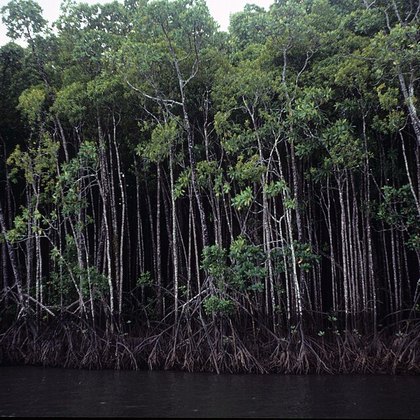
Mangrove, and outside it next to nothing: the bird occupies the closed tidal forests of the northern coast across their whole width, from the seaward fringe to the landward transition, and forages in the canopy and the middle storey of the trees. Adjoining that it uses the vegetation immediately bordering mangrove — paperbark swamp along tidal creeks, monsoon forest and vine thicket on the levee, and scrub at the saltmarsh edge — but almost always within earshot of the tidal forest itself. Inland forest, however suitable in structure, is not occupied. That strict tie makes the distribution map of the species an all but exact imprint of the mangrove belt of northern Australia.
Where the bird is most often found, arranged by main group and formation.


Range and movements
The northern coast of Australia, from Shark Bay in Western Australia north along the Pilbara and Kimberley coast, across the Northern Territory and the shores of the Gulf of Carpentaria into western Cape York. The species is endemic to Australia and does not occur in New Guinea. There is no migration and no seasonal movement of consequence: parties stay all year in the same stretch of mangrove and shift at most a few kilometres along the coast. Within that long narrow range two forms are distinguished, a western and a northern one, differing slightly in saturation but not separable in the field.
- Resident
- dark = core range, pale = thinly spread
Where and when to look
Walk a track or a boardwalk into the mangrove at low tide and stand still to listen; the continuous high piping of a party is audible at fifty metres and the birds often come past of their own accord. Look in the canopy and not at the roots, for this species works the leaves and is seldom low. The best hours are the first two after sunrise, before the heat and before the mosquitoes drive the observer out. On every sighting look at the belly and not at the throat: three white-eyes have yellow on the throat, only one has yellow to below the tail.
Conservation
Least Concern: the species is widespread along the whole northern coast of Australia and numerous in suitable mangrove, and most of that habitat lies remote and is barely used. Against that, the species is so strictly tied to one vegetation type that its fate hangs entirely on the fate of the mangrove. Damage is chiefly local, at harbours, mining terminals and urban expansion on the north coast, where tidal forest is cleared or cut off behind bunds. In the longer term two things bear on it: sea-level rise, which mangrove can absorb only if the forest can move landward and does not run into levees or buildings, and the mass mangrove dieback that struck the Gulf of Carpentaria in 2015 and 2016 after a coincidence of extreme heat and a temporary fall in sea level. The species thus asks no management of its own, but it does ask that the mangrove belt as a whole stay intact and able to move.
Scientific name
Zosterops luteus | Gould, 1843
Gould described the bird in 1843 from material from Greenhill Island in Van Diemen's Gulf, off the north of the Northern Territory; because the species still stands in the genus in which it was described, author and date carry no brackets. The epithet luteus is Latin for 'saffron-yellow' and names the colour of the underparts. The genus Zosterops was introduced in 1827 by Vigors and Horsfield, from Greek zoster, 'girdle', and ops, 'eye', after the white ring round the eye. The names diverge here: the Dutch mangrovebrilvogel and the Spanish anteojito australiano take the habitat and the continent, while the English Canary White-eye takes the colour, as did the older English name Yellow White-eye. All three angles hit the mark, for this bird is both the yellow and the mangrove-bound white-eye of Australia.