All species › Passerines › White-eyes and allies › Slender-billed White-Eye
Slender-billed White-Eye | Zosterops tenuirostris
Dunsnavelbrilvogel | Anteojitos picofino
The Slender-billed White-Eye lives on one island and nowhere else: Norfolk, a volcanic dot of thirty-five square kilometres in the Tasman Sea. Among the white-eyes it is the long-billed exception, with a fine slightly decurved bill with which it probes bark, moss and clusters of dead leaves instead of working over flowers. Its entire world population hangs on the remnant of native forest in the national park, and it shares that forest with a white-eye that came to live there of its own accord and forages in the same places.
Voice
A soft, thin and somewhat wistful warbling, built of fine high notes that run into one another without clear structure; it is less loud and less brassy than the song of the Silvereye with which the species shares the forest. The ordinary contact note is a fine rising tsee, often repeated in twos or threes while a party works through the canopy. Because the two white-eyes of the island lie close in voice and both sit in the same trees, sound is at most an indication for identification and never proof; to be certain you must see the bird and look at the bill. The song is heard best in the early morning, when the parties gather.
Recording: Eric S. J. Tan — CC BY-NC-SA 4.0 · Palm Glen, Norfolk Island National Park, Norfolk Island, South Pacific , Australia · xeno-canto
Identification
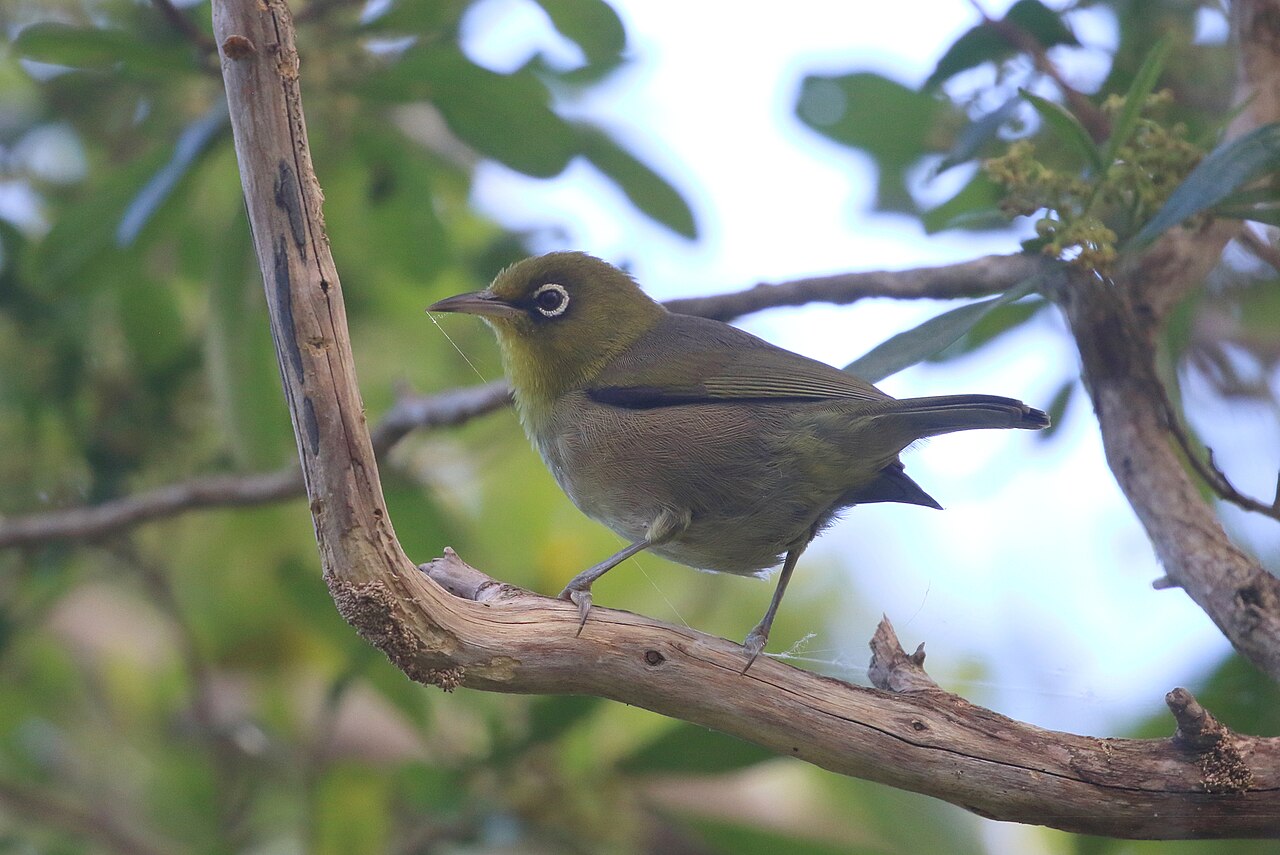
Thirteen to fourteen centimetres, and thereby clearly larger and heavier than the other white-eye of Norfolk. The upperparts are olive-green, most saturated on crown and rump; the underparts are pale grey-white, at most faintly grey-washed on the flanks and without any buff or chestnut. A narrow, sharply marked ring of short white feathers runs round the eye. The character everything turns on is the bill: long, fine, pointed and slightly decurved, dark in colour, and proportionally visibly longer than in any other white-eye in this guide. The legs too are stout and long. The bird forages by climbing and probing along trunks, branches and clumps of moss, often hanging upside down, and works a tree more slowly and systematically than its neighbour. Male and female are alike; young birds have a narrower eye-ring.
Confusion species
Silvereye (Zosterops lateralis) is the only real confusion species and sits in the same trees: it is smaller, has a much shorter and straighter bill, a grey back that stands out against the green head and wing, and buff to chestnut flanks — precisely the flank colour the Slender-billed White-Eye lacks. On Norfolk, moreover, two forms of that species occur together, a resident one and one wintering from Tasmania, which makes the picture more variable still. Ashy-bellied White-Eye (Zosterops citrinella) and Canary White-Eye (Zosterops luteus) do not occur on Norfolk and play no part here. Anyone reading older literature or old records from the island must allow for Zosterops albogularis, a third, larger white-eye with a clean white breast that occurred on Norfolk and has not been certainly recorded since the nineteen-eighties; for that reason that species is not included in this guide. In the field: if the bill is long, fine and decurved and there is no brown on the flank, it is the Slender-billed White-Eye.
Habitat
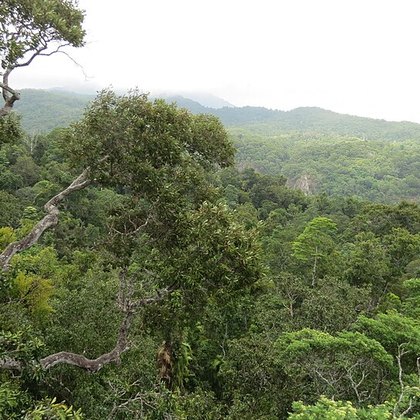
The native forest of Norfolk: the subtropical rainforest remnants on the slopes of Mount Pitt and Mount Bates within the national park, with Norfolk Island pine, palms, tree ferns and a dense layer of epiphytes and moss in which the bird seeks its food. It is precisely that mossy bark and the bundles of dead leaves caught in the canopy that are the working ground of the long bill. Outside the continuous forest the species occurs in smaller numbers in restored plantings, native trees around homesteads and old gardens at the edge of the park, but densities there are lower and the centre of gravity lies unmistakably in the old forest. Ground choked by exotic shrubs such as cherry guava yields far less.
Where the bird is most often found, arranged by main group and formation.

Range and movements
Norfolk Island, east of Australia, and nowhere else; within it almost wholly confined to the few hundred hectares of native forest in the national park and its immediate surroundings, and it is not known as a breeder from Phillip Island or Nepean Island. There is no migration and no movement of consequence: the bird stays in the same forest all year and parties at most range a little wider outside the breeding season. A world range of this size means that every storm, every fire and every new predator or plant on the island strikes the whole species at once.
- Resident
- dark = core range, pale = thinly spread
Where and when to look
Enter the national park and walk the tracks through the old forest, preferably in the first hours after sunrise when the mixed parties move most. Look not at the colour but at the bill: at ten metres the difference from the Silvereye is immediately visible, at fifty metres it is not. Watch the way of foraging, which gives the species away before the bill can be seen: climbing slowly along mossy trunks and branches, often hanging beneath them, rather than moving fast and restlessly through the leaves. Parties are noisy enough to locate and often stay minutes in the same tree.
Conservation
Vulnerable (VU), and that status rests almost entirely on the size of the range: the whole species lives on a few hundred hectares of forest on a single island, which makes it sensitive to events that would stay local anywhere else. The concrete threats are known. Black rats plunder nests. Exotic shrubs, cherry guava above all, close the understorey and displace the native trees whose mossy bark forms the foraging ground. Cyclones can open a substantial part of the canopy in one night. On top of that comes the Silvereye, which settled on the island of its own accord around the start of the twentieth century, has built up far beyond the native species in numbers and searches the same trees for the same food; the longer bill does give the Slender-billed White-Eye a niche of its own, but not necessarily room enough. Management turns on three things: rat control, pushing back exotic plants in the park, and enlarging the forested area by replanting native species around the existing core.
Scientific name
Zosterops tenuirostris | Gould, 1837
Gould described the bird in 1837; because the species still stands in the genus in which it was described, author and date carry no brackets. The label on the type gave the Murrumbidgee in New South Wales, which was a mistake: the bird comes only from Norfolk, and the type locality has since been corrected accordingly. The epithet tenuirostris is formed from Latin tenuis, 'thin, slender', and rostrum, 'bill', and so names exactly the character by which the species is recognised in the field. The genus Zosterops was introduced in 1827 by Vigors and Horsfield, from Greek zoster, 'girdle', and ops, 'eye', after the white ring round the eye that the whole family wears. The Dutch dunsnavelbrilvogel, the English Slender-billed White-Eye and the Spanish anteojitos picofino all three translate the same character.