All species › Penguins › Penguins › Snares Penguin
Snares Penguin | Eudyptes robustus
Grote kuifpinguïn | Pingüino de Snares
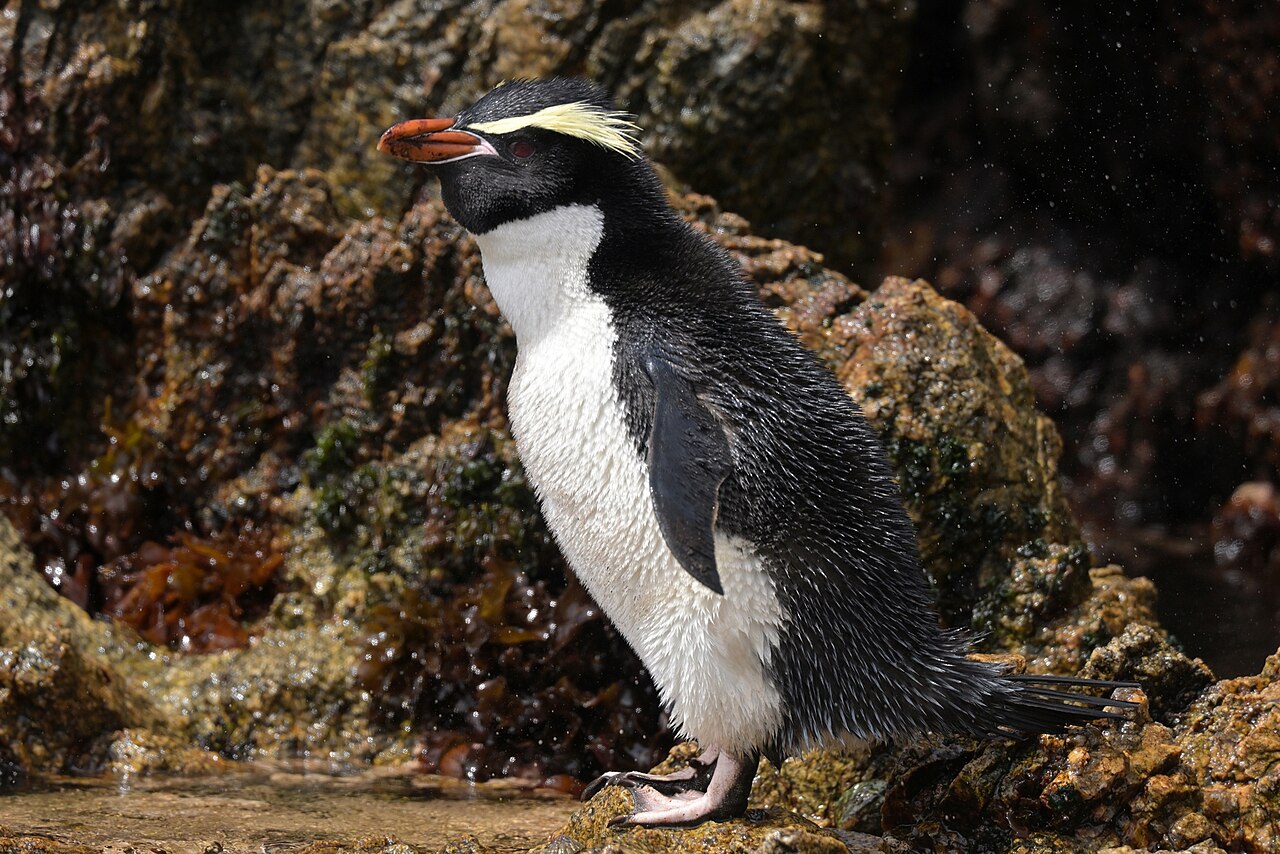
This crested penguin — Eudyptes robustus, the Snares Penguin — breeds on one island group of three hundred hectares south of New Zealand and nowhere else on earth. It is a solid black-and-white crested penguin with a broad yellow eyebrow stripe and a heavy orange bill, and it is the only one of its genus whose numbers are not falling.
Voice
At the colony comes a very loud pulsing bray, delivered with the head thrown back and the flippers spread, carrying across the whole plateau; between neighbours there is low growling. At sea it is silent apart from a short contact bark on landing. Anyone comparing the sound with that of Erect-crested Penguin (Eudyptes sclateri) hears that this species pulses higher and sharper where the other booms deeper.
No freely licensed recording has been found for this species yet; what to listen for is described below.
Identification
A solid, stocky crested penguin of some sixty centimetres, with black back, black face and black throat meeting the white underparts sharply. A broad yellow eyebrow stripe begins close to the nostril, runs over the red-brown eye and ends in a drooping, bushy crest. The best character is at the bill base: around the heavy orange bill runs a clear thin strip of bare pink skin. Seen head-on the two crests diverge in a V. Legs and feet are dull pink; young birds have a smaller, duller bill and a pale thin eyebrow stripe.
Confusion species
Note that the Dutch guide name Grote kuifpinguin is shared in this guide by two species. The other is Eudyptes sclateri, which is larger (about sixty-five centimetres), has pale blue-white rather than pink skin at the bill base, a crest held erect and running parallel rather than in a V when seen head-on, and breeds only on the Bounty and Antipodes Islands. Fiordland Penguin (Eudyptes pachyrhynchus) is the same size but has only a thin strip of black skin at the bill base, a narrower eyebrow stripe and three to six whitish stripes on the black cheek, and breeds on the mainland. Eastern Rockhopper Penguin (Eudyptes filholi) is clearly smaller with a thin parallel-sided yellow stripe and a much lighter bill. Royal Penguin (Eudyptes schlegeli) is larger and has a white to pale grey cheek and chin instead of black.
Habitat
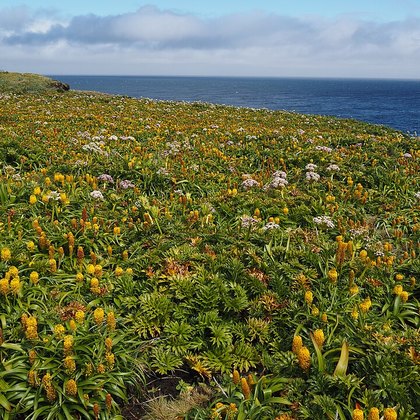
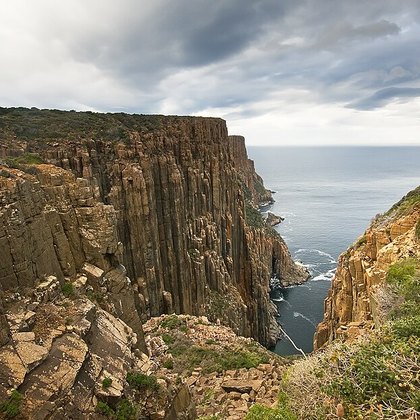
Subantarctic and cool temperate sea around the Snares, where the birds dive for krill, squid and small fish and in the breeding season stay within a few tens of kilometres of the island. Ashore they breed on the forest floor under the low Olearia tree daisy woodland and on the bare peat and rock plateaus above it, in dense groups where the trampling of thousands of feet leaves no plant standing. Worn 'penguin highways' run from the colony down the rocks to the sea.
Where the bird is most often found, arranged by main group and formation.

Range and movements
The Snares Islands only, some two hundred kilometres south of the South Island: North East Island and Broughton Island carry the bulk of the colonies, and the Western Chain islets a few hundred pairs with a later breeding schedule of their own. Outside the breeding season the birds range over the subantarctic sea south and west of New Zealand. Moulting or weakened individuals come ashore now and then on Stewart Island and the south coast of the South Island; in Australia the species is barely recorded at all.
- Resident
- dark = core range, pale = thinly spread
Where and when to look
Landing on the Snares is forbidden, so you depend on a subantarctic expedition voyage that cruises the north-east coast by zodiac between November and February. Look then for the worn penguin highways on the rock and for the rafts of hundreds of birds waiting together offshore. Without a ship: any crested penguin on a southern New Zealand beach is worth a look, and the bare pink rim around the bill is the character that fixes this species.
Conservation
Vulnerable (VU), and that despite a healthy population of about thirty thousand pairs which, unlike six of the seven other crested penguins, appears stable. The reason for the category is the place itself: the entire world population sits on three hundred hectares, so a single introduced rat, one oil spill or one disease outbreak could strike the species within a short time. The islands have so far stayed free of introduced mammals and are strictly protected; guarding that freedom is the whole of conservation here.
Scientific name
Eudyptes robustus | Oliver, 1953
The New Zealand naturalist Walter Oliver described the species in 1953 as Eudyptes robustus, on anatomical differences from the mainland birds; it has stayed in that genus, so author and year carry no parentheses. The genus Eudyptes is Vieillot's, 1816, from Greek eu, 'good', and dyptes, 'diver'. robustus is Latin for 'strong, sturdily built', after the heavy bill and stocky frame. The type locality is the Snares Islands. Hutton had earlier meant to name the bird atrata, but lost his specimen before the description appeared; the Maori name is pokotiwha.