All species › Passerines › Honeyeaters › Spiny-cheeked Honeyeater
Spiny-cheeked Honeyeater | Acanthagenys rufogularis
Goudkeelhoningeter | Mielero golicanelo
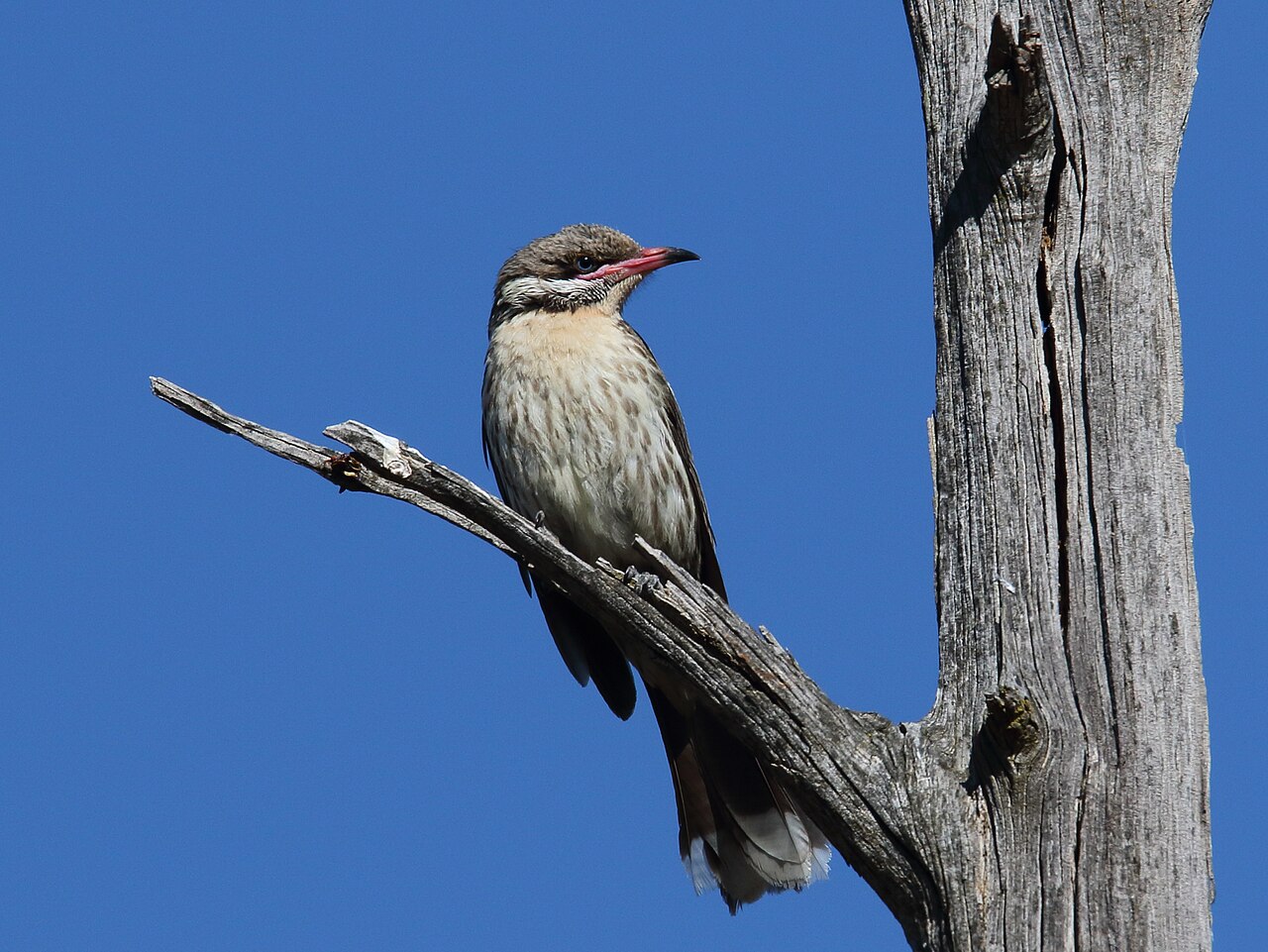
The Spiny-cheeked Honeyeater is the honeyeater of Australia's dry interior: a slim, long-tailed bird with a creamy orange throat and upper breast, a white cheek from which a row of stiff, spiny bristles projects, and an unmistakable two-toned bill — pink at the base, black at the tip. In silhouette it reads as a scaled-down wattlebird, but no other Australian honeyeater carries that combination of colours. Usually you hear it before you see it: a bubbling, gurgling little song from a mulga bush or a flowering eremophila.
Voice
For a bird of the red plains it is surprisingly musical. The song is a bubbling, gurgling mixture of clear whistles and chattering, slightly tumbling notes, strongest at first light and again at dusk. Cutting through it comes a hard, isolated tock, as though two pebbles were being knocked together, which carries remarkably far over open mulga and is often the first sign that the species is present. It also mimics other birds, so an unfamiliar call from a bush in the interior may still belong to this one.
No freely licensed recording has been found for this species yet; what to listen for is described below.
Identification
A medium-sized honeyeater of twenty-three to twenty-six centimetres, slimly built, with a long white-tipped tail and a long, straight-looking bill. The crown is grey scalloped with brown, the back mottled grey-brown, the wings grey with pale feather edges. The face is the mark: a white cheek from which a line of stiff, spiny bristles runs back below the ear coverts, with a dark stripe through the eye above it. Throat and upper breast are warm orange-brown, the remaining underparts white with fine brown streaking. The eye is pale blue-grey, ringed with bare pink skin; the bill is pink with a black tip — in sunlight one of the most visible features of all. Young birds are browner and have yellow rather than white cheek spines.
Confusion species
In build and streaking it resembles the wattlebirds. Red Wattlebird (Anthochaera carunculata) is much larger, carries a red wattle below the eye and a yellow belly patch, and has no orange throat at all; Little Wattlebird (Anthochaera chrysoptera) and Western Wattlebird (Anthochaera lunulata) are darker, show a rufous wing panel and have an entirely dark bill. In all three the two-toned pink-and-black bill is missing, and that bill is the clincher for Spiny-cheeked Honeyeater. Striped Honeyeater (Plectorhyncha lanceolata) shares the dry woodland and is likewise streaked, but its streaking is crisply black on white over head and breast, its throat is white rather than orange, and its bill is wholly dark blue-grey.
Habitat
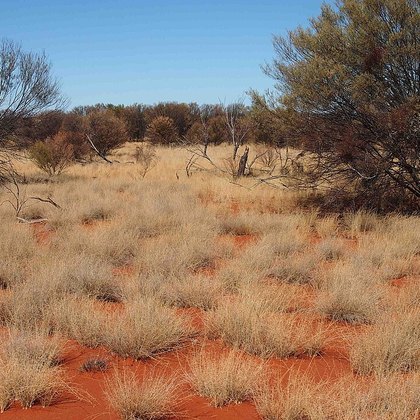
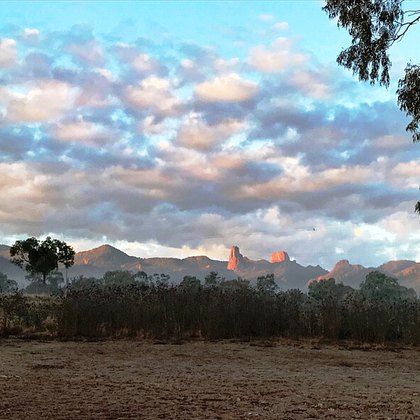
Dry woodland, mallee and acacia scrub — especially mulga with a spinifex understorey — make up its core country, along with saltbush plains carrying scattered shrubs, coastal scrub, river red gum woodland along inland creeks and, locally, orchards and plantings around country towns. It takes fruit and nectar in roughly equal measure: mistletoe berries, quandong and emu bush fruit, and nectar from eremophila, grevillea, eucalypt and mistletoe — studies put nectar at rather more than a third of the diet. It also gleans insects in the foliage, and small reptiles and nestlings taken from other birds' nests have been recorded. The nest is a deep, suspended cup slung between twigs one to thirteen metres up.
Where the bird is most often found, arranged by main group and formation.



Range and movements
Almost the whole of arid and semi-arid mainland Australia, from the west coast to the western slopes of the Great Dividing Range. On the southern coast it reaches the sea, from Esperance in Western Australia east across the Nullarbor and the Eyre and Yorke peninsulas into the Victorian mallee and, exceptionally, as far as Melbourne, with a resident population on Kangaroo Island. It is absent from the east coast and the eastern slopes of the ranges, from the tropical north — Cape York, Arnhem Land, the Kimberley — and entirely from Tasmania. It does not occur in New Zealand.
- Resident
- dark = core range, pale = thinly spread
Where and when to look
In the interior, look for it while it is still cool, because that is when it sings: stand quietly at sunrise by a clump of flowering eremophila or a mistletoe cluster in a river red gum along a creek, and wait for the bubbling phrase to start. When the bird then comes into view, do not study the streaking — study the bill. Pink with a black tip is visible from tens of metres and rules out every wattlebird at once. At a waterhole in the middle of the day it often drops in briefly and entirely silently.
Conservation
Least Concern (LC) and common to numerous over most of dry Australia; locally the species has even gained from the many artificial stock waters of the pastoral industry and from planted gardens and orchards in inland towns. At a regional scale there is pressure on its habitat: overgrazing by stock, goats and rabbits thins the shrub layer it nests in, and intense, large-scale fire in spinifex and mulga country can remove the fruiting shrubs for years. Because the species wanders widely and responds fast to flowering and fruiting, it generally absorbs such local setbacks well.
Scientific name
Acanthagenys rufogularis | Gould, 1838
John Gould described the species in 1838 as Acanthagenys rufogularis; author and year stand without parentheses, because it has always remained in this genus. Acanthagenys is built from Greek akantha, 'thorn' or 'spine', and genys, 'cheek' — exactly the stiff bristles on the cheek that the English name records. The epithet rufogularis comes from Latin rufus, 'reddish', and gula, 'throat'. The Dutch name goudkeelhoningeter and the Spanish mielero golicanelo therefore follow the scientific epithet and point at the throat, while the English name picks the cheek instead. The species is the only one in its genus; two subspecies are recognised.