All species › Passerines › Thornbills, scrubwrens, gerygones and allies › Weebill
Weebill | Smicrornis brevirostris
Eucalyptushaantje | Gerigón piquicorto
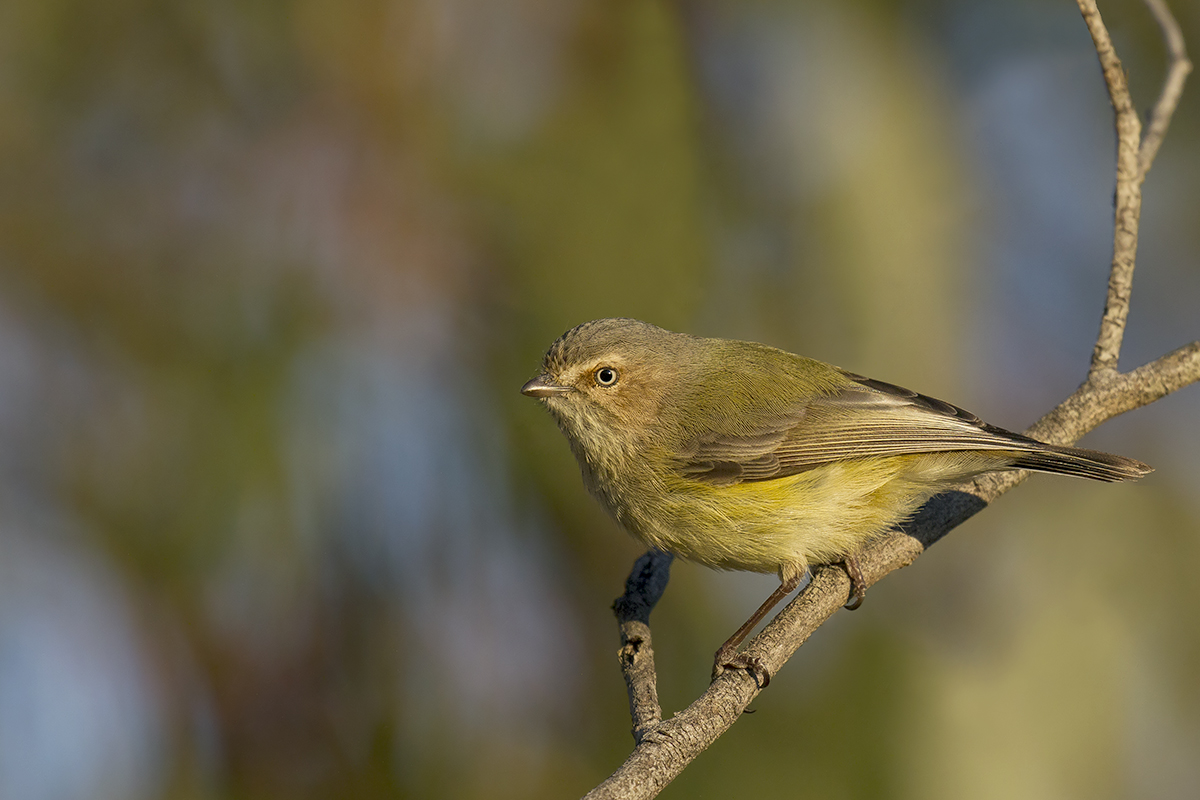
The Weebill is Australia's smallest songbird: eight to nine centimetres and about six grams, with a strikingly short, pale bill. It lives in the outer leaves of the canopy, where it searches continuously for scale insects, and is found across almost the whole mainland. Those who do not see it hear it — the call belongs to dry eucalypt woodland as much as the rustle of the leaves.
Voice
A clear, musical run of five to seven notes, classically rendered wee bit or wee willy weetee, with a rising swing at the end. It is loud for so small a bird and carries hundreds of metres across open woodland, so that the bird is heard far more often than seen. Song is given all year and even in the middle of a hot day, when almost everything else falls silent. A foraging party also keeps up thin, high contact squeaks.
Recording: Kakadu Nat Park: Fire Project (via Colin Trainor) — CC BY-NC-SA 4.0 · TFM12, Kakadu, West Arnhem Shire, Northern Territory, Australia · xeno-canto
Identification
Eight to nine centimetres, the smallest Australian songbird, with a rounded head and a conspicuously short, blunt, pale bill — the best single character. Dull grey-brown on the head and olive-brown on the back above, light yellow to pale buff below. The iris is pale cream to white, with a faint pale supercilium above it; the tail is brown with a black bar and a white tip. The sexes are alike. Northern birds are paler and yellower, southern ones dull light brown. Young birds show a yellower bill and a greyer eye.
Confusion species
Thornbills of the genus Acanthiza are the standing pitfall: all are larger and all have a finely streaked or scalloped forehead, which the Weebill entirely lacks, and a longer, finer bill. Yellow Thornbill (Acanthiza nana) comes closest but is larger, yellower on the throat and has a dark eye with a faint eye-ring. Gerygones of the genus Gerygone are also larger and show a red to orange eye and a long slender bill. The bill settles it: short, thick and pale means Weebill.
Habitat
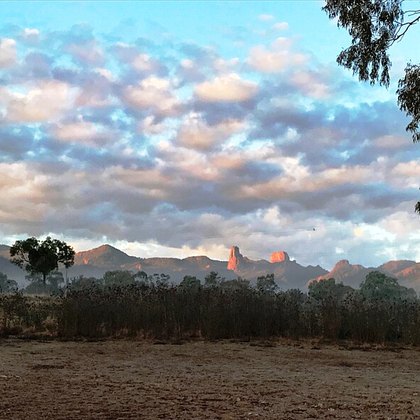
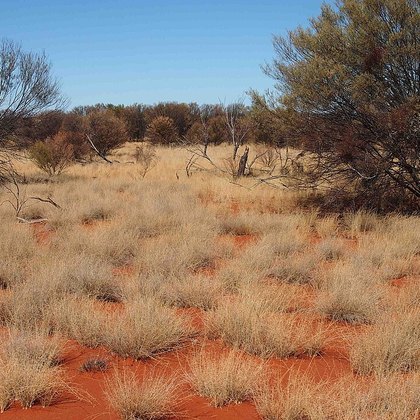
Almost any wooded country except the wettest forest: open eucalypt woodland, dry poor eucalypt forest, mallee (low, multi-stemmed eucalypt scrub of dry southern Australia), mulga (acacia scrub of the dry interior, dominated by Acacia aneura) and acacia shrubland, and riverine woodland along creeks. It forages in the outer twigs and leaves of the canopy and midstorey, usually in pairs or loose parties of up to eight, often within mixed roving flocks with thornbills. In the arid interior it keeps to the tree ribbons along watercourses. Parks and gardens with mature eucalypts are occupied as well.
Where the bird is most often found, arranged by main group and formation.


Range and movements
Across the whole Australian mainland, from the tropical north coast to the south coast and from the west coast to the east, including much of the arid interior wherever trees stand. It is absent from Tasmania. Four subspecies divide the range between north, west, centre and east. All populations are sedentary: they stay in the same country year-round with no seasonal migration, though parties wander within a wider area outside the breeding season.
- Resident
- dark = core range, pale = thinly spread
Where and when to look
Find it by ear, not by eye. Walk in dry eucalypt woodland and wait for the clear wee willy weetee; follow the sound to the outer leaf mass of a healthy eucalypt and look for the smallest moving speck in the foliage. Binoculars on the outer edge of the canopy and patience are enough. Watch the bill above all: at a glance it is shorter and blunter than that of any thornbill.
Conservation
Least Concern (LC). The species is common and spread over almost the entire mainland, and suitable woodland is still extensive. It declines locally where eucalypt woodland has been cleared for farming or where old trees disappear without replacement, since it depends on healthy, insect-rich foliage. Restoring woodland corridors in farmland benefits it directly. Brood parasitism by Horsfield's Bronze-Cuckoo (Chalcites basalis) is part of the species' normal life and is no threat.
Scientific name
Smicrornis brevirostris | (Gould, 1838)
Gould described the bird in 1838 as Psilopus brevirostris; because it was moved to the genus Smicrornis in 1843, author and year stand in parentheses. Smicrornis is formed from Greek smikros (small) and ornis (bird), and brevirostris from Latin brevis (short) and rostrum (bill) — the scientific name literally means 'short-billed small bird'. The English name Weebill was fixed by the RAOU in 1926, replacing older names such as short-billed smicrornis. The Dutch name refers to the habitat, the eucalypt woodland.