All species › Passerines › Pardalotes › Spotted Pardalote
Spotted Pardalote | Pardalotus punctatus
Gevlekte diamantvogel | Pardalote moteado
At nine centimetres the Spotted Pardalote is among the smallest songbirds in Australia: a ball of a bird with a black, white-spotted head, a yellow throat and a red rump, working over the leaves high in the eucalypt canopy. The surprise is underground: it digs a nest tunnel half a metre long into an earth bank, a road cutting or a flowerpot. Overhead you strain your eyes; below you walk straight past it.

Voice
A persistent two- or three-note whistle from the canopy, the last notes higher than the first, repeated endlessly with about five seconds between. In the breeding season it is so dogged that the bird is known in Australia as the headache bird. The sound is nearly always the only proof it is there, since the bird itself sits against the light in the topmost branches. Both sexes call; at the nest there is also a thin, fast tsit-tsit.
No freely licensed recording has been found for this species yet; what to listen for is described below.
Identification
Eight to ten centimetres, with a short tail, a short thick bill and a rounded head. The male has a black crown, black wings and black tail, all strewn with small, sharply drawn white spots, a pale eyebrow, a yellow throat, a cream belly and a red-brown rump. The female carries the same pattern more faintly, with a cream instead of a yellow throat and duller spots. Young birds are plain and almost without spots. The flight is quick and jerky, from crown to crown.
Confusion species
Striated Pardalote (Pardalotus striatus) is the same size and in the same trees, but has a striped or plain black crown without spots and a single white stripe in the wing instead of a spotted wing panel. Pardalotus rubricatus, the pardalote of the dry interior, is paler, has a large pale eye and lacks the red rump. Pardalotus quadragintus occurs only in Tasmania, is olive-green and lacks both eyebrow and red rump. Thornbills and the Weebill are as small, but plain brown or olive and unspotted.
Habitat
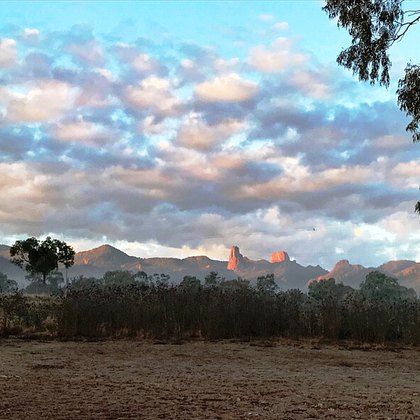
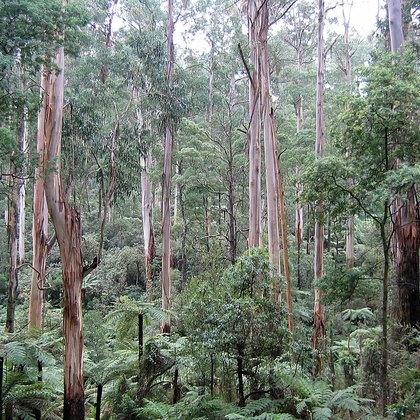
The canopy of eucalypt forest and woodland, where it works the leaves for psyllids and the sugary lerps they leave behind; also parks, gardens and street trees as long as there are eucalypts. For the nest it needs something else entirely: a vertical face of bare, cohesive earth — a creek bank, a road cutting, a building excavation, a heap of sand, and in gardens sometimes a flowerpot or a pile of potting soil. Nest and feeding place therefore often lie hundreds of metres apart.
Where the bird is most often found, arranged by main group and formation.


Range and movements
Eastern and southern Australia, from Cooktown in northern Queensland along the coast and the western slopes to Perth in the south-west, and throughout Tasmania. It is largely resident, but many birds drop to lower and drier country outside the breeding season, and in the winter months of June and July they turn up in gardens and city parks where they are absent in summer. The range has changed little over the past century. Locally it has gone where the eucalypts were felled for housing.
- Resident
- dark = core range, pale = thinly spread
Where and when to look
Learn the whistle first; after that it is everywhere. Then look down rather than up: in the breeding season, June to January, walk along a bare earth face beside a track or a creek and watch for a hole the width of a thumb with a worn, smooth lip. Anyone who sees a bird disappear into one has found the nest; keep your distance, for the pair will abandon the tunnel if disturbed.
Conservation
Not threatened (LC) and common throughout its range, including in built-up country. The most vulnerable point of its year is the nest: earth banks get filled in, cuttings planted and sand heaps carted off, all three usually in the breeding season. In gardens the young land on the ground when they leave the tunnel and are easy prey for cats. Where earth banks and old eucalypts are left standing, the bird stays of its own accord.
Scientific name
Pardalotus punctatus | (Shaw, 1792)
Shaw described the bird in 1792 as Pipra punctata, among the South American manakins; because the species was later moved to another genus, author and year stand in parentheses. Vieillot introduced the genus Pardalotus in 1816, from Greek pardalotos (spotted like a leopard). punctatus is Latin for 'spotted'. The type locality reads no more than 'New Holland', the old name for Australia.