All species › Pigeons and doves › Doves and pigeons › Squatter Pigeon
Squatter Pigeon | Geophaps scripta
Bonte kwartelduif | Paloma escrita
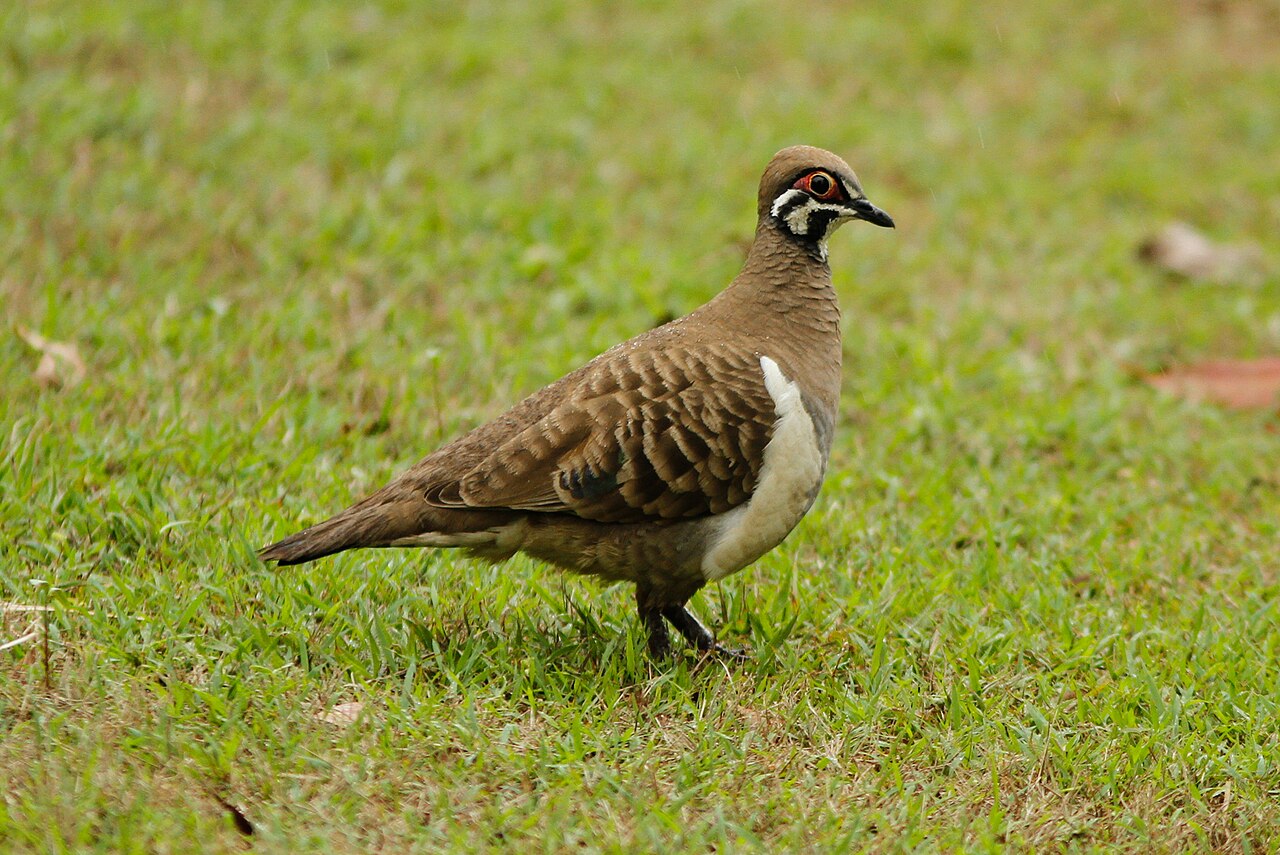
The Squatter Pigeon is a ground pigeon of the dry woodlands of eastern Australia: grey-brown and inconspicuous until it turns its head and the sharp pattern of black and white stripes across cheek and throat comes into view. It walks in pairs or small coveys over bare ground and along dusty roads, and would rather flatten itself than fly — which is where the name squatter comes from.
Voice
A soft, low-held coo-woop of two syllables, the second dropping away; it barely carries twenty metres and is easily missed. Far more noticeable is the hard clattering rattle of the wings when a covey bursts up at your feet. At a waterhole the birds exchange short, dull growling contact notes.
No freely licensed recording has been found for this species yet; what to listen for is described below.
Identification
A squat ground pigeon of twenty-six to thirty-two centimetres, grey-brown above with pale scalloping on the wing coverts and with purple-green gloss patches on the wing that only catch in good light. The face is the mark: black and white stripes across cheek, chin and throat, with a broad white stripe running up obliquely from the flank. The breast is grey, the lower belly white. The bare skin around the eye is blue-grey in the southern form and pinkish red in the birds of Cape York.
Confusion species
Partridge Pigeon (Geophaps smithii) is the closest relative and the only real confusion, but the ranges do not meet: that bird is in the Top End and the Kimberley, has a large bare red or yellow eye patch and no striped pattern on cheek and throat at all. Spinifex Pigeon (Geophaps plumifera) of the arid interior is rufous with an erect crest and a single black-and-white band across the face. Common Bronzewing (Phaps chalcoptera) is larger, has a pale forehead and one thin white line under the eye, but no banding anywhere.
Habitat
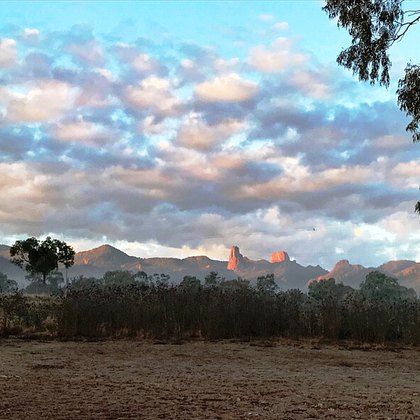
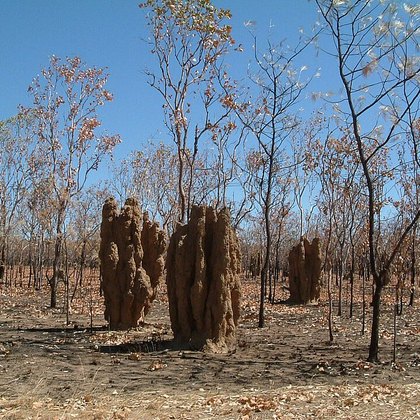
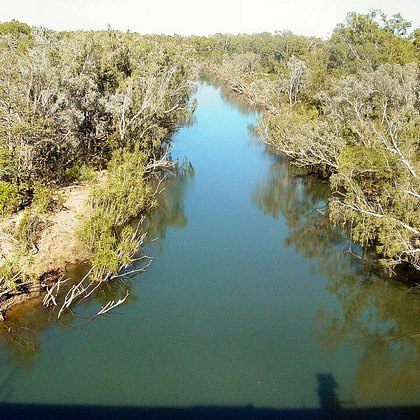
Open eucalypt and acacia woodland with a thin grass sward and bare patches between the tussocks: it needs that bare ground both to pick up seed and to dust-bathe. It stays within about three kilometres of drinking water — a creek, a stock dam or a trough at a stockyard. Within that country it is seen most often on road verges, dusty wheel tracks and around stockyards.
Where the bird is most often found, arranged by main group and formation.
Range and movements
North-eastern Australia only. The northern form holds Cape York south to roughly Townsville, the southern one runs from the Burdekin-Lynd divide south into northern New South Wales and inland to about Charleville. That range covers some 440,000 square kilometres, but the bird occupies only a fraction of it; north of the Carnarvon Ranges it is still common, south of them fragmented.
- Resident
- dark = core range, pale = thinly spread
Where and when to look
Drive a gravel road through open woodland in central Queensland at walking pace in the early morning or the last hour of daylight and watch the verge: the birds feed on exactly that bare strip and press themselves flat as you approach rather than flushing. Then work the nearest water, because everything comes in to drink early and late. Check the colour of the bare eye-ring on every bird — it tells you at once which of the two forms you have.
Conservation
Least Concern (LC) globally, but that figure hides what is happening inside Australia: the southern subspecies is listed Vulnerable federally and Endangered in New South Wales, with an estimate of forty thousand breeding birds around the year 2000. Overgrazing, the advancing mat of buffel grass that closes up the bare feeding patches, and predation by fox and feral cat press hardest in the south. Recent distribution modelling picks out fox predation as the heaviest of those factors.
Scientific name
Geophaps scripta | (Temminck, 1821)
Temminck described the species in 1821 as Columba scripta; because it later moved to Geophaps, author and year stand in parentheses. George Robert Gray introduced that genus in 1842, from Greek geō 'ground' and phaps 'wild pigeon' — a pigeon of the floor. scripta means 'written upon, marked with characters', for the striped pattern on the head, and the Spanish name paloma escrita says exactly the same thing. The type locality is given no more precisely than New Holland, the name Australia went by at the time.