All species › Pigeons and doves › Doves and pigeons › Partridge Pigeon
Partridge Pigeon | Geophaps smithii
Naaktoogkwartelduif | Paloma de smith
The Partridge Pigeon is the pigeon of the tropical eucalypt savanna of northern Australia, a squat brown-grey ground bird almost always met on foot, in pairs or in coveys of ten or so. Its trademark is the large bare patch of skin around the eye — fiery red in the Top End, yellow in the Kimberley — which gives the face a startled, spectacle-less look.

Voice
A soft, low, short whoop, usually single and repeated at long intervals, so unobtrusive that it disappears under the sound of wind in the spear grass. Disturbed, the bird flies up with an explosive clattering of wings and lands again after twenty or thirty metres. Between feeding birds come low, clipped growling notes.
No freely licensed recording has been found for this species yet; what to listen for is described below.
Identification
A small, compact ground pigeon of twenty-five to twenty-eight centimetres, plain grey to pinkish brown, with a finely scalloped grey breast patch and a white to off-white belly and vent. The wingtips are dark and the flight feathers carry a modest gloss; the tail is dark brown. Everything turns on the head: a broad unfeathered patch of skin around the eye, red in the eastern form and yellow in that of the northern Kimberley, with a narrow white line below it. There is no striped pattern on cheek or throat.
Confusion species
Squatter Pigeon (Geophaps scripta) is the sister species and the closest match, but it sits only in Queensland and northern New South Wales: it has a narrow blue-grey or pinkish-red eye-ring and a bold pattern of black and white stripes across cheek and throat, entirely lacking here. Spinifex Pigeon (Geophaps plumifera), which can occur alongside this species in the Kimberley, is rufous, carries an erect crest and has a black-and-white face band. Common Bronzewing (Phaps chalcoptera) is larger and longer-tailed and has no bare eye patch at all.
Habitat
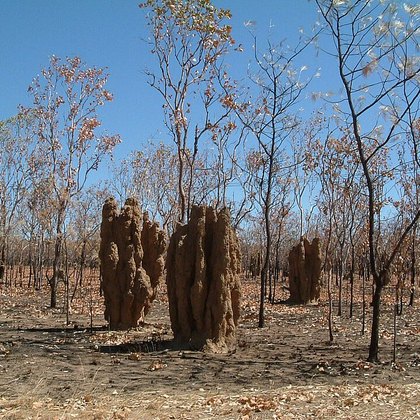
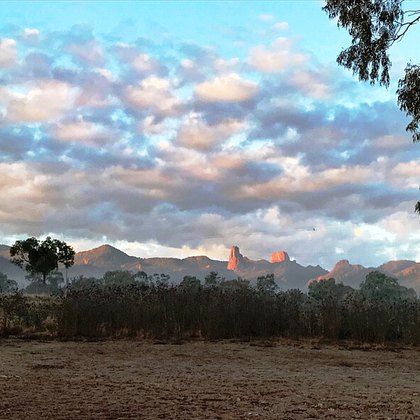
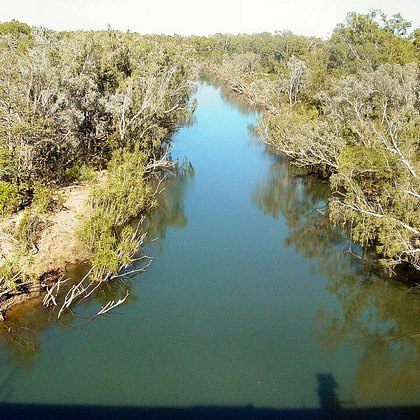
Open eucalypt savanna and grassy woodland on sandy soil, with an understorey of annually burnt grass and scattered bare patches. It forages on foot for grass and herb seed and, like its sister species, needs open ground to do it. Water nearby is essential: the birds drink daily, early and late, at creeks, billabongs and stock dams.
Where the bird is most often found, arranged by main group and formation.
Range and movements
The tropical north coast of Australia only, in two separate blocks. The eastern form holds the Top End of the Northern Territory, from western Arnhem Land round to the Darwin area, with Kakadu as its stronghold; the western form sits in a narrow strip along the north coast of the Kimberley in Western Australia. Between the two lies a gap of hundreds of kilometres, and along the eastern edge the species has dropped out of part of its former range.
- Resident
- dark = core range, pale = thinly spread
Where and when to look
Look for it in the dry season along the unsealed roads of Kakadu, ideally early in the morning: the birds walk the verge and the bare patches then, and hold their ground for a long time before flying. Stand still the moment you see one, because a covey often scatters into the grass and regathers afterwards. A pigeon that presses itself flat in front of the vehicle and only clatters up at the last moment is almost always this species.
Conservation
Least Concern (LC) on the global assessment, but the Australian picture is more worrying: both forms are listed Vulnerable federally and the species has disappeared from parts of its former range. The heaviest pressure comes from the changed fire regime — large, late, hot dry-season fires that remove seed supply and cover at a stroke — and beyond that from feral cats, which leave a ground nester with a nest in a scrape little chance. Grazing by cattle and water buffalo compacts and tramples the understorey.
Scientific name
Geophaps smithii | (Jardine & Selby, 1830)
Jardine and Selby described the bird in 1830; because the species was later placed in Geophaps, their names stand in parentheses. The genus Geophaps is George Robert Gray's, from 1842, from Greek geō 'ground' and phaps 'wild pigeon'. The epithet smithii honours a Smith; exactly which one could not be established with certainty from the sources reachable from this working environment. The type material came from the north coast of Australia, from the neighbourhood of the short-lived British settlements that stood there around 1830. The Dutch name points to the bare eye patch, the English one to the partridge-like, walking impression the bird gives.