All species › Pigeons and doves › Doves and pigeons › Chatham Islands Pigeon
Chatham Islands Pigeon | Hemiphaga chathamensis
Chathamduif | Paloma de las Chatham
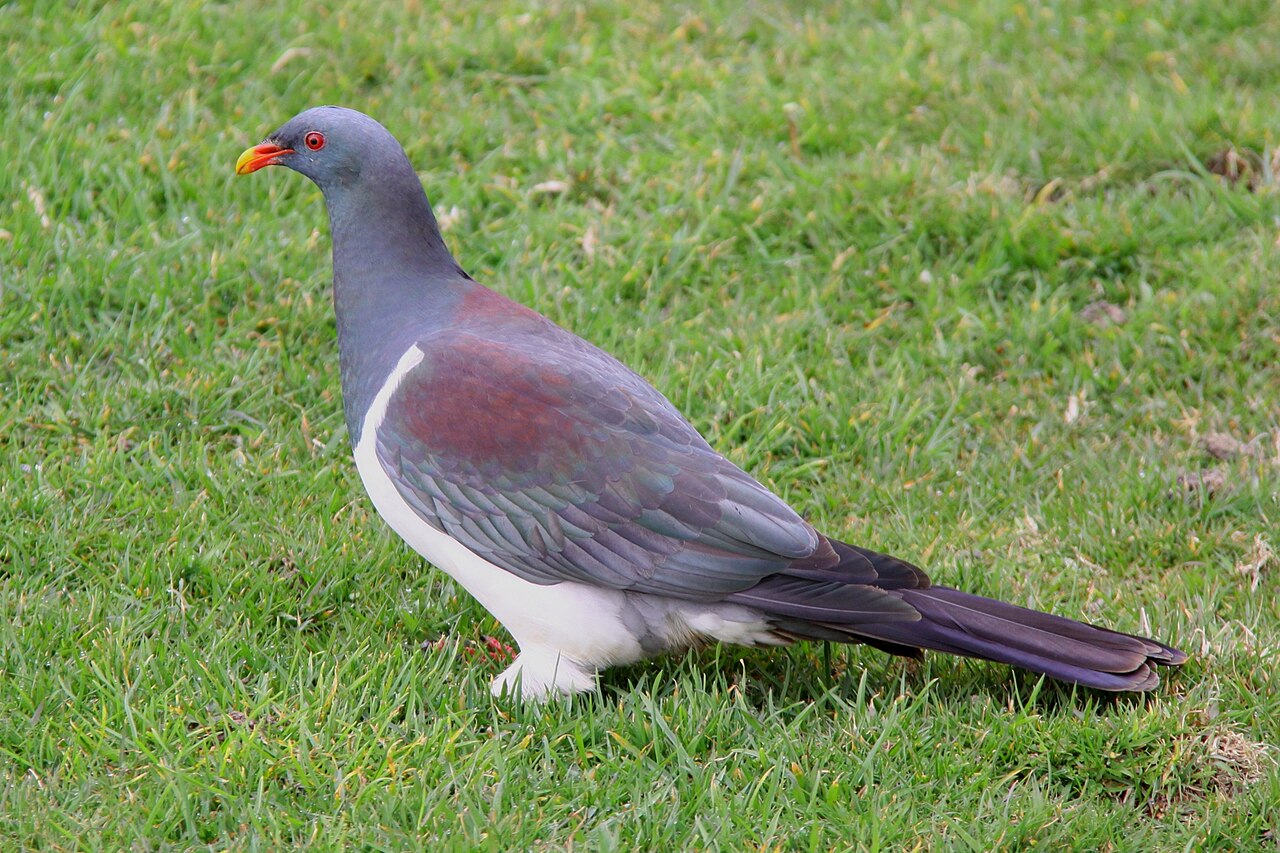
The Chatham Islands Pigeon, parea on the islands themselves, is New Zealand's largest pigeon: a fifty-five centimetre, near-eight-hundred-gram arboreal bird with a blue-black head, a maroon mantle, a pale grey rump and a snow-white belly. It occurs only on Chatham Island, eight hundred kilometres east of the South Island, and was down to forty-five birds in 1989.
Voice
Like its mainland relative it is all but silent: an occasional short, low oo at alarm, and a softer, longer contact note that bends upward at the end. Nestlings beg with thin, barely audible squeaks. In a quiet forest the heavy wingbeat as the bird flushes is the sound that finds it for you.
No freely licensed recording has been found for this species yet; what to listen for is described below.
Identification
A very large, heavy arboreal pigeon of fifty-five centimetres. Head, neck and upper breast are blue-black with a faint green-blue sheen; mantle and wing coverts are maroon with iridescence of the same tone, and rump and upper tail coverts are strikingly pale grey with a faint green wash. The flight feathers are grey, the upper tail black. From the upper breast down the underside is clean white, sharply bordered. The bill is red with an orange tip, the legs crimson, the eye reddish.
Confusion species
New Zealand Pigeon (Hemiphaga novaeseelandiae) is the sister species — until 2001 the parea was treated as a subspecies of it — and the only real point of comparison. It is smaller and lighter, lacks the pale grey rump entirely, has a green-blue rather than maroon mantle and a uniformly red bill with no orange tip. The two occur nowhere together: everything on the Chathams is parea, everything on the main islands kererū. No other large pigeon lives on the group.
Habitat
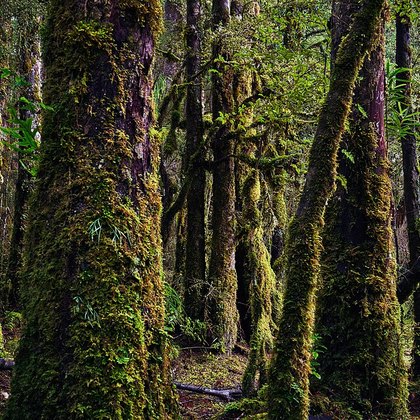
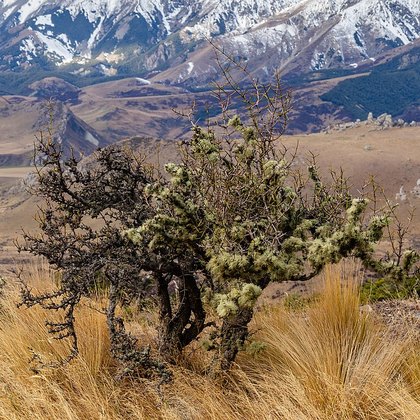
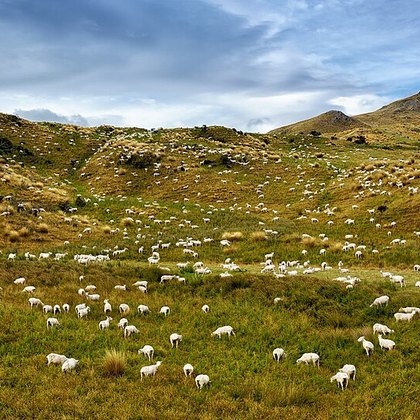
Native forest, both the large remaining blocks in the south of the island and small patches, and beyond that low scrub and bracken-covered slopes. The birds also feed on pasture adjoining forest or shelterbelt, and at times in brassica crops. The decisive plant is hoho (Pseudopanax chathamicus): the winter and spring fruit of that endemic tree governs both the timing and the length of the breeding season.
Where the bird is most often found, arranged by main group and formation.
Range and movements
Endemic to the Chatham Islands and now confined to Chatham Island itself, centred on the south — the Tuku and Awatotara catchments — with scattered groups around Te Whanga Lagoon. It formerly held Pitt Island and the smaller islands around it, where it has since gone. Nowhere else in the world does the species occur, and with a range of a few tens of square kilometres this is one of the most narrowly distributed birds in this guide.
- Resident
- dark = core range, pale = thinly spread
Where and when to look
The Tuku Nature Reserve in southern Chatham Island is the place; walk the forest edge and watch the outer branches of fruiting hoho. The birds feed strikingly low, down to the ground itself, which is unusual in pigeons of this size elsewhere — so do not only look up. Check the pale grey rump on every bird: at range that panel is the most reliable mark.
Conservation
Vulnerable (VU), and classed Nationally Vulnerable on the New Zealand list after being lifted out of Nationally Critical in 2013. Numbers bottomed out at forty-five birds in 1989; after years of pest control in the Tuku and Awatotara, a 2009 survey counted two hundred and sixty-three birds, with a total estimated at over six hundred. The threat comes from feral cats, possums, ship rats and weka, and from feral pigs digging out ground nests; because the bird nests low and feeds low, adults and eggs alike are within reach. Fencing of reserves and the exclusion of stock made the recovery possible.
Scientific name
Hemiphaga chathamensis | (Rothschild, 1891)
Rothschild described the bird in 1891; because the species ended up in Hemiphaga, author and year stand in parentheses. Bonaparte introduced that genus in 1854, building the name from Greek hēmi 'half' and the tail of Carpophaga 'fruit-eater'. chathamensis means 'of the Chathams', which is also where the type locality lies. For a long time the bird counted as a subspecies of the New Zealand Pigeon; a study in the Journal of the Royal Society of New Zealand argued in 2001 for full species status, and that has been generally accepted since. The name parea comes from the Moriori and the Maori of the islands.