All species › Tubenoses › Petrels, shearwaters and diving petrels › Subantarctic Shearwater
Subantarctic Shearwater | Puffinus elegans
Subantarctische kleine pijlstormvogel | Pardela subantártica
The Subantarctic Shearwater is a small black-and-white shearwater of the subantarctic islands: the southern counterpart of the Little Shearwater, from which it has only recently been split as a full species. It flies low and fast over the water on short, rapid wingbeats broken by stiff glides, and in the field reads as a small, compact, hard black-and-white contrast shooting away over the swell. Within this guide's region it breeds on the remote outliers - in large numbers on the rock stacks around the Antipodes, in a handful of pairs on the Chathams - but in the waters where people actually go looking it is a genuine rarity. Beyond New Zealand it also breeds in the southern Atlantic and Indian Oceans.

Voice
At sea it is silent, as nearly all shearwaters are; the repertoire belongs to the colony, in darkness. Above and inside the burrows come fast, wheezy, high-pitched series somewhere between a screech and a yelp, with the inhaling-exhaling cadence typical of Puffinus, and from the ground a barking and moaning out of the burrows. Honestly, the voice of this species is only moderately documented: the colonies sit on hard-to-reach islets, recordings are scarce, and where descriptions exist they often still refer to the composite taxon from before the split. Anyone meeting the bird in New Zealand waters will see it silent in any case.
No freely licensed recording has been found for this species yet; what to listen for is described below.
Identification
A small shearwater of around thirty centimetres and roughly 250 grams, hard black above - with a greyish cast in fresh plumage - and crisply white below, with a white underwing narrowly edged dark along the margins only. The decisive feature is in the face: the dark border passes below the eye, so the eye sits in the middle of the black of the cap and the face reads as comparatively dark. The bill is dark with blue-grey sides, short and fine; legs and feet are blue with pale pinkish webs. The flight is that of a small shearwater: low over the water, quick fluttering beats in series with short stiff glides between them, and far less shearing banking than the larger species. At a distance the flight suggests an auk as much as a shearwater.
Confusion species
The real test is the Little Shearwater (Puffinus assimilis), from which this species was split and which breeds around northern New Zealand. There is a genuine field character, and it lies in the face: the Little Shearwater has a whiter face with the dark border running through or above the eye, so the eye is surrounded by white or sits on the white side, whereas in this species the border passes below the eye and the eye therefore sits in the dark. In addition elegans is slightly larger (30 against 28 cm) and marginally bulkier in every AVONET measurement. Be honest about how usable that is: from a moving boat, at range, in spray and backlight, the face pattern of a small bird shooting low past you is rarely established with certainty, and a two-centimetre difference is invisible on a lone bird. In practice range and season help more than plumage - assimilis breeds around northern New Zealand and lays in midwinter, elegans breeds on the southern outliers and lays from late August to early October - and a claim outside the expected range needs photographs. The Fluttering Shearwater (Puffinus gavia, 31-37 cm) and Hutton's Shearwater (Puffinus huttoni, 36 cm) are both clearly larger, brown-black rather than jet black, and show smudgy brown markings on the underwing and axillaries; they also fly more slowly and less stiffly. The Common Diving Petrel (Pelecanoides urinatrix) is smaller again and far more thickset, with a whirring insect-like wingbeat, and dives straight into the water rather than pulling up.
Habitat
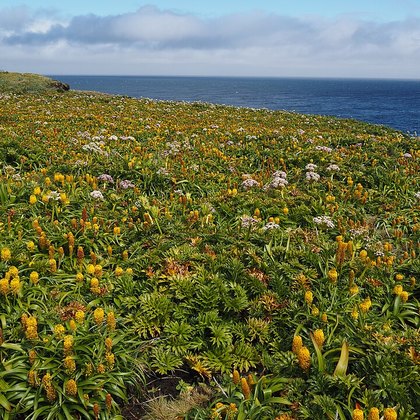
A bird of the cool subantarctic and southern temperate ocean, ranging over deep water outside the breeding season and rarely approaching land. To breed it comes ashore on predator-free rock stacks and coastal headlands, where it digs short burrows, usually less than a metre, into soil beneath tussock, among boulders or under dense herbaceous growth. Those islets are precisely the places rats and mice never reached: on the main islands of the same groups the species is absent or nearly gone. It is therefore a bird tied to two very different habitats - the open subantarctic sea to live in, and a few square kilometres of tussock island to breed on.
Where the bird is most often found, arranged by main group and formation.


Range and movements
Breeds on subantarctic and cool-temperate islands in three oceans: in the southern Atlantic around Tristan da Cunha and Gough, on islands of the southern Indian Ocean, and within this guide's region at the Antipodes - where the stacks around the main island hold tens of thousands of breeding pairs - and the Chathams, with some one hundred to one hundred and fifty pairs on the Star Keys and possibly a few on Little Mangere. Elsewhere in the region it is chiefly a wanderer: young birds and post-breeding adults disperse across subantarctic waters and have been recorded at the Bounty, Auckland, Snares and Solander Islands, exceptionally north to off the southern North Island, and east as far as Chile. New Zealand lists it as a native breeding species with the status Naturally Uncommon. For this guide that is an awkward combination: across 2015-2024 the measurements returned 608 observations and 224 distinct cases, well above the threshold for inclusion, but so thin and so unevenly spread that no seasonal pattern could be extracted. The seasonality assessment came back with too little data to classify, so the season and range map stays blank for this species - as it does for some fifteen other equally thinly documented species in this guide. On top of that the split is recent, the GBIF backbone taxonomy does not yet carry it as a separate species, and the great majority of small black-and-white shearwaters at sea are never identified to species at all.
Where and when to look
Realistically you will see this bird only on an expedition voyage to the New Zealand subantarctic islands - the Antipodes and the Bounty group - or on a Chathams pelagic; from the mainland it is an exceptional record. Always photograph, and aim for two things: the face in profile, to see whether the dark border passes below the eye, and the underwing, to judge the narrow dark margins. Record position and date precisely, because for this species the combination of place and season is often more convincing than the image itself. Logging an uncertain bird as small shearwater sp. is not a defeat but good practice.
Conservation
Globally the IUCN rates the species Least Concern: the total breeding stock across three oceans is large and there is no evidence of rapid decline. New Zealand nonetheless rates it Naturally Uncommon, because the number of occupied islands there is small and everything depends on the absence of introduced mammals. That is also the core of management: a burrow-nester of this size disappears from islets holding rats or mice, and the Antipodes population does well precisely because it sits on the surrounding stacks that rodents never reached. The successful eradication of mice from the main Antipodes Island in 2016 has measurably improved the outlook for the whole group. Otherwise the threats are those of all small seabirds: plastic ingestion, shifts in prey availability and incidental bycatch.
Scientific name
Puffinus elegans | Giglioli & Salvadori, 1869
The species name elegans simply means graceful or elegant - a compliment to the clean, sharply demarcated black-and-white plumage of this small shearwater. The genus name Puffinus is a latinised form of the English word puffin, which originally referred not to the Atlantic Puffin but to the fat, salted young of shearwaters once harvested for food; the name only later stuck to the wrong bird. The Dutch name says exactly what the species is: the subantarctic counterpart of the Little Shearwater, separated by breeding range and breeding season rather than by appearance.