All species › Tubenoses › Petrels, shearwaters and diving petrels › Fluttering Shearwater
Fluttering Shearwater | Puffinus gavia
Vlinderpijlstormvogel | Pardela gavia
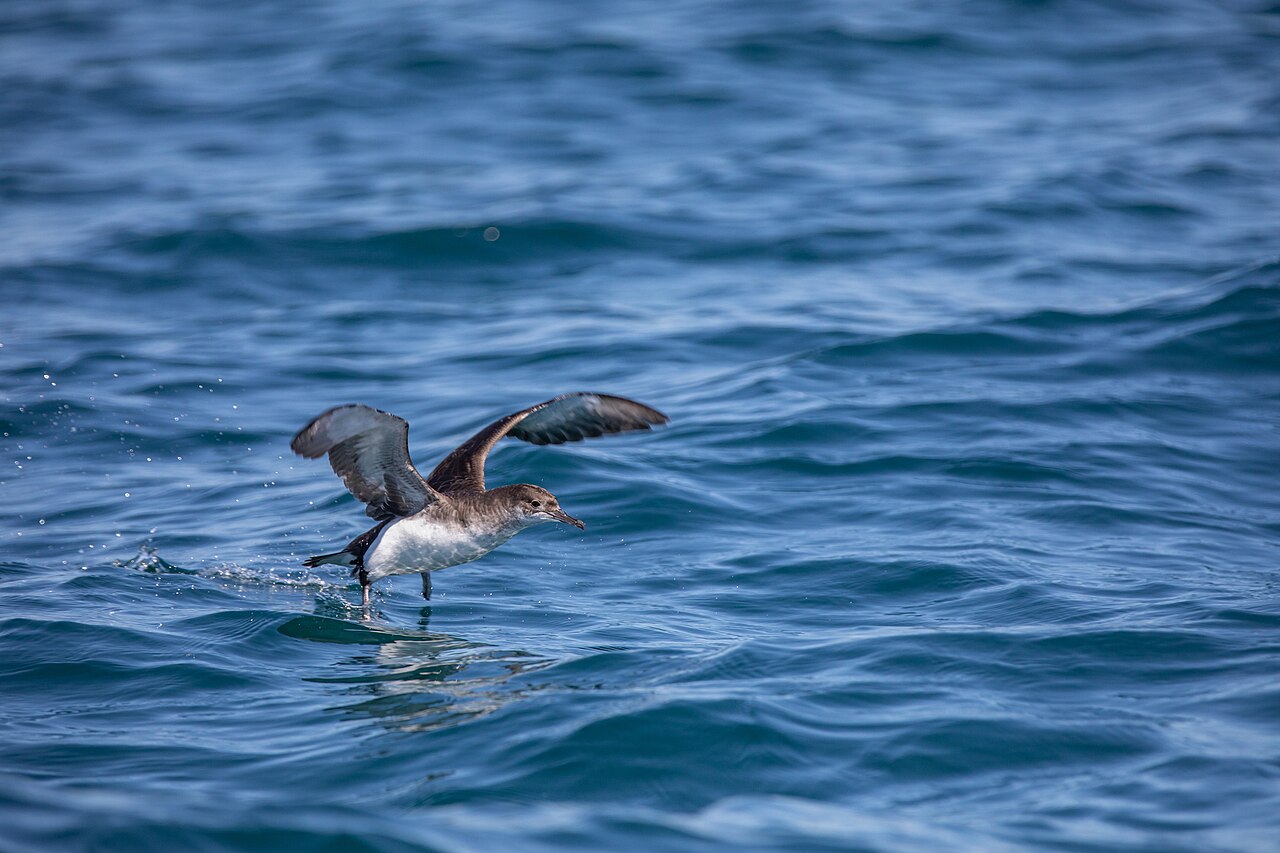
The Fluttering Shearwater is the everyday small shearwater of New Zealand's inshore waters: dark brown above, white below, with a dark cap reaching below the eye and a partial collar. Its name is in the flight — short, fast, stiff beats alternating with glides low over the water — and in summer great rafts of hundreds of birds lie in the bays and straits.
Voice
Usually silent at sea, though brief cackling may break out over a feeding shoal. At the colonies it calls mainly in flight at night: a striking staccato ka-hek ka-hek ka-hek, loud and rattling, which carries across the water of the bay and over an island sounds like a sustained clamour of dozens of birds.
No freely licensed recording has been found for this species yet; what to listen for is described below.
Identification
Thirty-one to thirty-seven centimetres, with a wingspan of seventy-five to eighty. The upperparts are dark grey-brown, with a dark cap running below the eye line into a partial collar; chin and throat are white, and there is more white on the face than in Hutton's Shearwater. The underwing is off-white with variable dark markings but without dark armpits. A dark thigh patch shows in flight. The bill is long and thin but shorter and stouter than Hutton's; the legs are pinkish-brown with dark webs, and the feet project just beyond the tail in flight. The outer vanes of the undertail coverts are white.
Confusion species
Hutton's Shearwater (Puffinus huttoni) is the twin species and must always be excluded: it is larger and heavier, with a darker head showing little white on chin and throat, a distinctly darker underwing with conspicuously dusky armpits, a longer and slimmer bill, and dark outer vanes to the undertail coverts. In Australian waters the two winter side by side, so a name there rarely stands up without a photograph of the underwing. Little Shearwater (Puffinus assimilis) at twenty-eight centimetres is far smaller, black-and-white with white reaching above the eye, a clean white underwing with a narrow black margin, a short bill, blue legs and a whirring auk-like flight. The much larger Buller's Shearwater (Ardenna bulleri) has grey upperparts with a dark M and a clean white underwing.
Habitat
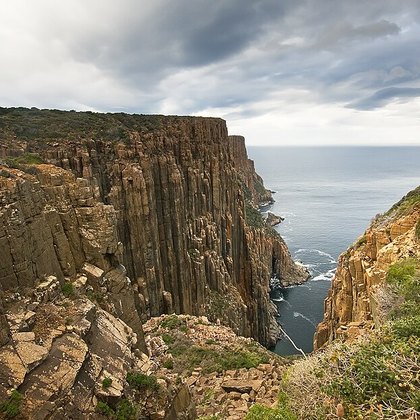
Shallow, cool inshore waters: bays, straits, harbour mouths and the water over the continental shelf, where it dives in dense flocks over baitfish shoals, often alongside terns, gannets and dolphins. It breeds in burrows and rock crevices on predator-free offshore islands, under scrub, tussock and coastal forest.
Where the bird is most often found, arranged by main group and formation.


Range and movements
It breeds only on islands of New Zealand. The large colonies are on the Three Kings, Moturoa, Motuharakeke in the Cavalli group, and the Bream, Mercury and Alderman Islands, with further numbers on the Poor Knights, the Mokohinau Islands and Hen Island; on Little Barrier the species has been returning in recent years. At sea it is abundant in the inshore waters of the northern half of New Zealand, especially the north-eastern North Island and the Marlborough Sounds–Cook Strait region. From February to August a large share of the birds cross the Tasman Sea to eastern and south-eastern Australia, where it is then a common sight along the coasts of New South Wales and Victoria.
- Resident
- Breeding (summer)
- dark = core range, pale = thinly spread
Where and when to look
This is the shearwater you see from land. In New Zealand take a headland above a bay in the Hauraki Gulf, the Bay of Islands or the Marlborough Sounds, or ride a ferry through Cook Strait, and look for the long low ribbons and the floating rafts. In Australia it can be watched in winter from the heads at Sydney and Wollongong. On every bird take a moment on the underwing: pale armpits and a clearly white chin rule out Hutton's Shearwater.
Conservation
Least Concern (LC), with a population estimated at a hundred thousand to a million birds, though the breeding range has shrunk to a set of islets and the New Zealand colonies count as relicts of a formerly far wider distribution. The greatest threat is the reinvasion of a predator-free island by rats, cats or stoats: a single swimming stoat can empty a colony in a few seasons. Beyond that come entanglement in fishing nets, the overharvesting of the baitfish shoals the species lives on, and oil spills in the busy inshore waters it frequents.
Scientific name
Puffinus gavia | (Forster, 1844)
Johann Reinhold Forster described the species in 1844 as Procellaria gavia, in the posthumously published account of his observations on Cook's second voyage; because the genus has since changed, author and year are bracketed. gavia is a Latin name for an unspecified seabird, used by Pliny for a gull-like bird. Puffinus is a Latinised form of the English 'puffin', originally the cured young of shearwaters. The type locality is Queen Charlotte Sound in the Marlborough Sounds, where Cook lay at anchor and where the species still breeds. The Maori name is pakahā.