All species › Tubenoses › Petrels, shearwaters and diving petrels › Hutton's Shearwater
Hutton's Shearwater | Puffinus huttoni
Hutton-pijlstormvogel | Pardela de Hutton
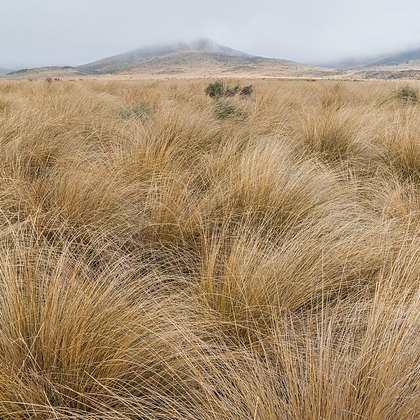
Hutton's Shearwater is the only seabird in the world that breeds in the alpine zone: its burrows lie in tussock slopes above twelve hundred metres in the Seaward Kaikōura Range, and every night the birds fly from there to the sea and back. On the water it is a dark, slender shearwater with a long thin bill, barely separable from Fluttering Shearwater — except by the dirty underwing with its dark 'armpits'.

Voice
At sea it is silent. Over and in the colony it is noisy: loud cackling series much like those of Fluttering Shearwater, a rattling ka-hek ka-hek, given at night by birds skimming the dark tussock slopes or answering from the burrow. Camp near a colony in March and you hear chattering and the thump of landing birds all night.
No freely licensed recording has been found for this species yet; what to listen for is described below.
Identification
Thirty-six centimetres, three hundred and fifty grams. The upperparts are dark grey-brown and run up over the head, with a broad mottled dark collar dropping from the neck down the side of the breast; the underparts are white from the upper breast. The clincher is the underwing: off-white with broad dark borders and distinctly dusky armpits, so that the wing never looks clean white from below. The bill is long, slender and dark grey; the legs are pinkish-brown with dark webs. The outer vanes of the undertail coverts are dark. The flight is fast stiff beats alternating with short glides low over the water.
Confusion species
Fluttering Shearwater (Puffinus gavia) is the twin species and the real problem, above all in Australian waters where both winter. It is slightly smaller and lighter, shows more white on chin and throat, has a clearly whiter underwing without dark armpits, a shorter and stouter bill, and white outer vanes to the undertail coverts where Hutton's has dark ones. Little Shearwater (Puffinus assimilis) at twenty-eight centimetres is far smaller and more compact, black-and-white rather than brown-and-white, with white reaching above the eye, a clean white underwing with a narrow black margin, a short bill and blue legs, and it flies with fast whirring beats like an auk. If the underwing cannot be seen properly, 'small Puffinus' is a more honest conclusion than a name.
Habitat
Breeds in self-dug burrows on steep tussock-covered slopes above the treeline in the alpine and subalpine zone, roughly between twelve and eighteen hundred metres — habitat no other shearwater uses. It feeds in shallow, cool inshore water over the continental shelf, often in large flocks over baitfish shoals alongside other shearwaters and dolphins.
Where the bird is most often found, arranged by main group and formation.


Range and movements
Breeds only in the Seaward Kaikōura Range of the South Island, in two natural colonies — in the Kowhai River catchment in Uerau Nature Reserve and at Shearwater Stream in Puhi Peaks Nature Reserve — plus a created colony on the Kaikōura Peninsula. From September to March the birds are numerous in the inshore waters off Kaikōura, mostly between Cape Campbell and Banks Peninsula, with scattered records from Northland to Foveaux Strait. After breeding they cross the Tasman Sea to Australia, where some birds complete a full anticlockwise circuit of the continent; young birds stay there four to five years before returning to Kaikōura.
- Resident
- Breeding (summer)
- dark = core range, pale = thinly spread
Where and when to look
The surest place is a boat trip off Kaikōura between November and February: the birds are numerous and close in the afternoon, and you can see the dusky armpits on the underwing as they bank past. From land the coast road north of Kaikōura works in an offshore wind. In Australian waters a photograph of the underwing and the undertail coverts is the only honest way to separate it from Fluttering Shearwater. In March, look not only seaward after dark but at the mountains: that is when the young fledge.
Conservation
Endangered (EN). The species has fallen from an estimated population in the millions to under half a million birds, with just over a hundred thousand breeding pairs in only two natural colonies; of the eight colonies known in the twentieth century, six were lost to feral pigs rooting out the burrows and to stoats and cats. On 14 November 2016 the magnitude 7.8 Kaikōura earthquake struck the colonies around midnight at the peak of laying: at least forty thousand breeding birds were lost in landslides and potentially another eighty thousand to burrow collapse. Since 2005 a third colony has been built up at Te Rae o Atiu on the Kaikōura Peninsula from transferred chicks inside a predator-proof fence, where over forty pairs now breed. From mid-March to early April fledglings are disoriented by street lighting and come down in the town, where they are picked up and released each year.
Scientific name
Puffinus huttoni | Mathews, 1912
Gregory Mathews described the species in 1912 as Puffinus reinholdi huttoni, as a subspecies; because the genus has not changed, author and year carry no parentheses. The epithet honours Frederick Wollaston Hutton (1836–1905), the English-born naturalist who put New Zealand ornithology in order. Puffinus is a Latinised form of the English 'puffin', originally the cured young of shearwaters. The type locality is recorded as 'Snares Island' — a puzzling label, because where the species actually bred stayed unknown until Geoff Harrow found the colonies high in the Kaikōura mountains in 1965. The Maori name is Kaikōura tītī.