All species › Storks › Storks › Black-necked Stork
Black-necked Stork | Ephippiorhynchus asiaticus
Zwarthalsooievaar | Jabirú asiático
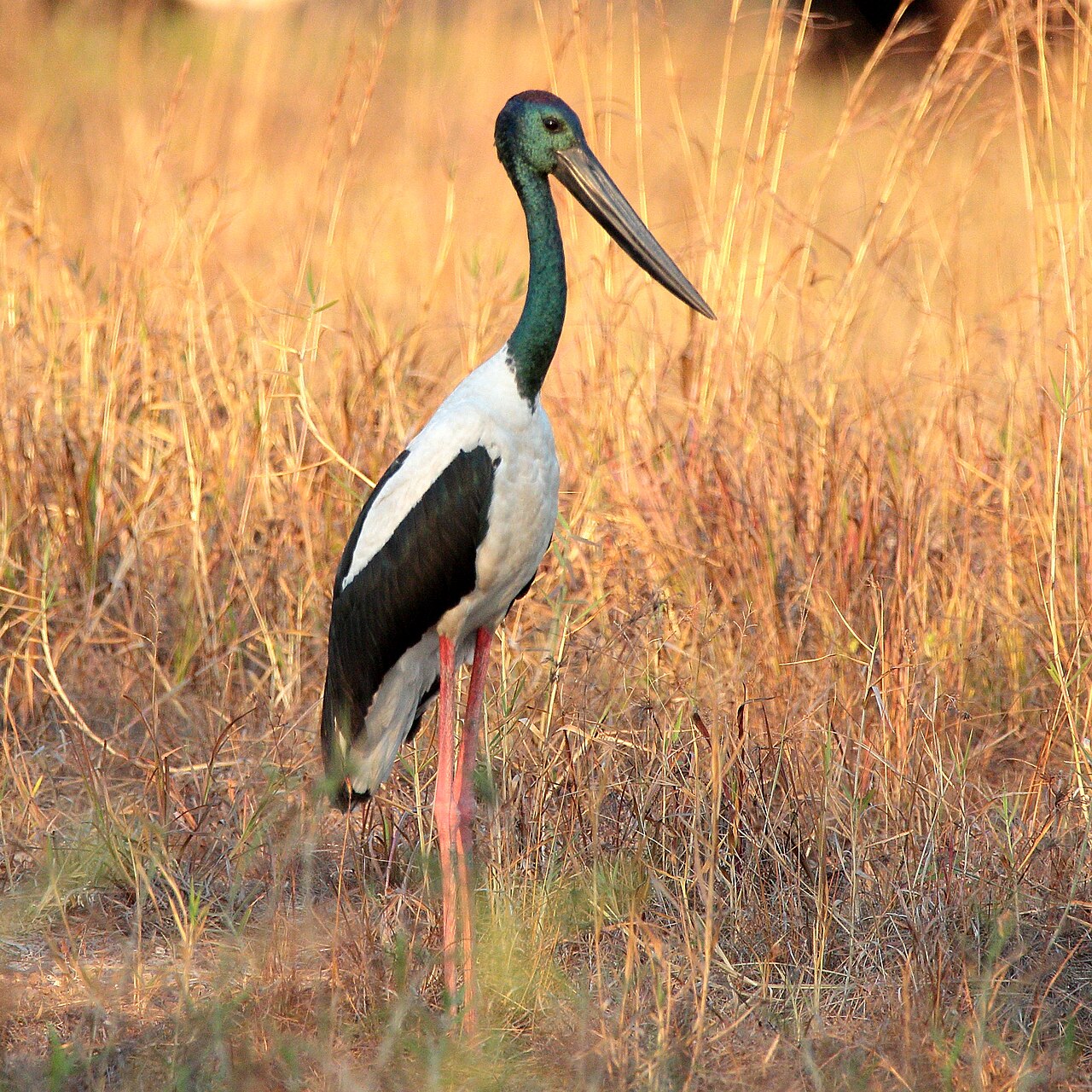
The Black-necked Stork is Australia's only stork: over a metre and a third tall, with a glossy green-black head and neck, a heavy black bill and long coral-red legs. In Australia it is called jabiru, although the true jabiru lives in South America and the two are no more closely related than storks in general.
Voice
As an adult it is virtually voiceless, like most storks: the sound comes from the bill. At the nest and in greeting it clatters the mandibles loudly and at length, a dry rattle that carries across a whole swamp. Beyond that it gives a dull booming or hissing in threat, and young beg with a loud, high-pitched yammering. The wingbeats are audible too: the heavy swish of a bird taking off betrays it in the reeds.
No recording with a suitable Creative Commons licence has been found for this species yet; what to listen for is described below.
Identification
A huge black-and-white wading bird of nearly a metre and a half, with a snow-white body, a glossy green and purple-black head and neck, and a broad black band across the wing and the tail. The bill is black, straight and heavy, the legs coral-red and projecting well beyond the tail in flight. The sexes are marked alike and are separated only by the eye: the female has a yellow iris, the male a dark brown to black one. Young birds are dull brown and white, with a dull bill and grey legs. In flight it holds neck and legs outstretched and sails on slow, deep beats with a striking black-and-white wing pattern.
Confusion species
There is no second stork in this region, so confusion comes from other large waders. Brolga and Sarus Crane are grey, with a grey neck and a red head, and fly in flocks; the Black-necked Stork flies alone or in pairs. Herons are far smaller and fly with the neck drawn in, White-necked Heron and Great Egret among them. In flight the black-and-white wing pattern can recall a Magpie Goose, which is much shorter in neck and leg and travels in noisy parties.
Habitat
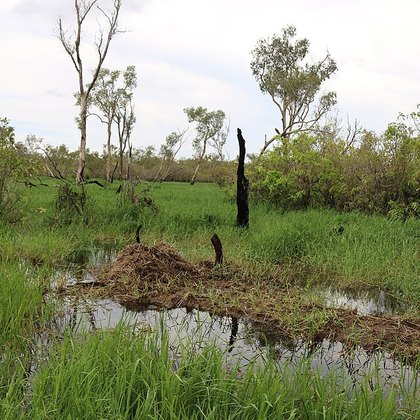
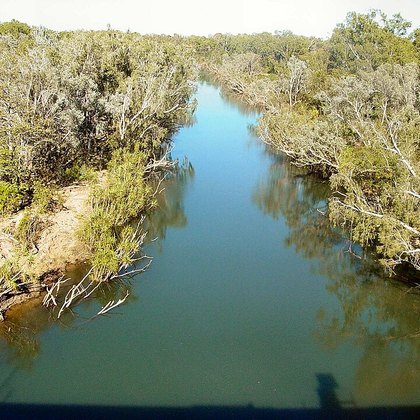
Shallow freshwater swamps, billabongs (cut-off river channel that flows only at high water) and river floodplains, with open water between reed and lily where it wades slowly and probes for fish, frogs and young turtles. It also uses estuaries, tidal flats, the mangrove edge and wet pasture and rice fields, particularly as the freshwater swamps dry out. It avoids dry country and deep water, and needs tall trees for the nest.
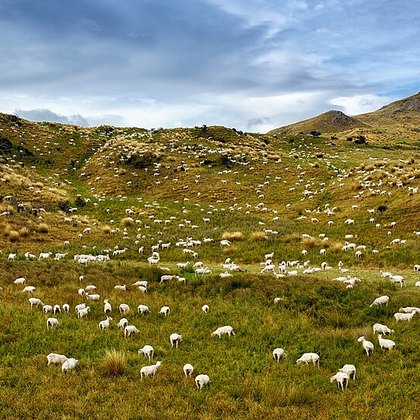
Where the bird is most often found, arranged by main group and formation.



Range and movements
From India through Southeast Asia to New Guinea and Australia. In Australia it occupies the coast and the country just behind it from the Kimberley across the Top End and Cape York to the east coast of Queensland, and south into northern New South Wales. From much of eastern New South Wales, where it was once ordinary, it has gone with the draining of the floodplains. It does not migrate, but young birds wander far, and after major floods birds turn up deep inland.
- Resident
- dark = core range, pale = thinly spread
Where and when to look
Kakadu in the late dry season, June to October, is the surest site: Yellow Water and Mamukala, where birds concentrate at the shrinking billabongs. Look for a tall black-and-white shape standing motionless in shallow water, then check the iris through the telescope — that names the sex at once.
Conservation
Globally Least Concern (LC), but the Australian picture is double: in the monsoonal north it does well, in the southeast of its range it does not. In New South Wales the species is listed as endangered under state law, with only a few hundred birds left in the whole southeast. Drainage of floodplains, the loss of tall nest trees, collision with powerlines and drowning in barbed wire are the main causes.
Scientific name
Ephippiorhynchus asiaticus | (Latham, 1790)
Latham described the bird in 1790 as Mycteria asiatica; because it was later placed in another genus, author and year stand in parentheses. The genus Ephippiorhynchus was introduced by Bonaparte in 1855, from Greek ephippion, saddle, and rhunkhos, bill — after the yellow saddle-shaped shield on the bill of the African Saddle-billed Stork, its sister species in the same genus. asiaticus means Asian. The type locality is India, which explains why Australia's only stork carries an Asian species name.