All species › Passerines › Thornbills, scrubwrens, gerygones and allies › Tropical Scrubwren
Tropical Scrubwren | Sericornis beccarii
Beccari's struiksluiper | Sedosito de beccari
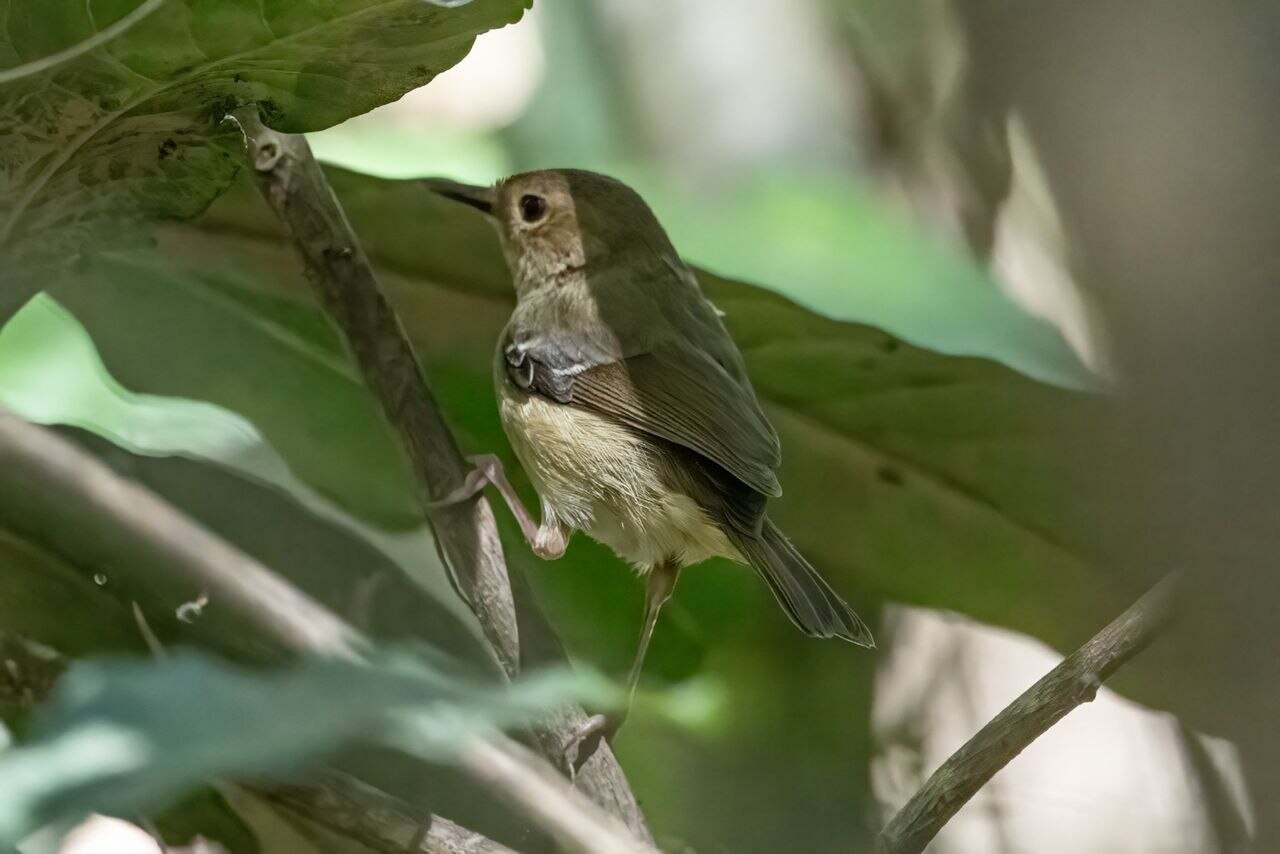
The Tropical Scrubwren is the scrubwren of the rainforests of northern Cape York Peninsula, and the only member of its genus that also occurs outside Australia: its weight lies on New Guinea and the Aru Islands. It is a small, brown, busy bird with a black, white-tipped shoulder patch and a faint pale eyebrow, flitting almost invisibly through dense undergrowth and making itself known mainly by voice.
Voice
A busy, bright chirping with sharp, sustained notes, kept up almost continuously by a pair or a party as it moves through the undergrowth; it is a noisy bird for its size. There is also a sharp, repeated scold in alarm. Because the bird itself stays hidden in dense leaves, the sound is often the only evidence of its presence in Cape York rainforest.
No freely licensed recording has been found for this species yet; what to listen for is described below.
Identification
About eleven centimetres and ten to eleven grams: small, brown above and pale below, with a short tail and a long, pointed bill angled slightly upward. The decisive mark is on the shoulder: the wing coverts form a black patch tipped with white. With it go a faint white eyebrow and a reddish iris that looks black in the gloom of the rainforest. The male has dark lores with a pale line above and below them; the female has a plainer face.
Confusion species
Large-billed Scrubwren (Sericornis magnirostra) shares the forest in the north but has a plain, featureless face without an eyebrow and lacks the black-and-white shoulder entirely. Sericornis frontalis has a far sharper, broad white eyebrow above and below the eye and a pale cream iris, and barely reaches the rainforest north of Cooktown. The gerygones of the genus Gerygone are slimmer and plainer and forage in the canopy rather than the undergrowth. A small brown scrubwren with a black, white-spotted shoulder in the rainforest of northern Cape York is this species.
Habitat
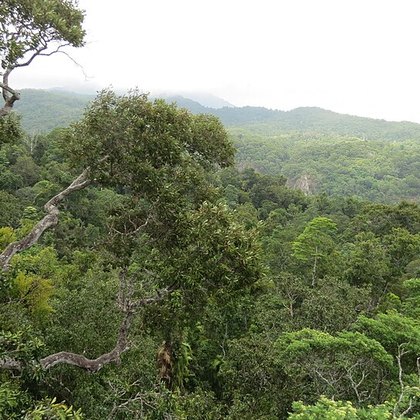
Closed tropical rainforest and the smaller closed forest patches and vine thickets in the savanna matrix, together with forest edges and rank creek margins. It prefers dense undergrowth and forages there and in the lower canopy, but also comes to the ground. It keeps to pairs or small parties and moves almost without pause. The forest blocks of Iron Range and the McIlwraith Range are its Australian stronghold.
Where the bird is most often found, arranged by main group and formation.

Range and movements
In Australia only Cape York Peninsula, from about Cooktown northward, where it is locally common; outside Australia southern New Guinea and the Aru Islands. Eight subspecies are recognised in all, most of them on New Guinea. It is sedentary. Because the Australian part of the range lies far from settlement and falls largely within national parks, the species is poorly studied there but also little pressed.
- Resident
- dark = core range, pale = thinly spread
Where and when to look
Drive to Kutini-Payamu (Iron Range) or the Lockerbie Scrub and take a forest track early in the morning. Stand at a dense shrubby edge and listen for the sustained chirping — it nearly always comes from a party of these birds. If you get one in view, go straight for the shoulder: the black patch with white tips is the one feature that separates it from the Large-billed Scrubwren, and it vanishes as soon as the bird folds the wing against its flank.
Conservation
Least Concern (LC). The world range covers New Guinea, the Aru Islands and northern Cape York and is large; in Australia most of it lies within protected areas. The risk lies in the quality of the forest itself: fire too frequent or too hot, eating into the edges of the rainforest blocks, and feral pigs turning over the undergrowth and litter. No national decline is known.
Scientific name
Sericornis beccarii | Salvadori, 1874
Salvadori described the species in 1874 from material from Wokan in the Aru Islands. Sericornis is formed from Greek serikos (silken) and ornis (bird). The specific name beccarii honours Odoardo Beccari, the Italian naturalist and collector whose material from the Indies underlay much of Salvadori's work; the Dutch name keeps that tribute, while the English Tropical Scrubwren points to where the range lies.