All species › Passerines › Thornbills, scrubwrens, gerygones and allies › White-browed Scrubwren
White-browed Scrubwren | Sericornis frontalis
Oostelijke witbrauwstruiksluiper | Sedosito cejiblanco
The White-browed Scrubwren is the scrubwren most people in Australia know: small, brown, with a sharp white eyebrow above and below the eye, a dark lore between them, and a pale cream iris. It lives in every dense shrub along the east coast, gardens and city parks included, and it makes itself heard above all — a sustained, shrill scolding rattle the moment anyone comes too close to its bush.

Voice
Almost constant hard, shrill, grating scolding, especially when disturbed; find a cat or a snake in the bush and the whole neighbourhood joins in. The song itself is a loud, high ts-cheer or a repeated ch-weip, ch-weip, ch-weip, often from cover. It also mimics other species. Of all the scrubwrens this is the noisiest, and the sound is usually what produces the record.
Recording: Romuald Mikusek — CC BY-NC-SA 4.0 · Wilderness Retreats at Wilsons Promontory National Park (near Tidal River), South Gippsland Shire, Victoria, Australia · xeno-canto
Identification
Eleven to thirteen centimetres, about twelve grams. The upperparts are dark olive-brown, the throat grey-buff and the flanks and belly dull rufous. The face is the feature: a white stripe above and below the eye, with a dark field across the lore between them, and in the middle of it all a pale cream iris. A dark, white-tipped covert patch stands on the wing. The female is slightly duller, above all on the face, where the lore is grey rather than black.
Confusion species
Within the genus the three nearest relatives are geographically separate and were once treated as a single species: Tasmanian Scrubwren (Sericornis humilis) in Tasmania is larger and duller and lacks the sharp white brow, and Spotted Scrubwren (Sericornis maculatus) in the west and along the South Australian coast has spotted, streaked underparts; the latter was recognised again as a separate species only in 2019, on genetic grounds. There is no overlap — where you stand decides which of the three it is. Otherwise Large-billed Scrubwren (Sericornis magnirostra) is the commonest confusion: plain dull brown, no eyebrow, a dark eye and a long bill, and it forages high in the branches. Brown Thornbill (Acanthiza pusilla) is smaller and shorter-billed, with a scalloped forehead, and lacks the white face pattern.
Habitat
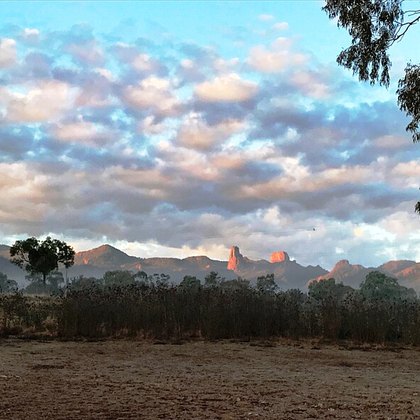
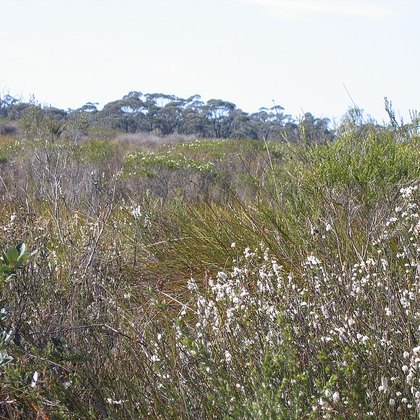
Anything with a dense lower layer: rainforest edge, open eucalypt forest, woodland, heath, creek vegetation, dune scrub — and in town the garden, the park and the cemetery, as long as there is a dense shrub or a compost corner. It rarely rises above shrub height and shuffles through litter and the lowest leaves with its tail held low. The large, globular grass nest with a side entrance sits on or just above the ground in thick cover. Other group members often help raise the brood.
Where the bird is most often found, arranged by main group and formation.


Range and movements
The eastern half of the continent: from northern Queensland, where it reaches the Atherton Tableland, along the whole east coast south and west into South Australia, wherever the understorey is dense enough. It is sedentary, holds the same territory all year and hardly crosses open ground. It is the commonest and most widespread scrubwren in Australia, and a fixture of suburban gardens in Sydney, Brisbane and Melbourne.
- Resident
- dark = core range, pale = thinly spread
Where and when to look
You need not travel far: a dense shrub in a city park will do. Stand by a shrubby edge and make a soft hissing sound — this species nearly always comes to it and pushes its head through the leaves, just long enough to show the white stripe above and below the eye and the pale iris. It is the best way to fix the face pattern you will need later in the forest to separate it from Large-billed Scrubwren (Sericornis magnirostra).
Conservation
Least Concern (LC). The species is common, widespread and benefits from gardens and parks with dense planting; the range has not measurably contracted over the past century. Where it disappears, it is local and for one reason: the clearing away of understorey. A garden or park without a shrub layer will not hold it, and stray cats take a bird that does everything close to the ground easily.
Scientific name
Sericornis frontalis | (Vigors & Horsfield, 1827)
Vigors and Horsfield described the bird in 1827; because it was later placed in another genus, authors and year stand in parentheses. Sericornis is formed from Greek serikos (silken) and ornis (bird), after the soft plumage. frontalis is Latin and refers to the forehead, here in the sense of the brow. The prefix 'eastern' in the Dutch name distinguishes it from the Spotted Scrubwren (Sericornis maculatus). The type locality is Sydney.