All species › Parrots › Old World parrots › Varied Lorikeet
Varied Lorikeet | Psitteuteles versicolor
Veelkleurige lori | Lori versicolor
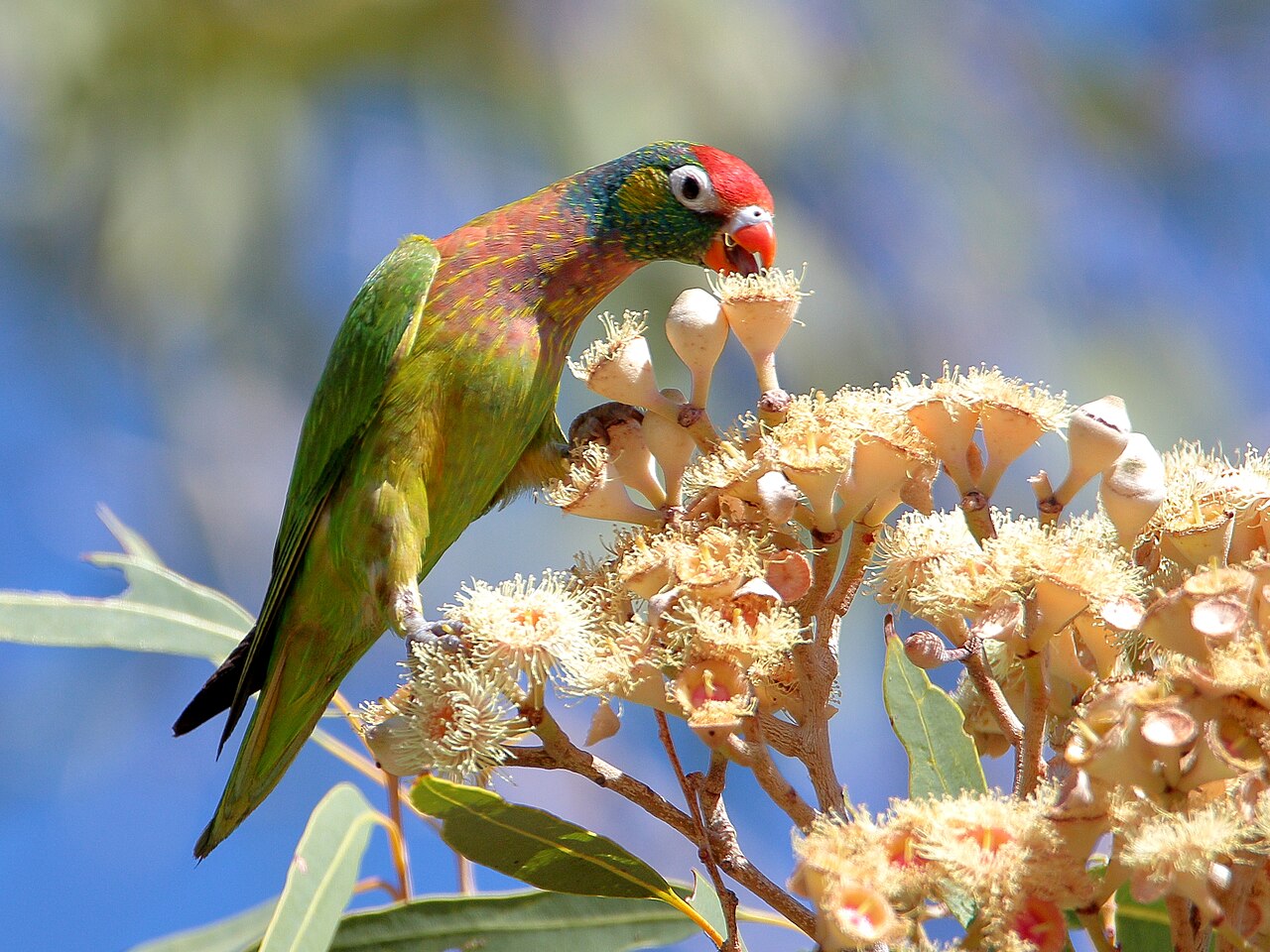
The Varied Lorikeet is the small streaked lorikeet of tropical northern Australia: green, covered all over with short yellow streaks, with a bright red crown and a pale ear patch. It wanders in fast, screaming parties through the savanna and is one of the least predictable birds of the Top End — present in hundreds one week, gone the next.
Voice
The contact call is a sharp, shrill screech, repeated without pause in flight, so that a flock is almost always heard before it is seen. It is higher and thinner than the screech of the Red-collared Lorikeet, with which it often shares a tree. Feeding birds keep up a soft high chatter broken by short, angry squabbling over blossom; young birds beg with a steady squeaking rattle.
No freely licensed recording has been found for this species yet; what to listen for is described below.
Identification
Seventeen to twenty centimetres and fifty to sixty-two grams, smaller than a Musk Lorikeet. The plumage is green but strewn all over with short yellow streaks, a streaking no other lorikeet in the region shows. Forehead, lores and crown are bright red, the ear coverts carry a pale yellow patch, and a mauve to pink wash with yellow streaks lies across the upper breast. The bill is coral-red, with a pale ring around the eye. The female has less red on the head and a duller breast; juveniles show little red on the forehead, lack the pink breast wash and have a horn-coloured bill.
Confusion species
Throughout its range it shares trees with Red-collared Lorikeet (Trichoglossus rubritorquis), half again as long and with a dark blue head, an orange-red nape collar and a black belly — where this species shows a red crown, streaked green plumage and no blue at all. Rainbow Lorikeet (Trichoglossus moluccanus) further east separates on the same points. The small southern lorikeets, Little (Parvipsitta pusilla) and Purple-crowned (Parvipsitta porphyrocephala), do not overlap with it and are besides plain green without yellow streaking. In the north a small streaked lorikeet with a red crown is always this bird.
Habitat
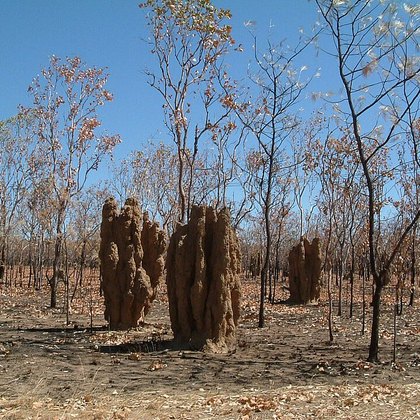
Open eucalypt forest and monsoon woodland of the tropical savanna, with a marked preference for the strips along creeks and the edges of swamps; flowering paperbarks and Darwin Woollybutt are its main food trees. It also forages in grassland with scattered trees and in flowering melaleuca swamp. It nests in unlined tree hollows, usually in a horizontal limb.
Where the bird is most often found, arranged by main group and formation.


Range and movements
Tropical northern Australia, from Broome and most of the Kimberley in Western Australia through the Top End of the Northern Territory to the southern tip of the Gulf of Carpentaria, and in Queensland south to about Mount Isa. At the northern edge it exceptionally reaches the Jardine River on Cape York. It is strongly nomadic and follows the blossom over long distances, so its presence in a district varies sharply from year to year.
- Resident
- Winter
- dark = core range, pale = thinly spread
Where and when to look
In the dry season look for it at flowering paperbarks along a creek and listen for the shrill calling overhead; parties come over high and fast, then drop suddenly into the canopy. Then watch texture rather than colour: on a well-lit bird the yellow streaking over the green is still visible at fifteen metres, and it is the only mark you need. If a larger lorikeet with a blue head sits alongside, the size comparison comes with it.
Conservation
Not threatened (LC), with a large range in thinly settled country and no demonstrated national decline. As a hollow-nester it does depend on old savanna trees, and the altered fire regime of northern Australia — fires too frequent and too late in the dry season — reduces the stock of hollow trees over time. Because it wanders so widely it is hard to count and local numbers are a poor measure of the population; no firm national trend is known.
Scientific name
Psitteuteles versicolor | (Lear, 1831)
Edward Lear figured the bird in 1831 in his Illustrations of the Family of Psittacidae and called it Trichoglossus versicolor; no locality was given, and Mathews later fixed the type locality on Cape York, Queensland. Author and year take parentheses because the species later changed genus. Latin versicolor means ‘of changing colour, varied’, which the Dutch and English names also carry. The genus Psitteuteles was introduced by Bonaparte in 1854 and is formed from the name Psittacus euteles, which Temminck gave in 1835 to the Olive-headed Lorikeet; Gray designated this very species as the type in 1855.