All species › Passerines › Fairywrens, grasswrens and emu-wrens › Western Grasswren
Western Grasswren | Amytornis textilis
Westelijke grassluiper | Maluro occidental
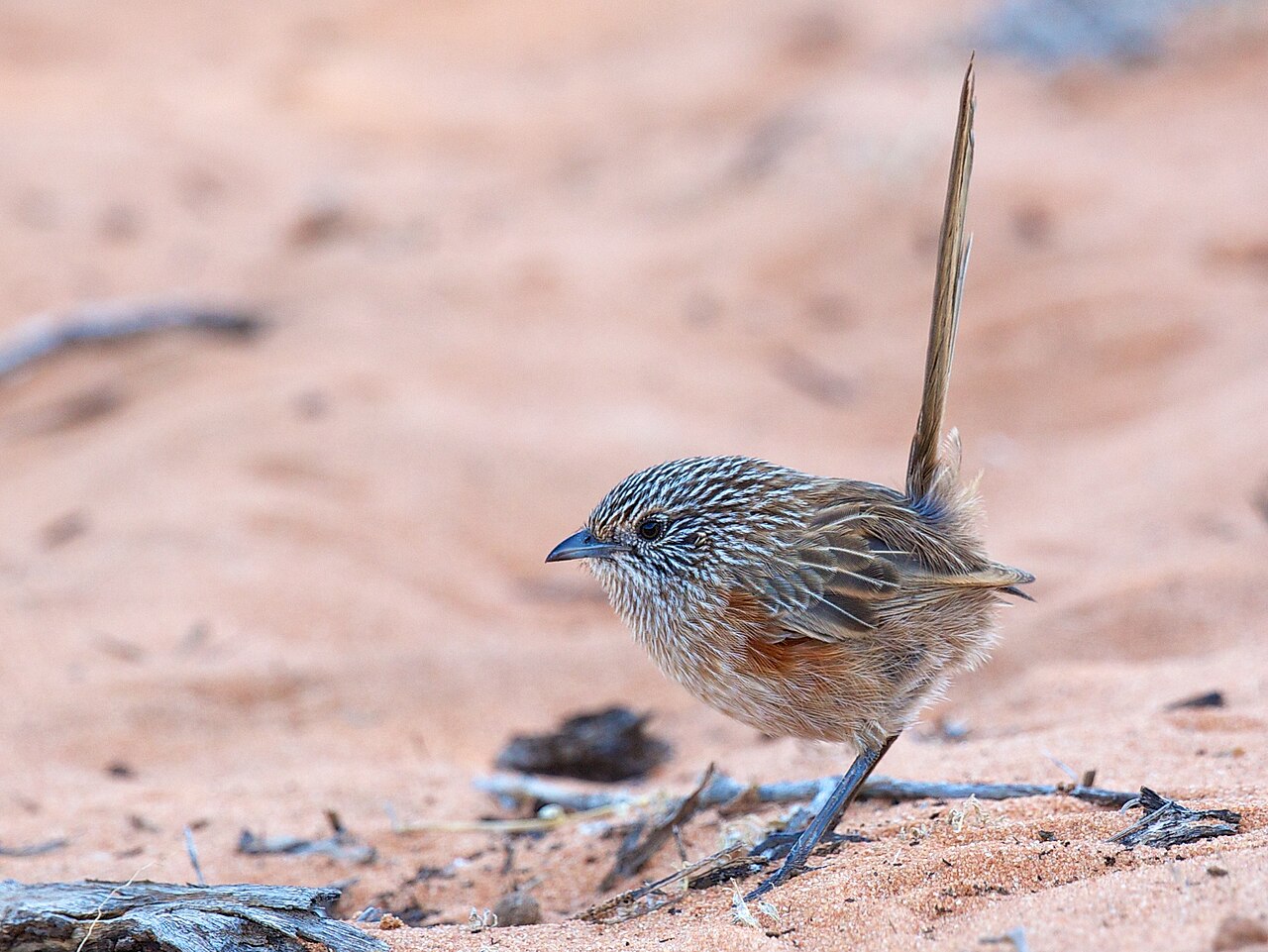
The Western Grasswren is one of the largest and longest-tailed grasswrens: a dull, grey-brown bird of dense acacia scrub and saltbush (salt-tolerant dwarf shrubland of saline plains) plains in Western and South Australia. Unlike most of its relatives it is not a spinifex (spiny, hummock-forming desert grass of the interior) bird but a shrubland bird, and for exactly that reason it has disappeared from much of its former range since the arrival of sheep and cattle.
Voice
A thin, high, long-sustained reeling song, slower and fuller than that of the spinifex grasswrens, often delivered from the top of a shrub or a low branch. Contact calls are fine tsip notes and a soft grating churr by which a pair keeps in touch under cover. On a still morning the sound carries further than the bird can be seen.
Recording: Mark Carter — CC BY-NC-SA 4.0 · Whyalla Barson, The Corporation of the City of Whyalla, South Australia, Australia · xeno-canto
Identification
Seventeen to twenty centimetres, almost half of it the long, often cocked tail. The bird is far duller than the rufous spinifex species: grey-brown to sandy above, with fine white shaft streaks that are less sharply edged in black and so read at a distance as a finely woven pattern. Throat and breast are off-white with fine dark streaking; a malar stripe is present but faint. The female has rufous flanks, the male does not. The bill is heavier and blunter than in the spinifex grasswrens.
Confusion species
The Thick-billed Grasswren (Amytornis modestus), split out of this taxon as a separate species, looks all but identical: equally dull, equally long-tailed, with the same heavy bill. The two cannot be told apart reliably in the field and the distinction rests on range — modestus occupies the central and eastern interior, this species Western Australia together with the Eyre Peninsula and Gawler Ranges of South Australia. The Short-tailed Grasswren (Amytornis merrotsyi) shares part of that South Australian ground but has a conspicuously short tail and lives on rocky hills rather than shrubland plains. All the spinifex grasswrens — among them the Striated Grasswren (Amytornis striatus) and the Pilbara Grasswren (Amytornis whitei) — are smaller, warmer rufous and show a crisply bordered white throat with a black malar stripe.
Habitat
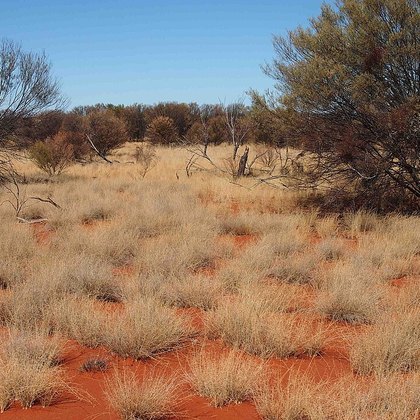
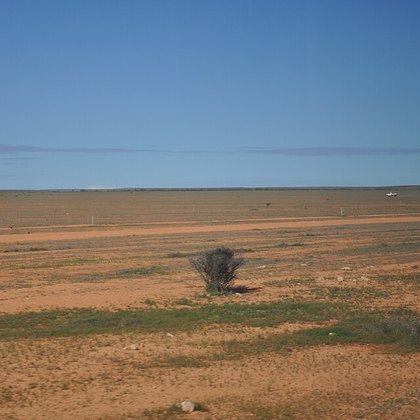
Dense low shrubland on flat ground: acacia scrub, especially of Acacia species that branch right down to the soil, and saltbush and bluebush (blue-grey salt-tolerant shrubland of the semi-arid interior) plains with enough closed shrub cover to run through unseen. What the bird needs is less a particular plant than an unbroken low layer; where stock have eaten that layer open it disappears, even if the shrubs themselves remain standing.
Where the bird is most often found, arranged by main group and formation.
Range and movements
Two separate areas. In Western Australia the Shark Bay region, including the Peron Peninsula and the islands offshore, and further inland parts of the Murchison. In South Australia the Eyre Peninsula and the Gawler Ranges and their surroundings. Between the two lies a gap of more than a thousand kilometres, largely the Nullarbor. Resident: pairs hold the same ground year-round and rarely fly more than a few tens of metres.
- Resident
- dark = core range, pale = thinly spread
Where and when to look
The Peron Peninsula at Shark Bay is the most reliable place: walk the edge of dense acacia scrub there in the early morning and listen for the sustained reeling song. The birds would rather run than fly, so look low and follow the movement of the cocked tail. Your chances are best where the scrub is closed to ground level; open, grazed-out patches can be skipped.
Conservation
The IUCN places the species among the birds of Least Concern (LC), but that verdict covers a long history of retreat: since the arrival of sheep, cattle, goats and rabbits the bird has vanished from much of the interior of Western and South Australia, leaving two widely separated cores. The causes are loss of the low shrub layer to grazing, fire that is too frequent, and predation by feral cats and the introduced fox. On islands and in fenced areas from which stock and predators have been excluded, such as around Shark Bay, the species holds up well.
Scientific name
Amytornis textilis | (Quoy & Gaimard, 1824)
Jean René Constant Quoy and Joseph Paul Gaimard, ships' naturalists on the French expedition of the Uranie, described the bird in 1824 as Malurus textilis; because it was later moved to another genus, the author and date are bracketed. The type locality is Shark Bay, more precisely fixed at the Peron Peninsula. textilis is Latin for 'woven' and refers to the finely streaked plumage, which resembles woven cloth. The genus was first called Amytis, after a Persian noblewoman; because that name was already taken, Leonhard Stejneger proposed Amytornis in 1885, adding the Greek ornis (bird).