All species › Passerines › Fairywrens, grasswrens and emu-wrens › Striated Grasswren
Striated Grasswren | Amytornis striatus
Witkeelgrassluiper | Maluro estriado
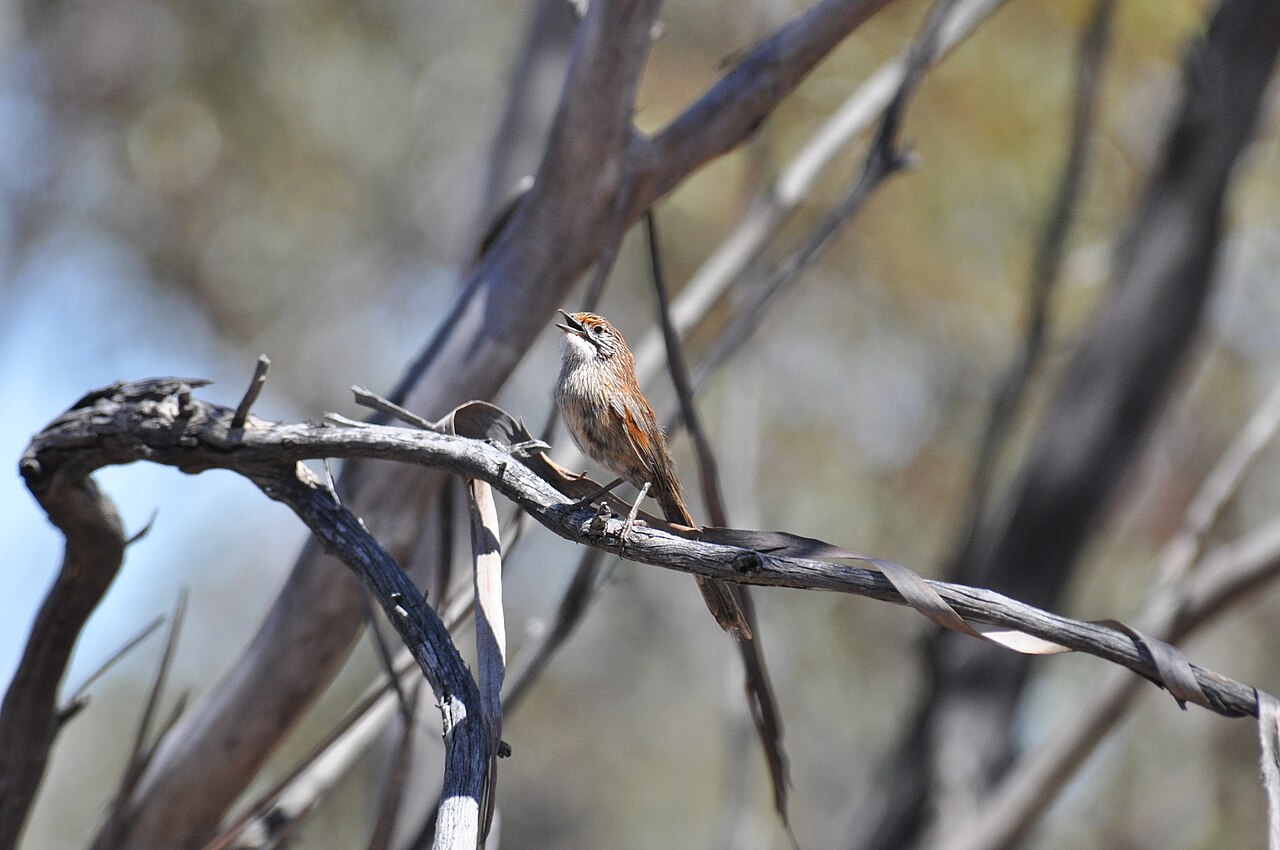
The Striated Grasswren is the best known and most southerly of the thirteen grasswrens in this guide: a rufous, long-tailed bird with a crisply bordered white throat, living in the spinifex beneath the mallee of south-eastern Australia. Three western and northern forms have been split from it as separate species this century, so its range has shrunk considerably on paper.
Voice
A high, thin, fast reeling song of two to four seconds with a slightly rising close, often delivered from the top of a spinifex hummock or a low mallee branch. The contact call is a fine, sharp tsip. When alarmed the birds give dry chek notes. The whole repertoire sits so high that it is lost in wind or background noise — many observers find this bird by ear or not at all.
No freely licensed recording has been found for this species yet; what to listen for is described below.
Identification
Fourteen to sixteen centimetres, well over half of it tail; that tail is carried straight up when the bird runs. The upperparts are warm rufous with fine white shaft streaks, each edged black — clear streaking at close range, a plain rusty bird at a distance. The throat is clean white and sharply bordered. The male has a black malar stripe along that white throat, the female does not, but has rufous flanks. The bill is fine and dark and the legs long.
Confusion species
Within the genus, range is by far the most usable character. The Pilbara Grasswren (Amytornis whitei), the Sandhill Grasswren (Amytornis oweni) and the Opalton Grasswren (Amytornis rowleyi) were split from this species and look all but the same, but all three live far to the west or north and do not overlap with it. The Short-tailed Grasswren (Amytornis merrotsyi) occurs in the Flinders and Gawler Ranges of South Australia and is told by a distinctly shorter tail and by rocky ground rather than mallee. The Western Grasswren (Amytornis textilis) and its relative Amytornis modestus, absent from this guide, are larger, duller and plainer and lack both the warm rufous tone and the crisp black-and-white throat pattern. In the same spinifex under the mallee there is also the Mallee Emu-wren (Stipiturus mallee), far smaller and with a thin tail of loose, hair-like feathers.
Habitat
Old, dense hummocks of spinifex (Triodia) beneath mallee eucalypts, and also spinifex on open sandplains and dune ridges. What matters is not the mallee but the age of the hummocks: it needs hummocks unburnt for a decade or so and large enough to nest under. After fire it disappears from a site and takes years to return.
Where the bird is most often found, arranged by main group and formation.


Range and movements
The south-eastern interior of Australia: the mallee of north-western Victoria, south-western and central New South Wales and adjoining South Australia, with well-known strongholds in the Big Desert and Sunset Country, at Round Hill and Nombinnie, and in the Riverland. The type locality lies on the lower Namoi in New South Wales. Resident on fixed territories; the population has become badly fragmented by farming and by large fires.
- Resident
- Passage
- dark = core range, pale = thinly spread
Where and when to look
Walk a belt of mallee where the spinifex hummocks stand knee-high and closed in the first hour after sunrise, and stop as soon as you hear the thin song. Look for the singing bird on the crown of a hummock or on a dead branch just above the ground. Crossing through the hummocks flushes the birds and yields nothing but a running brown shape. Ground burnt within the last few years can be skipped.
Conservation
The IUCN places the species among the birds of Least Concern. Note that the AviList dataset carries no category for this name, because the Red List still uses it in the broad sense, including the western and northern forms that have since been split off. Within Australia the species does badly in places: the mallee has been cleared for farming over huge areas, and the reserves that remain are hit by very large fires, after which a site stays unsuitable for years. Feral cats and foxes do the rest. Management therefore turns above all on keeping large tracts of long-unburnt spinifex.
Scientific name
Amytornis striatus | (Gould, 1840)
John Gould described the bird in 1840 as Dasyornis striatus, among the bristlebirds, from a specimen from the lower Namoi in New South Wales; because the species was later moved to another genus, the author and date are bracketed. striatus is Latin for 'striped', after the fine white shaft streaks. The genus was first called Amytis, after a Persian noblewoman; because that name was already taken, Leonhard Stejneger proposed Amytornis in 1885, adding the Greek ornis (bird). The Dutch name points to the white throat, the one feature that gives this group away at a distance.