All species › Passerines › Honeyeaters › Western Wattlebird
Western Wattlebird | Anthochaera lunulata
Westelijke lelhoningeter | Mielero lunulado
The Western Wattlebird is the south-western Australian counterpart of the Little Wattlebird: a slim, grey-brown, streaked honeyeater without wattles, with a red-brown eye, a white cheek patch and a rufous flash in the wing in flight. It is one of the birds found only in the continent's south-western corner, and in the banksia heath and the gardens of Perth it is a noisy, ever-present figure.
No freely licensed photograph of a living wild bird of this species exists. Do you have one that meets the rules? Send it in.
Voice
Harsh, hoarse and plaintive: a run of barking, coughing notes and a drawn-out, wailing kweeow delivered from a high branch or a roof edge. The repertoire is much like Little Wattlebird's, but to Western Australian ears a little higher and more mournful. In quarrels over a flowering banksia it runs into a fast, angry rattle, and at the flowers themselves you hear a soft, throaty grunting.
No freely licensed recording has been found for this species yet; what to listen for is described below.
Identification
A medium to large honeyeater of twenty-five to thirty centimetres, slimly built, with a long tail and a fairly long, slightly decurved grey bill. The upperparts are dark grey-brown, the underparts finely streaked white over brown, becoming whiter on the belly. The head is fairly plain brown, without the heavy streaking that marks the eastern bird's head, and carries below the eye an elongated white cheek patch running almost to the shoulder. The eye is red-brown, with a dark stripe through it. Wattles are absent. In flight a warm rufous patch lights up in the primaries — the clearest mark at range.
Confusion species
Its double is Little Wattlebird (Anthochaera chrysoptera), from which it was only recently split on differences in size, plumage and eye colour. That species occurs solely in south-eastern Australia and Tasmania; range is the decisive factor here, because in Western Australia any wattle-less wattlebird is this one. Where plumage does help: lunulata is trimmer, has a smoother, less streaked head, a longer white cheek patch and a red-brown rather than blue-grey eye. Red Wattlebird (Anthochaera carunculata) shares the gardens of Perth with it and is the real field problem: it is markedly bigger and heavier-built, has a short red wattle below the eye, red cheek patches and a yellow belly patch, and shows no rufous in the wing. Brown Honeyeater (Lichmera indistincta) is far smaller and uniformly olive-brown.
Habitat
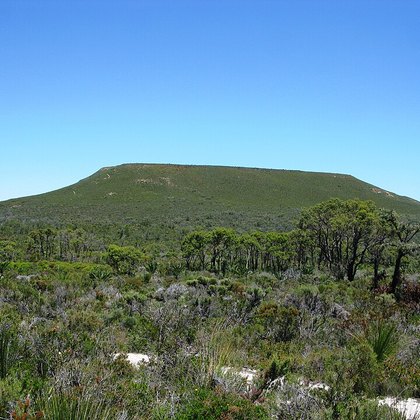
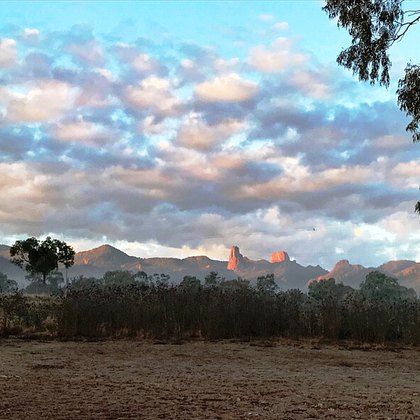
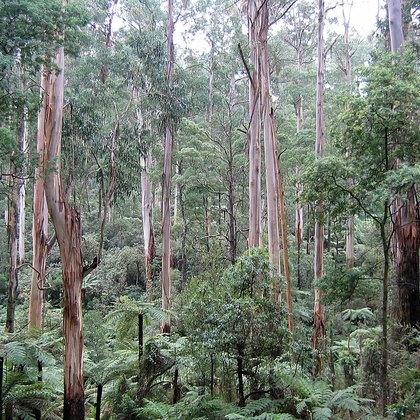
The kwongan heath and banksia woodland of south-western Australia, plus jarrah and marri forest, coastal scrub and open woodland. Like its eastern counterpart it is besides a settled town bird: in the gardens, parks and street trees of Perth, Mandurah and Albany it is among the commonest large birds, especially where banksias, grevilleas and hakeas have been planted.
Where the bird is most often found, arranged by main group and formation.

Range and movements
Endemic to the south-western corner of Western Australia, roughly from Geraldton south along the coast and then east to Israelite Bay, inland to about the Stirling Range and the edge of the wheatbelt. That range coincides closely with the old high-rainfall forests and heaths of the south-west. Within it the bird is locally nomadic, following the flowering of banksia and Dryandra through the year.
- Resident
- dark = core range, pale = thinly spread
Where and when to look
In Perth, Kings Park is the easiest place: walk the banksia heath there and listen for the wailing bark. Separate it from Red Wattlebird, which uses the same trees, on size and on the cheek — a small red wattle and red cheek patches against an elongated white cheek streak. To be certain, wait for the bird to fly: only this species then shows rufous in the primaries.
Conservation
Least Concern (LC) and common to numerous in suitable country; in garden suburbs planted with natives it has if anything increased. The worries concern not the species itself but its habitat: the kwongan heath and banksia woodland of the south-west have been badly damaged by clearing for wheat, by the root rot caused by Phytophthora that kills banksias and Dryandras, and by too-frequent fire. Because the bird occurs nowhere else on earth, everything that happens in that one corner bears directly on its future.
Scientific name
Anthochaera lunulata | Gould, 1838
John Gould described the bird in 1838 as Anthochaera lunulata; author and date stand without parentheses, because the species has always remained in this genus. It was, however, long treated as the western subspecies of Little Wattlebird and only restored to species rank on differences in size, plumage and eye colour. lunulata is Latin for 'marked with little moons', from lunula, a little moon — after the crescent-shaped pale feather edges on breast and belly. The genus Anthochaera was erected in 1827 by Vigors and Horsfield, from Greek anthos, flower, and khairo, to enjoy. The Dutch name simply distinguishes it geographically from its eastern sister species.