All species › Passerines › Honeyeaters › Yellow Wattlebird
Yellow Wattlebird | Anthochaera paradoxa
Geellelhoningeter | Mielero ventriamarillo
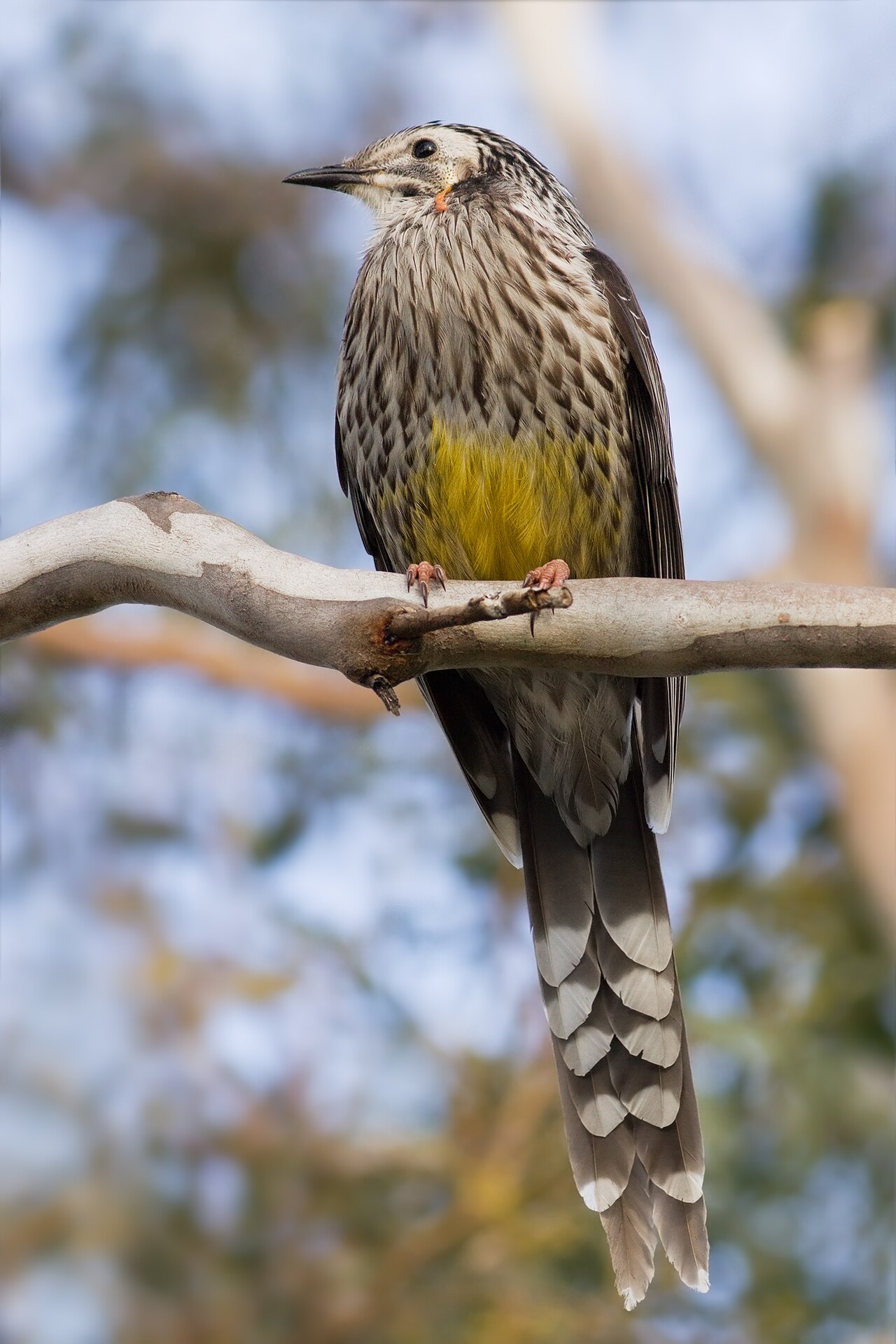
The Yellow Wattlebird is the largest honeyeater in the world and one of the twelve birds found only in Tasmania: a gangling, long-tailed bird of almost half a metre, with a pale streaked face, a bright yellow belly patch and — the feature everything turns on — two long, floppy orange-yellow wattles that hang along the jaw like earrings and swing with every movement. It is noisy, tame, and in Hobart as easily found in a city park as in the bush.
Voice
Loud, harsh and raucous: a run of hoarse, coughing kuk or kuk-kuk notes that sound as though the bird were choking, delivered with a violent jerk of head and neck that sets the wattles flying. There is no song in the ordinary sense; the whole repertoire consists of these grating exclamations, alarm rattles and a sawing, plaintive begging note from the young. On a still Tasmanian morning the sound carries down the whole valley.
No freely licensed recording has been found for this species yet; what to listen for is described below.
Identification
A very large, slim honeyeater of close to half a metre, with a long tail, long legs and a slightly decurved dark bill. The upperparts are grey-brown, the underparts white with heavy dark streaking, and on the belly sits a sharply bounded, bright yellow panel. The face is strikingly pale and finely streaked, the crown streaked black. From each cheek hangs a long fleshy orange-yellow wattle, longer in the male than the female and brighter in the breeding season; young birds still have short wattles and duller plumage. In flight — undulating, with heavy beats and a great deal of tail — the yellow belly stands out.
Confusion species
Within Tasmania only one serious confusion is possible: Little Wattlebird (Anthochaera chrysoptera), which shares the same gardens and heaths there. It is much smaller at twenty-six to thirty centimetres, has no wattles at all, no yellow on the belly, and shows a rufous wing patch in flight. Red Wattlebird (Anthochaera carunculata) is absent from Tasmania and is in any case told by its short red wattle below the eye, red cheeks and smaller, vaguer yellow belly patch; on the mainland, where Yellow Wattlebird turns up at most as a great rarity, that is the pair to separate. Regent Honeyeater (Anthochaera phrygia) is far smaller, black with yellow scaling, and does not occur in Tasmania.
Habitat
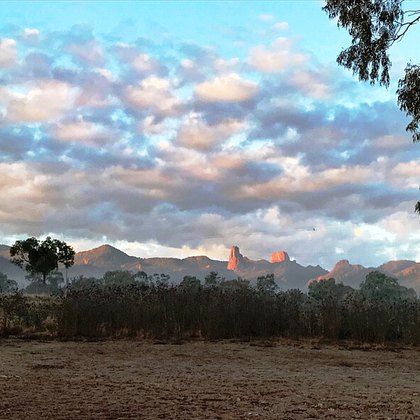
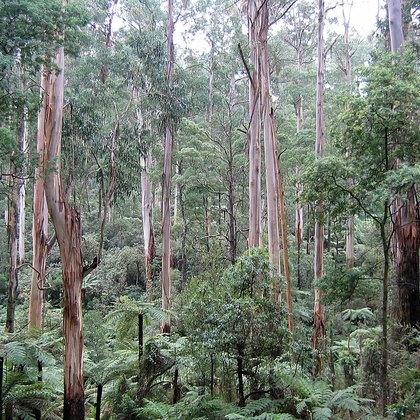
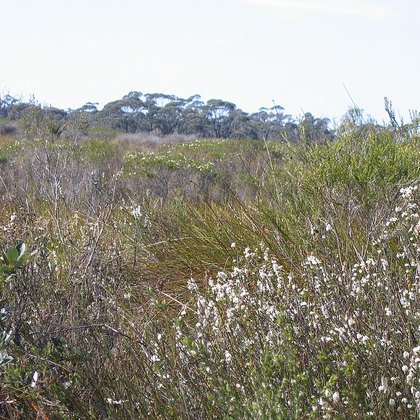
From sea level to over thirteen hundred metres, and in between nearly everything Tasmania has to offer: dry and wet eucalypt forest, open woodland, coastal banksia heath and the shrub layer up into the subalpine zone. Besides that it is a matter-of-course town bird, in parks, cemeteries, golf courses and gardens, drawn to flowering eucalypts and to overripe fallen fruit.
Where the bird is most often found, arranged by main group and formation.

Range and movements
Endemic to Tasmania, where it is widespread and common through the east and centre of the island and much scarcer in the wet west. It also occurs on King Island, Three Hummock Island and Hunter Island in Bass Strait. On the Australian mainland it is known only from a handful of old and disputed records. Within Tasmania it moves with the blossom and the season: in winter many birds leave the uplands for the lower coastal and urban country.
- Resident
- dark = core range, pale = thinly spread
Where and when to look
In Hobart it takes almost no effort: look up in the Royal Tasmanian Botanical Gardens or in a cemetery with flowering eucalypts and listen for the coughing squawk. To be sure of the wattles the bird has to turn its head — at rest they lie flat against the cheek and are surprisingly inconspicuous. If a large, long, streaked honeyeater with a yellow belly patch flies off in Tasmania, it is this species; if it is markedly smaller and flashes rufous in the wing, it is Little Wattlebird.
Conservation
Least Concern (LC). The species is common in eastern and central Tasmania, holds up well in towns and gardens, and has a population regarded as stable. It has not always been so: according to the Australian Museum, numbers fell alarmingly early in the twentieth century when the bird was hunted as game, and that hunting continued regularly into the early 1970s. It has recovered since. The present concern is chiefly the loss of dry eucalypt forest in the east of the island, and the vulnerability of the small island populations, above all on King Island, where nearly all forest birds are under pressure.
Scientific name
Anthochaera paradoxa | (Daudin, 1800)
François Marie Daudin described the species in 1800 as Corvus paradoxus — he took the bird for a crow — and because it later moved to Anthochaera, author and date stand in parentheses. paradoxa is Greek-Latin for 'contrary to expectation, strange', which may refer as much to that mistaken placement as to the bizarre wattles. The genus Anthochaera was erected in 1827 by Vigors and Horsfield, from Greek anthos, flower, and khairo, to enjoy: the flower-lover. The Dutch and English names both point at the yellow wattles, although only half the genus actually carries them.