All species › Passerines › Honeyeaters › Regent Honeyeater
Regent Honeyeater | Anthochaera phrygia
Geschubde lelhoningeter | Mielero regente
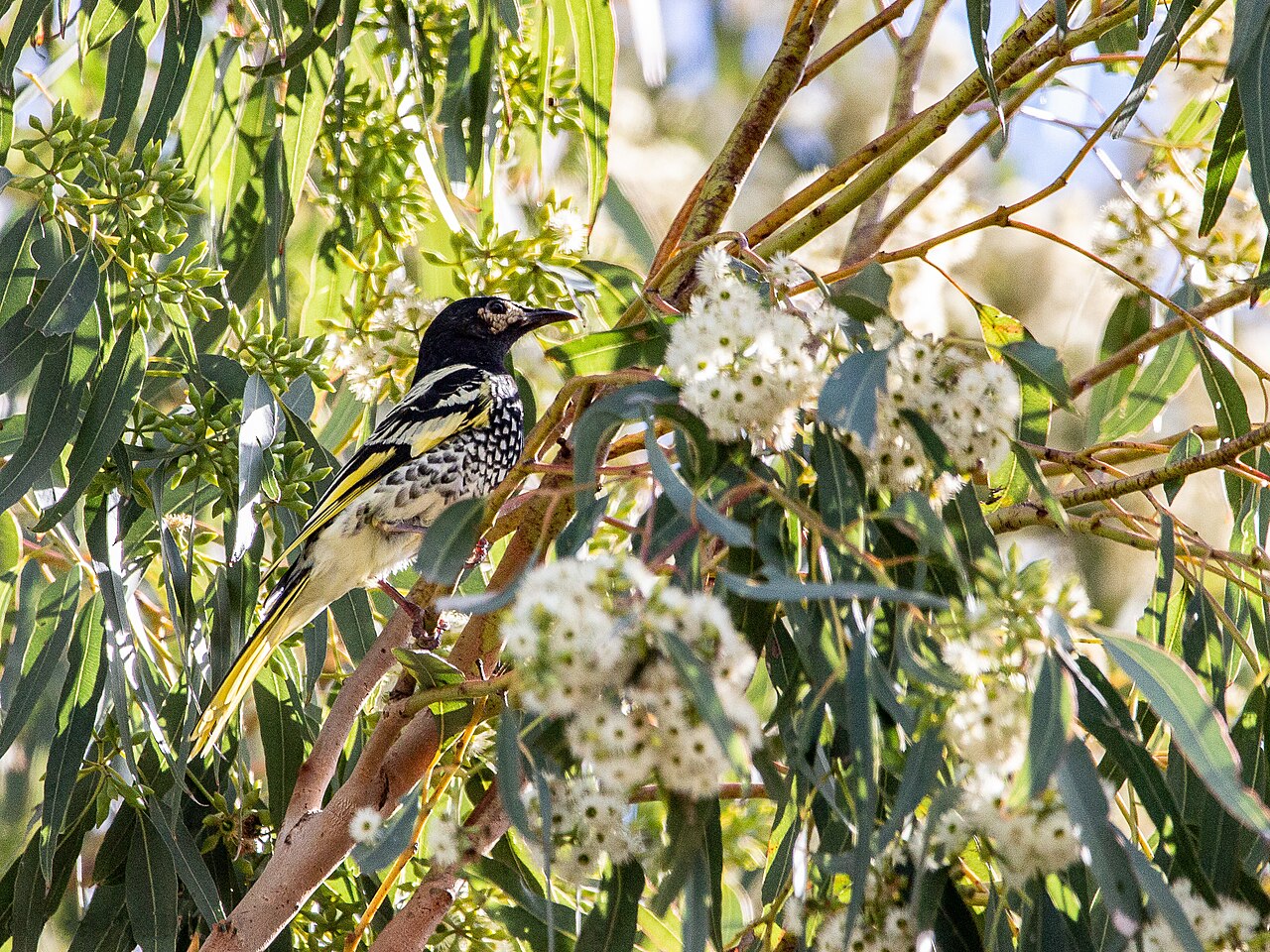
The Regent Honeyeater is the most endangered honeyeater in Australia: a black bird with a lemon-yellow back, yellow wing panels, yellow tail edges and underparts that shade from black to yellow in a finely scaled pattern. A block of warty, yellowish skin surrounds the eye. Fewer than two hundred and fifty of these birds are left in the wild.
Voice
A soft, flowing, slightly metallic phrase of a few bell-like, chiming notes, far less raucous than the other wattlebirds. In this species the voice has become a story in itself: with so few adult males left, young birds can no longer find one of their own kind to learn from, and some of them now sing the songs of other honeyeaters. Researchers from the Australian National University and Taronga Zoo have therefore taught young males in captivity the original species song, using recordings and just two wild-born tutors — a rescue operation for a song.
Recording: Ross Crates — CC BY-NC-SA 4.0 · Capertee National Park, New South Wales, Australia · xeno-canto
Identification
A medium-sized honeyeater of twenty to twenty-four centimetres and just over forty grams, with a slightly decurved black bill. Head, neck and upper breast are black; the back and the underparts are pale lemon-yellow with every feather black-edged, so that breast and belly look scaled. The black wing carries a broad yellow panel and the black tail broad yellow edges, both brilliant in flight. In the male an extensive field of warty, pale yellow bare skin surrounds the eye; the female is smaller, with less black on the throat and a smaller skin patch. Juveniles are duller and browner, with a yellowish-brown lower mandible.
Confusion species
It resembles no other wattlebird: Red Wattlebird (Anthochaera carunculata), Yellow Wattlebird (Anthochaera paradoxa), Little Wattlebird (Anthochaera chrysoptera) and Western Wattlebird (Anthochaera lunulata) are all much larger, grey-brown and streaked rather than black-and-yellow scaled. The real trap is White-fronted Honeyeater (Purnella albifrons), which is smaller and likewise gives a dark, streaked impression, but lacks the warty yellow eye patch and the yellow tail edges and has a white forehead. At a distance a young Red Wattlebird can briefly confuse; it is still larger, longer-tailed and has no yellow in the wing. Every report of this species deserves a photograph — it is so rare that a misidentification is likelier than the bird.
Habitat
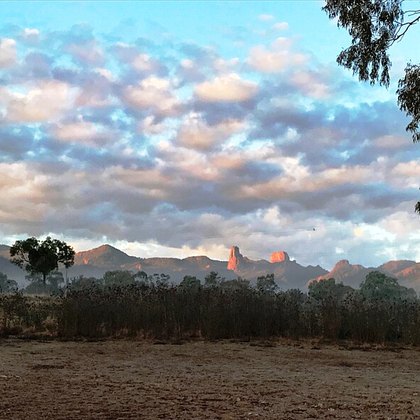
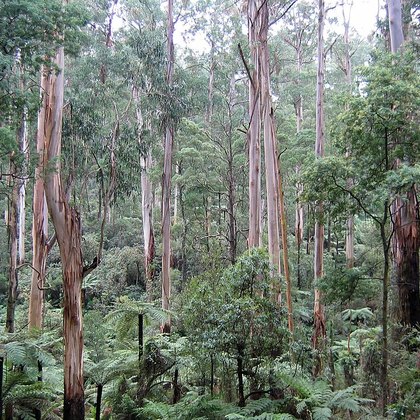
Dry eucalypt forest and open woodland on the western slopes of the Great Dividing Range, with a strong preference for box-ironbark woodland (dry eucalypt forest of box and ironbark species) and for the riverine forests of river oak and river red gum along the creeks. It follows the nectar of a handful of key trees — yellow box, white box, mugga ironbark (eucalypt with deeply furrowed, hard bark), spotted gum — and of mistletoes, and is strongly nomadic as a result: one year it breeds in the Capertee Valley, the next hundreds of kilometres away, depending on where the blossom is.
Where the bird is most often found, arranged by main group and formation.

Range and movements
Formerly from Rockhampton in Queensland to Adelaide in South Australia; now only a handful of core areas in New South Wales and north-eastern Victoria — chiefly the Capertee Valley, the Lower Hunter Valley, the Bundarra-Barraba district and the country round Chiltern. Beyond those, wanderers appear irregularly as far as the southern Queensland coast. The range has not only contracted but broken apart, which makes it hard for the few remaining birds to find one another.
- Resident
- Breeding (summer)
- Winter
- dark = core range, pale = thinly spread
Where and when to look
Do not look at random, look at the blossom: from August to October at flowering ironbark and yellow box in the Capertee Valley or around Chiltern, and watch mistletoes, which draw it outside the eucalypt flowering. Work through every busy party of honeyeaters at a flowering tree for yellow in the wing and the tail. If you find one, report it — with this species every record counts towards the recovery programme.
Conservation
Critically Endangered (CR) on the IUCN Red List and under Australia's EPBC Act, and by Australian assessments one of the ten native birds most likely to go extinct. Fewer than two hundred and fifty birds remain in the wild. The cause is first of all the wholesale loss of the box-ironbark and riverine woodland of the western slopes, which stood on precisely the fertile, level ground cleared first for farming; what survives is fragmented and impoverished. On top of that come competition for nectar with larger, aggressive honeyeaters in those remnants, nest predation, and the bushfires of 2019-2020, which struck much of the known breeding habitat. The recovery programme rests on three pillars: replanting nectar trees in the core areas, a captive-breeding programme at Taronga Zoo and Taronga Western Plains Zoo with releases in the Lower Hunter Valley and near Chiltern among others, and — most unusually — the restoration of the song culture, because the zoo population has become the last repository of the original species song. After that tutoring programme more than half of the zoo-bred males again sing the old wild song variant.
Scientific name
Anthochaera phrygia | (Shaw, 1794)
George Shaw described the species in 1794 as Merops phrygius, placing it with the bee-eaters; because it has since moved, author and date stand in parentheses. phrygia refers to Phrygia in Asia Minor, whose people were famed in antiquity for embroidery shot through with gold — exactly the image the black-and-yellow scaled plumage calls up. The species long stood in a genus of its own, Xanthomyza ('yellow sucker'); a molecular study in 2004 placed it with the wattlebirds, Anthochaera, a name built from Greek anthos, flower, and khairo, to enjoy. In English it was formerly the warty-faced honeyeater, after the bare skin round the eye; the present name regent honeyeater and the Dutch 'geschubde' both point at the regal, embroidered dress.