All species › Passerines › Honeyeaters › New Zealand Bellbird
New Zealand Bellbird | Anthornis melanura
Maoribelhoningvogel | Mielero maorí
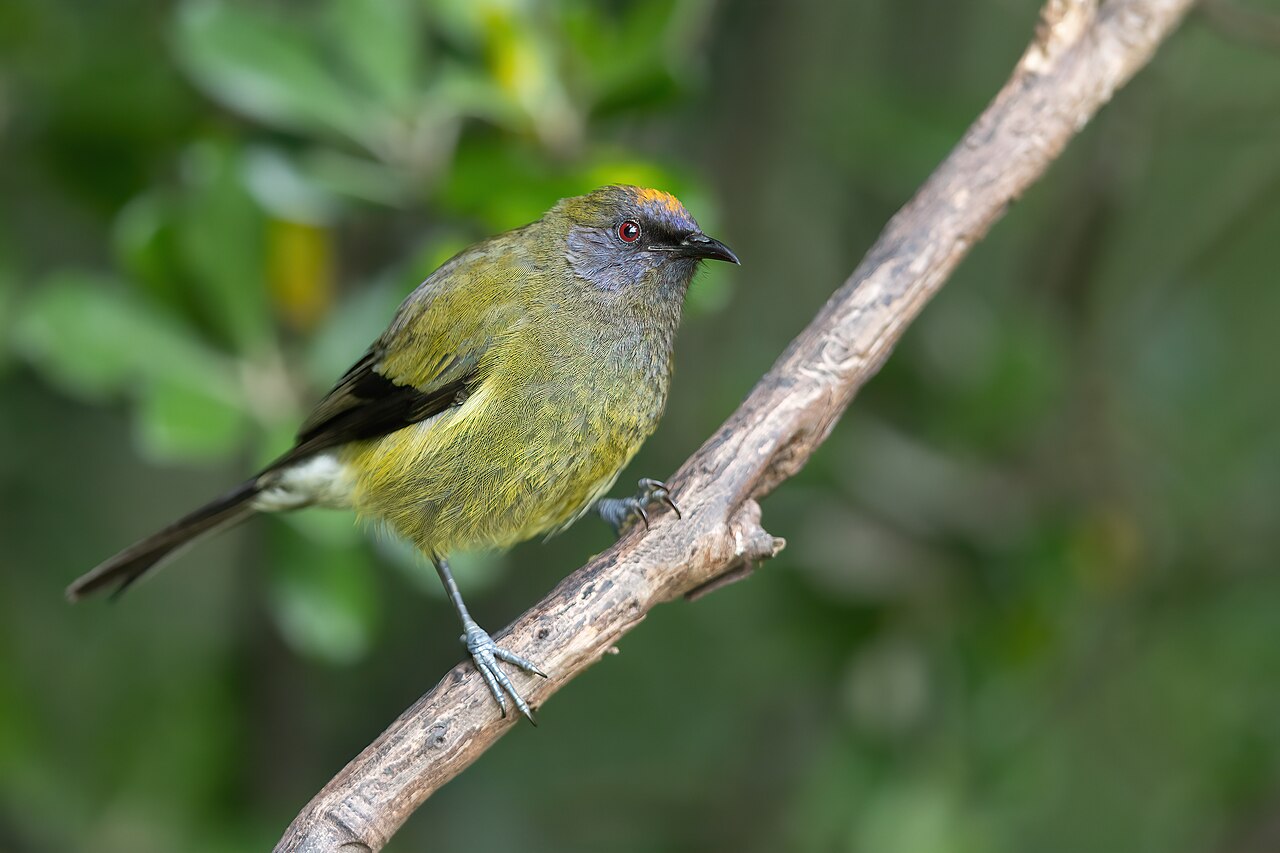
The New Zealand Bellbird, or korimako, is the voice of the New Zealand bush: a compact, olive-green honeyeater of twenty centimetres with a red eye, a short curved bill and a forked tail, which lets fall a run of clear, chiming notes at first light. It was this sound that James Cook's crew described in 1770 as 'small bells most exquisitely tuned' — a dawn chorus Cook called the most melodious he had ever heard.
Voice
Clear, ringing, metallic notes without the grunts, creaks and wheezes that break up the song of the Tui: that is the simplest way to tell the two apart. The song consists of short runs of two to five pure tones, often alternated with a sharp tink as a contact or alarm note. Strikingly, the song differs from district to district: every population has its own dialect, and on remote islands the birds sound audibly unlike those on the mainland. Females sing too, a little softer and slower than the males.
No freely licensed recording has been found for this species yet; what to listen for is described below.
Identification
A medium-sized, stocky honeyeater of twenty centimetres, with a short, slightly decurved black bill, grey legs, a red eye and a clearly forked tail. The male is olive-green with a dark, purple-glossed head and black wings and tail. The female is browner and duller, with a bluish sheen on the head and — the handiest mark — a narrow white-yellow stripe across the cheek, running back and down from the base of the bill. Juveniles resemble the female but have a brown eye and a yellow cheek stripe. The flight is fast and direct with an audible whirr of wings; in the tree it moves restlessly and often hangs upside down at a flower.
Confusion species
The great confusion is Tui (Prosthemadera novaeseelandiae), which shares the same forest and also drinks nectar: at thirty centimetres it is much larger and heavier, glossed blue-black rather than olive-green, and carries two white throat tufts. In song the Tui is given away by its coughing, rattling and grating interpolations; this species' chiming notes are pure and unbroken. The dull female is sometimes taken by beginners for a Silvereye (Zosterops lateralis), but that bird is much smaller, has a white eye-ring and lacks the forked tail and the red eye. The related Chatham Islands Bellbird (Anthornis melanocephala) was larger and dark-headed, but went extinct early in the twentieth century.
Habitat
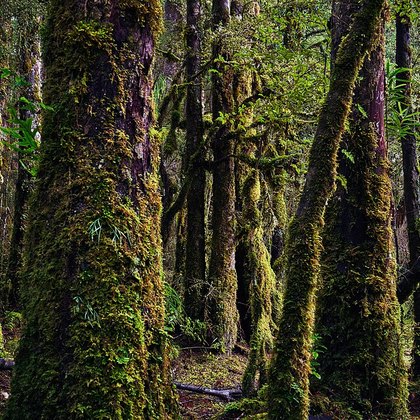
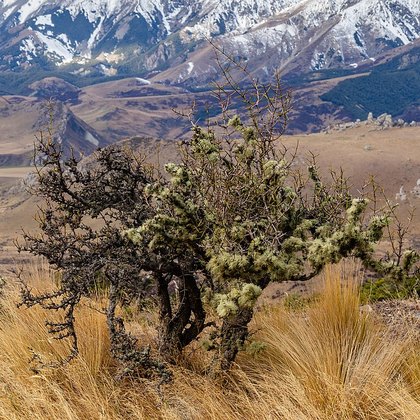
Native forest of every kind: southern beech forest, podocarp-broadleaf forest, kauri forest and the shrub layer beneath them, plus manuka and kanuka scrub and regenerating shrubland. It is not fussy so long as there are flowers and fruit, and so turns up in gardens, town parks and exotic plantations as well, especially where kowhai, flax, fuchsia and, later in the season, berry-bearing shrubs grow. In the mountains it goes up to the treeline.
Where the bird is most often found, arranged by main group and formation.


Range and movements
Endemic to New Zealand. On the South Island it is the most widespread and familiar honeyeater, present almost everywhere there is forest, with a gap across the cleared Canterbury Plains; on the North Island it is common south of the Waikato but scarce north of it and virtually absent from Northland. It also occurs on Stewart Island, the Auckland Islands and many offshore islands. Three subspecies are recognised: the widespread melanura, the form oneho of Manawatawhi/Three Kings and the form obscura of the Poor Knights. It shifts with the flowering, from the coast into the mountain forest and back.
- Resident
- dark = core range, pale = thinly spread
Where and when to look
Stand in a piece of New Zealand bush or a garden with kowhai at sunrise and listen: the unbroken, purely chiming phrase is this bird, the chiming with creaks and coughs between is Tui. If all you get is a silhouette, look at the tail — the fork is obvious on a bellbird and absent on a Tui. On a predator-free island such as Tiritiri Matangi or Ulva Island the densities are so high that you can hardly miss it.
Conservation
Least Concern (LC) internationally and 'Not Threatened' in the New Zealand system; the two island subspecies do rank as At Risk, Naturally Uncommon, simply because they sit on a few square kilometres. That is a calmer picture than the nineteenth century promised: between about 1860 and 1900 the population collapsed, beginning in the north, and in many places the bird disappeared altogether. The cause has never been fully settled, but the ship rat is named as the chief suspect. From about 1910 the species largely recovered on the mainland, although it never returned to Northland or the Canterbury Plains. Predator control and predator-free islands now carry the densest populations, and in managed areas it is increasing.
Scientific name
Anthornis melanura | (Sparrman, 1786)
Anders Sparrman described the species in 1786 as Certhia melanura, from material of Cook's second voyage; because it later moved to a genus of its own, author and date stand in parentheses. melanura is Greek for 'black-tailed', from melas, black, and oura, tail. The genus Anthornis was erected in 1840 by George Robert Gray, from anthos, flower, and ornis, bird: the flower bird. In Maori it is korimako, komako or makomako, and the Dutch and English names both refer to the bell-like voice. The proverb me te korimako e ko ana — 'like the singing korimako' — is used of someone eloquent.