All species › Passerines › Honeyeaters › Gibberbird
Gibberbird | Ashbyia lovensis
Woestijnschijnpaapje | Eptianuro de ashby
The Gibberbird is the bird of the gibber: the endless plains of wind- and sun-polished pebbles in the heart of arid Australia, where hardly a shrub stands upright. It is yellow from forehead to vent, grey on the crown, and has a bright yellow eye that is unmistakable at close range. Of all honeyeaters this is the most terrestrial: it walks, forages, rests and nests almost entirely on the ground, and flies only when you are nearly on top of it. In carriage and gait it suggests a pipit rather than a honeyeater.

Voice
A soft, musical chatter that barely carries across the open plain: a squeaky weet-weet-weet used mainly in pair bonding. More conspicuous is the display flight, in which the bird climbs steeply while uttering a sharp whit-whit-whit or a clear tswee-tswee-tswee, then glides back down on spread wings. The alarm call is five or six high, piercing notes; on that sound the surrounding birds drop away among the pebbles and the saltbush.
No freely licensed recording has been found for this species yet; what to listen for is described below.
Identification
A small bird of twelve and a half to thirteen centimetres, long-legged, upright in stance, with a short, pointed, dark brown to black bill. Forehead, face and the whole of the underparts are yellow, the crown grey, the back and rump grey-brown to blackish-brown. The legs are grey-brown. The best feature is the iris: bright, almost lemon yellow, which separates it from every relative. Male and female are barely distinguishable; the female is duller, somewhat browner on throat and neck and more heavily marked on the breast. Juveniles are brown on back, crown and wings, with a pale yellow throat. In the field it is the behaviour that stands out: short, quick runs over the bare stones, the bird drawing itself upright each time to look around.
Confusion species
The Yellow Chat (Epthianura crocea) is the only real pitfall: it too is yellow below, but lives in reeds, samphire and scrub beside water rather than on open gibber, shows a black breast band in the male, and lacks the bright yellow eye. The Orange Chat (Epthianura aurifrons) in female and immature plumage is also washed yellow, but those birds are pale sandy below rather than clean yellow and keep to the shrub layer. The genus Ashbyia sits close to Epthianura — both were once placed together in a family of their own, the Epthianuridae, and are now regarded as aberrant honeyeaters — so any small yellow bird of the interior should be checked against both genera. The walking habit also recalls the pipits (Anthus), but those are streaked brown and show no yellow at all.
Habitat
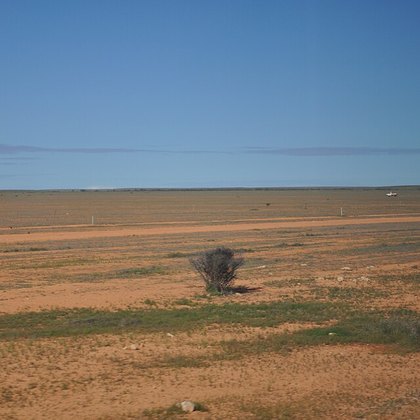
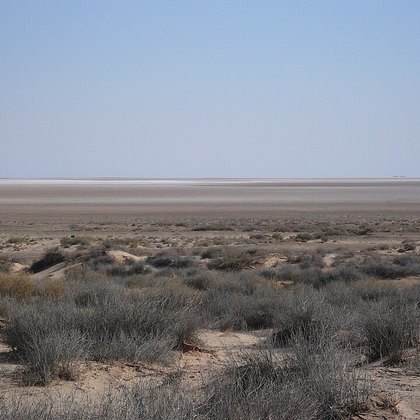
Gibber plain: flat, stone-hard country carpeted with tightly packed, polished silcrete pebbles, with widely spaced tussocks of Astrebla and Enneapogon grass and low chenopod shrubs such as Sclerolaena and Atriplex between them. The core is the Kati Thanda-Lake Eyre basin. It eats almost nothing but invertebrates — spiders, caterpillars, moths, cicadas and grasshoppers — picked from the ground while walking, and it turns over clods of clay with the bill to get at them; occasionally it takes an insect in a short flight up to about a metre. The nest is a cup in a scrape in the ground, in the lee of a saltbush or grass tussock, sometimes with several pairs within a hundred metres of one another.
Where the bird is most often found, arranged by main group and formation.


Range and movements
Endemic to Australia, and there only to the arid heart: south-eastern Northern Territory, south-western Queensland, north-western New South Wales and north-eastern South Australia. The stronghold is the gibber country around Kati Thanda-Lake Eyre and the Sturt Stony Desert. The species is resident with no demonstrated migration; in drought, or conversely after flooding, it shifts locally in search of food. With rather more than a thousand Australian records in ten years this is one of the least-reported land birds in the guide — not because it is rare, but because so few people go where it lives. It does not occur in New Zealand.
- Resident
- Winter
- dark = core range, pale = thinly spread
Where and when to look
You find it from the road. Drive the Birdsville, Strzelecki or Oodnadatta Track early in the morning and run your eye over the stone field rather than the horizon: the yellow belly of an upright bird lights up against the grey-brown gravel. It runs away instead of flying, so anyone who does not stop will not see it. Stay in the car — it is the best hide the gibber offers — and check the iris once the bird comes close: bright yellow rules out every chat of the genus Epthianura at once.
Conservation
Not threatened (LC). The range is small and lies almost wholly within a single arid basin, but within it the species is common and there is no evidence of decline. There are indications that it has benefited locally from pastoralism, the trampled ground and the stock themselves yielding more insect larvae. The main uncertainty is climate: a habitat that lives off the extremes of drought and flood changes with the rainfall regime of the interior.
Scientific name
Ashbyia lovensis | (Ashby, 1911)
Edwin Ashby described the bird in 1911 as Ephthianura lovensis, with Leigh Creek in South Australia as the type locality; author and year therefore stand in parentheses. In that same year the separate genus Ashbyia was erected for it, named after Ashby himself, a South Australian businessman and ornithologist. The epithet lovensis honours the Irish missionary James Love (1889–1947). The English name Gibberbird comes from 'gibber', the Australian word for the polished desert pebble, and so says everything about the habitat; the Dutch name woestijnschijnpaapje does the same while placing the bird among the chats, the group Epthianura to which it is most closely related. The species is the only one in its genus and has no subspecies.