All species › Passerines › Whipbirds and wedgebills › Western Whipbird
Western Whipbird | Psophodes nigrogularis
Grijskopzwiepfluiter | Zordala crestada occidental
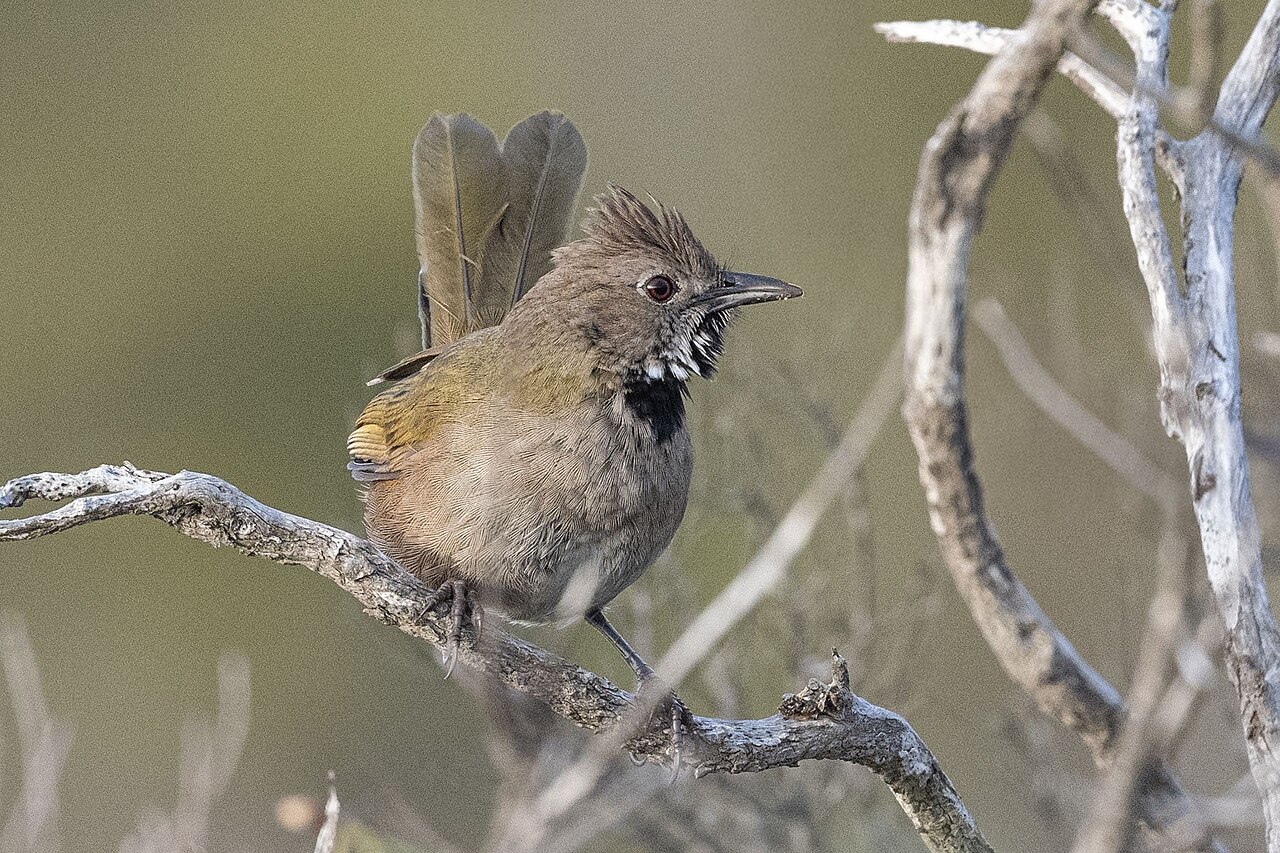
The Western Whipbird is the whipbird of the dense low scrub of southern Australia, and is rarely seen. It is olive-green above with a grey head and a black throat edged by a white stripe, but you will seldom see that: the bird stays inside dense vegetation and moves on foot. In practice the call is the only thing you record it by, and it is unmistakable.
Voice
This is the key to the species and almost the only one. A pair sings in duet: the male opens with a series of grating, creaking, almost mechanical notes to which the female adds a short ending, so tightly joined that it sounds like one bird. Australian observers render it as it's-for-teacher or pick-me-up. It is emphatically not the whipcrack of the Eastern Whipbird (Psophodes olivaceus): there is no whipped-up, exploding flourish in it, but a rasping, scraping quality. The birds sing chiefly in the early morning and are often entirely silent outside those hours.
Recording: Louis Masarei — CC BY-NC-SA 4.0 · Arpenteur Nature Reserve, Cheynes Beach, Western Australia, Australia · xeno-canto
Identification
Twenty-one to twenty-five centimetres, more than half of it tail. The upperparts are dull olive-green, the head grey with a short, often flattened crest, and the throat black with a narrow white malar stripe on each side that outlines the black bib sharply. The rest of the underparts are dull grey, the long tail dark with white tips. The bill is short and black. It almost never flies in clear view and moves by hopping and running through the lowest thirty centimetres of the scrub; whoever does see it usually sees a grey tail disappearing into a bush.
Confusion species
Eastern Whipbird (Psophodes olivaceus) is the direct counterpart but lives on the east coast, in moist forest and rainforest edge, and has a black crested head rather than a grey one — besides which its call is an explosive whipcrack impossible to confuse with the creaking duet of this species. The two inland wedgebills, Chiming Wedgebill (Psophodes occidentalis) and Chirruping Wedgebill (Psophodes cristatus), are plain greyish brown with a pointed crest, lack the black throat and the olive-green, and live in far more open, drier scrub. Confusion with any honeyeater or scrubwren of the same thicket is settled by the call. In practice the problem with this species is not which bird it is, but whether you get to see it at all.
Habitat
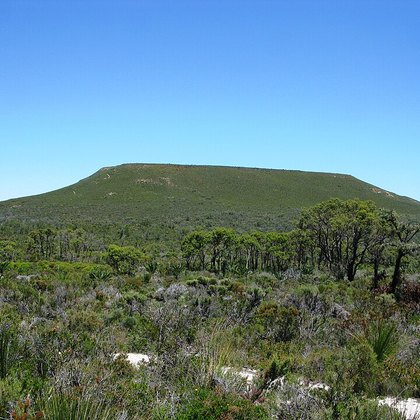
Dense, low, unbroken scrub on poor sandy soil: mallee (low, multi-stemmed eucalypt scrub of dry southern Australia) heath, the kwongan (species-rich heath-like scrub of south-western Australia) heath of the south coast of Western Australia, and coastal dune thicket. What counts is the structure, not the plant species — it needs a closed shrub layer to move about on and just above the ground, and it leaves as soon as that layer opens up. Scrub too soon after a fire is too thin; scrub very long unburnt can also become too thin. The species therefore hangs on a narrow band in time between two fires. It eats insects and other small invertebrates from the ground and the litter, and nests low in dense bushes.
Where the bird is most often found, arranged by main group and formation.

Range and movements
Scattered across southern Australia, but in strongly separated blocks: the south coast and south-west of Western Australia, with well-known sites such as Two Peoples Bay, the Stirling Range and the Fitzgerald River country, and further east isolated populations in the mallee-heath of South Australia and north-western Victoria. Between those blocks lies cleared or too open land that the bird will not cross. It is sedentary in the strictest sense and stays in the same block of scrub for life.
- Resident
- dark = core range, pale = thinly spread
Where and when to look
Go by ear and let go of looking. Be at a block of dense, long-unburnt mallee scrub or heath at first light, stand still and wait for the duet; that is the record. Anyone who also wants a sighting must keep patiently to a track or firebreak where the edge of the scrub is a little more open, and hope a bird crosses briefly. Walking into the thicket does not pay: the bird runs away faster than you get in, and you damage the vegetation it depends on. Always note the place — with a range this fragmented, that is the most valuable part of the record.
Conservation
The IUCN Red List currently places the species in Least Concern (LC), but that category only half covers the real situation. The range is severely fragmented: a series of scrub blocks cut off from one another among cleared cropping country, holding populations that cannot reach each other. Several of those subpopulations are listed as threatened nationally or by state within Australia. The threat is known and always the same: one fire too large or too early can make a whole block uninhabitable at a stroke, while the bird neither leaves it nor can recolonise it from another block. Feral cats and foxes play a part, as does cropping extended to the very edge of the remaining scrub. The species has besides long been understood as a set of strongly isolated populations, and some world lists split the eastern birds off as a separate species; the list this guide follows keeps them together.
Scientific name
Psophodes nigrogularis | Gould, 1844
Gould described the species in 1844 in The Birds of Australia, from material in Western Australia. The specific name nigrogularis is Latin for black-throated, after the black bib. Psophodes is formed from Greek psophos (sound, noise) and the ending -odes (resembling), and so says exactly what there is to notice about these birds: you hear them. The Dutch name cites the grey head that separates it from the black-headed eastern species; the English name cites only its position in the west, which does not hold for the eastern subpopulations.