All species › Passerines › Whipbirds and wedgebills › Chiming Wedgebill
Chiming Wedgebill | Psophodes occidentalis
Klokraltimalia | Zordala picocuña occidental
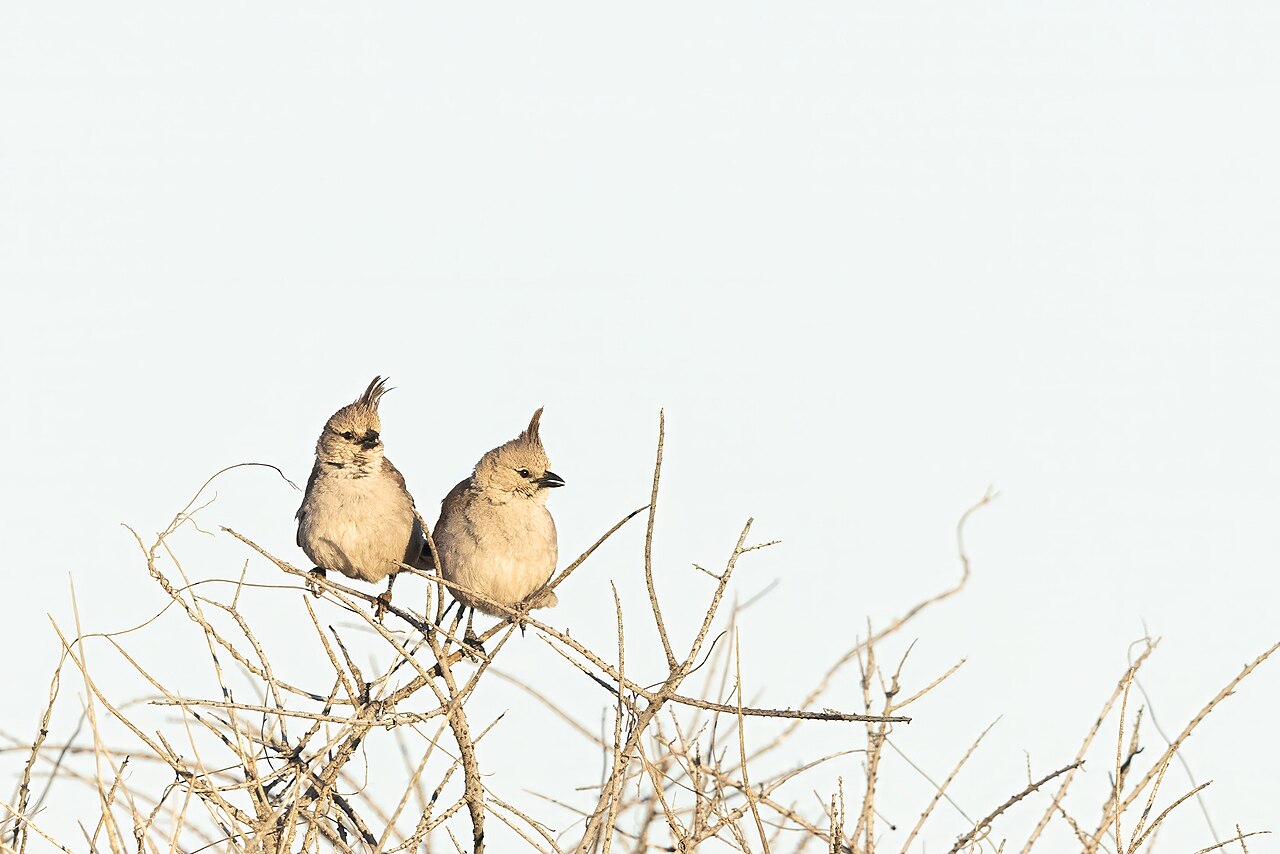
The Chiming Wedgebill is the wedgebill of the dry western and central interior: a plain greyish brown bird with a pointed, upstanding crest and a long tail, living in the acacia scrub of the desert margins. In appearance it is all but inseparable from the Chirruping Wedgebill (Psophodes cristatus); the two were not recognised as separate species until 1973, and then on song. Song is accordingly the only thing that identifies it.
Voice
The decisive character. The song is a series of clear, chiming, bell-like notes that run down and slow like a falling scale — often rendered did-he-get-drunk, or likened to a bicycle bell running out. It sounds melodious and sweet, and the bird may keep at it for hours, through the middle of the day and even at night under a full moon. That is the difference from the Chirruping Wedgebill, which delivers a shorter, faster, stuttering and much thinner tu-whit-tu-whee without that falling chiming cadence. Anyone who has once heard the two songs side by side will not confuse them again; anyone who only sees the bird cannot settle it.
No freely licensed recording has been found for this species yet; what to listen for is described below.
Identification
Nineteen to twenty-two centimetres, much of it the long tail. The whole plumage is plain greyish brown, a little darker above and paler below, with vague light markings on throat and breast. The most conspicuous character is the narrow, pointed crest standing upright on the head, which makes the silhouette recognisable at once. The tail is long and slim, with narrow white tips that show in flight and on landing. The bill is short and black, the eye dark. The bird moves low and fast through the scrub and would rather run than fly.
Confusion species
Chirruping Wedgebill (Psophodes cristatus) is the whole problem, and it is an honest one: the two cannot be told apart with certainty in the field on appearance. Chirruping Wedgebill is reported to be a little more finely streaked on throat and breast and to have a slightly shorter tail, but that difference cannot be made to hold on a moving bird in the shade of a bush. Use song, and as a second hold the range: this species lives in the west and centre — the Pilbara, the Murchison, the Goldfields and east to north-western South Australia and south-western Queensland — and the Chirruping Wedgebill in the eastern dry interior. In the narrow country where the two ranges approach, only song is proof. Western Whipbird (Psophodes nigrogularis) shares the genus but is olive-green with a black throat and lives in dense low scrub in the south.
Habitat
Dry interior country with tall acacia scrub: mulga and other acacia thickets, particularly along dry creek beds and on the transition to spinifex plains, and any low scrub dense enough to shelter in. It likes ground with structure — a shrub layer of one and a half to three metres — and is absent from bare gibber plains and from closed forest. It forages on the ground and in the lowest branches, on insects and seeds, and stays almost always within reach of cover. It lives in pairs or loose parties and builds an open cup nest low in a bush.
Where the bird is most often found, arranged by main group and formation.


Range and movements
The west and centre of the dry interior: from the Pilbara and the Murchison in Western Australia south to the Kalgoorlie country, and east across north-western South Australia into south-western Queensland. Within that vast range it is locally common where the acacia scrub is dense enough, and absent from the open plains between. It is sedentary, though numbers shift with the vegetation in dry years. In the east its range meets that of the Chirruping Wedgebill, the two largely avoiding each other.
- Resident
- dark = core range, pale = thinly spread
Where and when to look
Identify by ear and take your time over it. Stop on an inland road where tall acacia scrub stands, switch the engine off and listen: the falling, chiming series carries far and is repeated often, even in the middle of the day when the rest of the scrub is silent. Only then look. Always note the song with a record and not just the appearance — a wedgebill without a heard song is not a usable record in the overlap zone. A pointed crest and a long tail vanishing into a mulga bush are enough to settle the genus, not the species.
Conservation
Least Concern (LC). The range is enormous, lies largely in thinly settled and barely cleared interior, and within it the species is locally common. The sensitivity lies in the scrub: burning too often or too hot removes the shrub layer, and heavy grazing by stock, goats and camels does the same. Where the mulga stands, the bird stays. Feral cats are a factor where cover thins, but there is no sign of a nationwide decline.
Scientific name
Psophodes occidentalis | (Mathews, 1912)
Mathews described this bird in 1912 as a subspecies, Sphenostoma cristatum occidentale, from material at Day Dawn in Western Australia; the specific name is Latin for western. Only in 1973 was it separated from the Chirruping Wedgebill as a full species, on song. Psophodes is formed from Greek psophos (sound) and -odes (resembling). The Dutch name and the English name Chiming Wedgebill both cite the chiming quality of the song, and the English name besides the wedge-shaped bill that gave the old genus Sphenostoma its name.