All species › Passerines › Whipbirds and wedgebills › Eastern Whipbird
Eastern Whipbird | Psophodes olivaceus
Zwartkopzwiepfluiter | Zordala crestada oriental
The Eastern Whipbird makes the best-known sound of the Australian rainforest: the whipcrack everyone knows and almost nobody has watched being made. It belongs to the whipbirds and wedgebills, an Australian family of long-tailed, crested songbirds of dense undergrowth. It is numerous and loud and yet seldom seen.

Voice
The whipcrack is a duet and not a solo: the male begins with a long, swelling whistled note ending in a short, cutting snap — the whip — and the female answers at once with two short notes, choo-choo. The answer comes so fast that the whole sounds like one bird, and that is why birders hear one bird in it for years. Anyone who attends to it notices that the two parts come from different directions, sometimes tens of metres apart. Both birds also give a sharp, short chek by which they follow one another in the undergrowth. The duet is heard all year and loudest in the first hour after sunrise.
No freely licensed recording has been found for this species yet; what to listen for is described below.
Identification
Twenty-six to thirty centimetres, more than half of it tail; a slender bird with short, rounded wings that flies little. Head, crest and breast are black, with a large, sharply bounded white cheek patch; back, wings and the long tail are dark olive-green, the tail tipped white. The belly is grey-white, turning olive towards the flanks. Male and female are near-identical; the female is slightly smaller and has a smaller crest. Young birds lack the white cheek patch and have a browner head, so they look much duller.
Confusion species
In the eastern rainforest there is no other bird with a black head, a white cheek patch and a long olive-green tail. The western relative Psophodes nigrogularis lives in the heath of the south and south-west, lacks the extensive black on the breast and has a much smaller white face patch. The wedgebills of the interior are grey-brown and keep to open, dry country. Confusion arises mainly by ear: the female's part of the duet, heard without the whip, is put down to another species.
Habitat
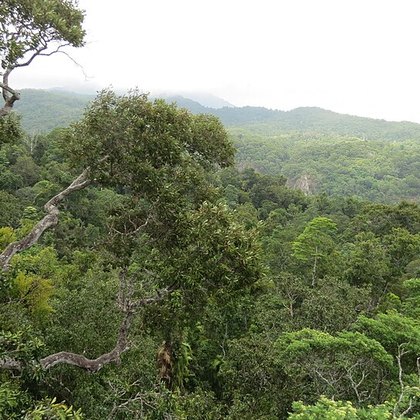
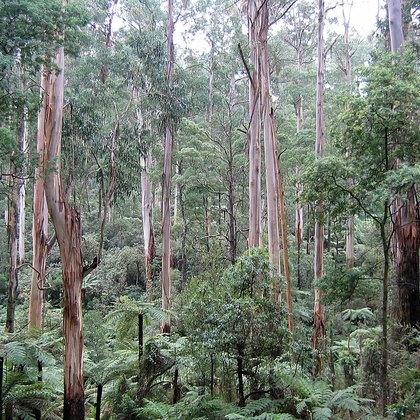
Rainforest and wet eucalypt forest with a dense shrub layer, and thick scrub along creeks and in gullies; always where the lowest two metres are impenetrable. Also drier forest with a dense understorey, and gardens and parks on the edge of Sydney and Brisbane where the planting is forest-like. The bird forages on the ground in the litter and rarely climbs more than a few metres. Open forest without an understorey is useless to it, however large.
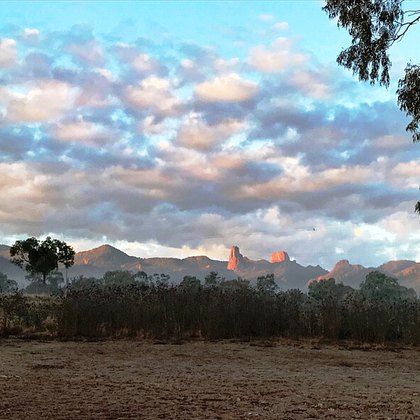
Where the bird is most often found, arranged by main group and formation.

Range and movements
Along the east coast of Australia, from eastern Victoria north into central Queensland, with a separate population in the wet tropics between Cooktown and Townsville. Resident in the strictest sense: a pair holds the same territory for years and defends it all year with the duet. The northern population is smaller and browner and is recognised as a subspecies of its own. The range has changed little; but the species has gone from suburbs where the understorey was cleared, and returned in restored creekside planting.
- Resident
- dark = core range, pale = thinly spread
Where and when to look
Stand where you hear the whipcrack and wait: the bird walks on the ground under cover and sooner or later crosses an opening. Do not move and look low, at ankle height between the stems. In the duet, note the direction the answer comes from — that is the female, and it tells you where the pair is. The best time is the first hour after sunrise, all year round.
Conservation
Not threatened and very common in suitable forest; with nearly three hundred thousand records in ten years it is one of the best-reported woodland birds of eastern Australia. The only real threat is the loss of the dense understorey, through clearing, through grazing and through tidying shrubbery in parks. Fires punch holes in the distribution, but the species returns as soon as the undergrowth closes again.
Scientific name
Psophodes olivaceus | (Latham, 1801)
John Latham described the bird in 1801 as Corvus olivaceus, among the crows; because the species was later moved to another genus, author and year stand in parentheses. Vigors and Horsfield introduced the genus Psophodes in 1827, from Greek psophōdēs ('noisy'), from psophos (sound, din). olivaceus is Latin for 'olive-coloured', after back and tail. The type locality is given as Australia and was later restricted to New South Wales.