All species › Passerines › Australasian bellbirds › Crested Bellbird
Crested Bellbird | Oreoica gutturalis
Kuifdikkop | Silbador campanillero
The Crested Bellbird is the voice of the dry interior: a loud, bell-like run of notes that comes from the left, then from the right, then from close by, while the bird has not moved. It belongs to the Australasian bellbirds, a small family of Australia and New Guinea. The ventriloquism of this species is notorious among inland birders.
Voice
The song is a run of four to six clear, bell-like notes, usually written as did-did did-did-dit, begun slowly and then accelerating. The bird throws its voice: the same run seems to come each time from another direction and another distance, so that a bird fifteen metres off is looked for a hundred metres away. What causes it has not been settled; the effect is that anyone going by the sound almost always ends up in the wrong place. There is also a hard, short chak when the bird is uneasy. Song is loudest from August to December and largely stops in the hottest months.
No freely licensed recording has been found for this species yet; what to listen for is described below.
Identification
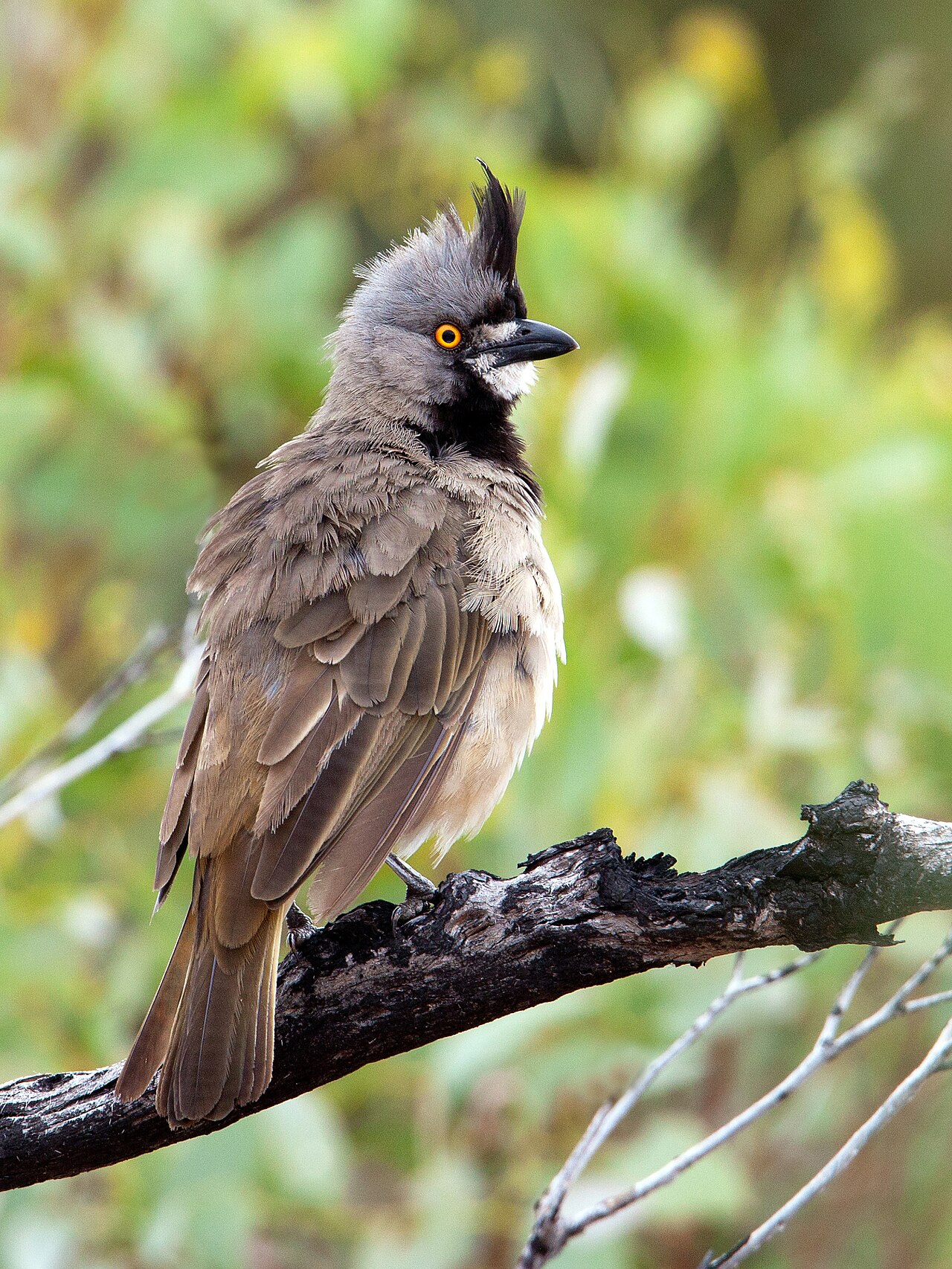
Nineteen to twenty-three centimetres: a compact songbird with a heavy head, a short tail and an orange-red iris that is striking at close range. The male has a grey head with a black, erectile crest running as a stripe over the crown, a white forehead and white throat, and below that a broad black breast band; back and belly are sandy brown to grey-brown. The female lacks the black breast band and has a smaller crest and a greyer head, so she is much duller. Young birds resemble the female but have a brown iris. The bird sits upright and still on a low branch and, once found, allows a long look.
Confusion species
The true whistlers of the genus Pachycephala in the same country have no crest and no orange-red iris. The female is taken for a female whistler or a young butcherbird; the heavy head, the short tail and the iris decide it. The Eastern Shriketit has a black-and-white striped head and works in trees, not on the ground. By ear confusion is impossible: no other bird of the interior makes this sound.
Habitat
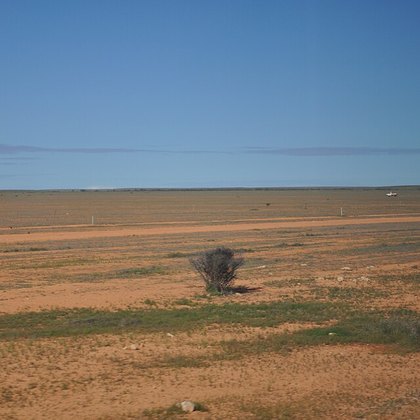
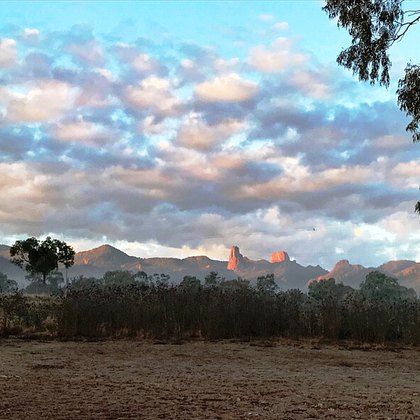
Mulga and other acacia scrub, mallee, dry eucalypt woodland, spinifex country and the saltbush plains of the interior. It forages on the ground and in low shrubs and needs open soil between the bushes for it. From semi-arid coasts to the heart of the desert, provided there are shrubs to nest in. It avoids closed forest and the humid east coast entirely.
Where the bird is most often found, arranged by main group and formation.




Range and movements
Across almost all of Australia west of the Great Dividing Range, from the west and south coasts into the south of tropical northern Australia; the far north and the wet east coast are missing. Resident over most of the range, but at the southern margin birds move north in winter, in June and July. In the south-east — Victoria and adjoining New South Wales — the species has gone from many districts during the twentieth century. Elsewhere it has stayed common, with well over forty thousand records in ten years.
- Resident
- dark = core range, pale = thinly spread
Where and when to look
Stop at a stand of mulga or mallee and switch the engine off; if the bird is there you will hear it within minutes. Do not follow the direction of the sound but work quietly along the low branches within twenty metres — it is closer than you think. The best months are August to December, at the start of the breeding season. If you find a nest, look at the rim from a distance: the bird lays caterpillars on it, and why has not been settled.
Conservation
Not threatened and common across the dry interior. In Victoria it does stand on that state's list of threatened species; there the scrub it lives in has largely been turned to crop and pasture. Grazing by sheep and cattle removes the low shrub layer, and that is everywhere the cause named for local disappearance.
Scientific name
Oreoica gutturalis | (Vigors & Horsfield, 1827)
Vigors and Horsfield described the bird in 1827 as Falcunculus gutturalis, among the shriketits; because the species was later moved to another genus, author and year stand in parentheses. Gould introduced the genus Oreoica in 1838, from Greek oreios ('of the mountains') and oikeō ('to dwell') — a name that sits badly on a bird of the plains. gutturalis is Latin for 'of the throat', after the black throat and breast of the male. The type locality reads 'Kent's Group' in Bass Strait, islands where the species does not occur; Hindwood examined that statement in 1942.