All species › Passerines › Shriketits › Eastern Shriketit
Eastern Shriketit | Falcunculus frontatus
Harlekijndikkop | Silbador cabezón
The Eastern Shriketit is known by its head: striped black and white, with a small crest that lies flat over the crown until the bird raises it. It belongs to a family all of whose species are Australian, set apart by a short, heavy bill hooked at the tip with which the bird tears bark off the trunk. Anyone in a eucalypt forest who hears pieces of bark coming down from somewhere overhead has found it.

Voice
A weak, mournful and mellow whistle, roughly whiert, whit-whit, wheeir, slow and with long pauses, and like the Crested Bellbird hard to place. There is also a repeated stuttering or chuckling rattle by which the pair follow one another in the canopy. The species mimics other forest birds too, though softly and in passing. The loudest sound it makes is not a call but the tearing of bark.
No freely licensed recording has been found for this species yet; what to listen for is described below.
Identification
Fifteen to nineteen centimetres, with a wingspan of twenty-four to twenty-nine; compact, with a short, thick, laterally compressed bill hooked at the tip. The head is black with two broad white bands, one above and one below the black eye-stripe, and carries a small crest that usually lies flat. The upperparts are olive-brown to olive-green, the underparts yellow. The male has a black throat, the female an olive-brown one; that is the only field character separating the sexes. Young birds have off-white underparts and browner wings.
Confusion species
There is no other Australian songbird with a black-and-white striped head and yellow underparts. AviList splits Falcunculus into three species: this eastern one, the western Falcunculus leucogaster of south-western Western Australia and the northern Falcunculus whitei of the Top End and the Kimberley; the three lie thousands of kilometres apart and nowhere overlap, so locality settles the identification. The whistlers of the genus Pachycephala have a plain head without stripes and a lighter bill. A bird tearing bark high in the canopy is, in the east, almost always this species.
Habitat
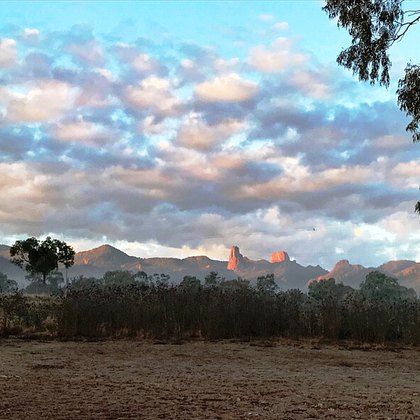
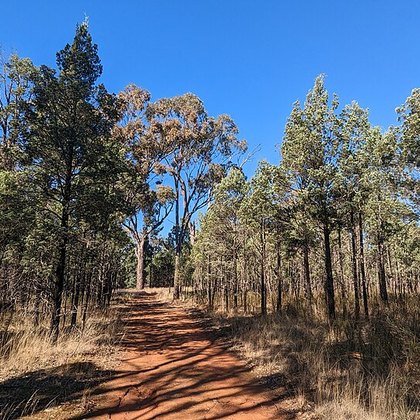
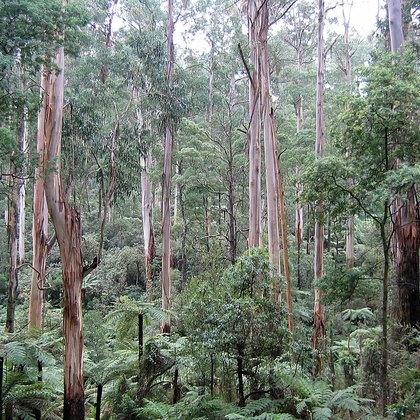
Eucalypt forest and open woodland, where it works the canopy; besides that mallee, callitris, coastal heath with tea-tree and banksia, and the trees along rivers in drier country. Rainforest is used as well, and sometimes parks, gardens and pine plantations with old trees. It feeds beneath loose bark and needs trees with flaking bark for it. It rarely comes on or near the ground.
Where the bird is most often found, arranged by main group and formation.



Range and movements
South-eastern Australia: from south-eastern South Australia through Victoria and eastern New South Wales into south-eastern Queensland, with scattered occurrences further north and west in Queensland. Resident, the pair staying together all year and working a large territory. Density is low everywhere: this is a species one looks for half a day and then sees twice in ten minutes. In the south-east it has declined where old forest with loose bark has been replaced by young growth.
- Resident
- dark = core range, pale = thinly spread
Where and when to look
Search with your ears and look up: the tearing of bark carries fifty metres and gives the bird away better than its whistle. Walk slowly beneath old eucalypts with flaking bark and watch for scraps of bark falling on the track. The pair works in silence and moves slowly, so once you have found the spot you have plenty of time. In the breeding season, from late August to early January, the birds are at the nest high in the crown of a young eucalypt.
Conservation
Not threatened, but everywhere at low density, so local decline is hard to establish. The species depends on old forest with loose, flaking bark; where that is cut or replaced by even-aged planting it disappears. The decline of canopy-feeding woodland birds in south-eastern Australia has been reported for decades, and this species belongs to it.
Scientific name
Falcunculus frontatus | (Latham, 1801)
John Latham described the bird in 1801 as Lanius frontatus, among the shrikes; because the species was later moved to another genus, author and year stand in parentheses. Vieillot introduced the genus Falcunculus in 1816, a diminutive of Latin falco ('falcon'), after the hooked bill. frontatus is Latin for 'having a forehead', after the striking pattern of forehead and head. The type locality reads 'Nova Hollandia' and was restricted by Mathews in 1923 to Sydney, New South Wales.