All species › Passerines › Shriketits › Western Shriketit
Western Shriketit | Falcunculus leucogaster
Westelijke harlekijndikkop | Silbador cabezón occidental
The Western Shriketit is the bird of the wandoo and salmon gum woodlands of south-western Australia: a stocky songbird with a boldly black-and-white striped head, a short crest and a heavy hooked bill with which it tears open the bark of eucalypt trunks. It is nowhere numerous, and in the settled parts of the wheatbelt it has become distinctly rare; it has been recognised as a species in its own right only recently. Its scientific name, 'white-bellied', points at the one character separating it from its eastern relatives: a paler, less yellow underside.

Voice
Slow, mournful whistles falling in pitch, usually in short series with long silences between, and a softer chattering or churring within a pair or family party. As with its relatives, though, the mechanical sound is the most useful: the crackling tear of loose bark pulled from a trunk or branch with the heavy bill. In the quiet, open wandoo woodland that sound carries well, and in practice it more often prompts you to look up than the song does. A party at work in a tree sends a rain of bark strips down to the forest floor; that too betrays their presence.
No freely licensed recording has been found for this species yet; what to listen for is described below.
Identification
A stocky songbird of about sixteen to nineteen centimetres with a large head, a short erectile crest and a deep, laterally compressed hooked bill remarkably heavy for a songbird of this size. The head is black with a broad white band across the face and a black eye-stripe, the back is olive-green and the wings are dark. The underparts are yellow, but in this species paler and whiter on belly and flanks than in eastern birds — the character from which the scientific name leucogaster is taken. The male has a black throat, the female an olive-green one; that is the only reliable sex character. The bird moves slowly and deliberately along trunks and thick branches, regularly hanging upside down, and prises strips of bark free with its bill.
Confusion species
Honesty is again in order: on appearance this species cannot be reliably separated from its closest relatives. The Eastern Shriketit (Falcunculus frontatus) of eastern and south-eastern Australia and the Northern Shriketit (Falcunculus whitei) of the tropical north were until recently treated as one species with this bird. The stated difference — a paler, whiter belly — is a matter of degree that varies within every population and can hardly be judged in the field without comparative material. Identification therefore rests almost entirely on range, and in this case that is very clear indeed: the south-western population is cut off from both the others by the whole arid interior of Western and South Australia, many hundreds of kilometres with no suitable woodland. A shriketit in the south-western corner is this species, full stop. At a distance the yellow underparts may still suggest an Australian Golden Whistler (Pachycephala pectoralis), but that bird has a plain head with no stripes or crest and a far finer bill.
Habitat
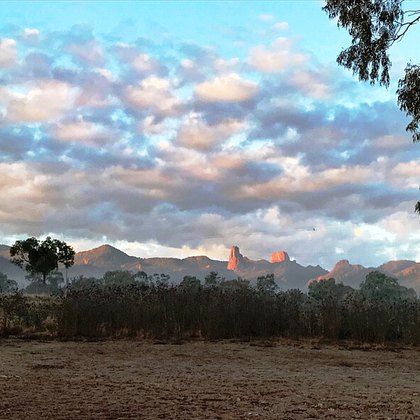
The dry eucalypt forest and woodland of south-western Australia, with the emphasis on the open woodlands of wandoo, salmon gum and related eucalypts, and beyond that mallee and the more heavily timbered strips in the transition towards the interior. The bird needs large, old trees with loose, flaking bark, because that is where its food is: it prises and tears the bark open and takes the insects, larvae, spiders and beetles beneath. It forages slowly and thoroughly, usually in pairs or small family parties working steadily from tree to tree. The nest is a deep, neat cup of bark fibre and grass finished with cobweb, built high in a vertical fork; the birds strip the surrounding twigs bare, leaving the nest standing clear in the tree.
Where the bird is most often found, arranged by main group and formation.

Range and movements
Endemic to south-western Australia and irregularly distributed within it: from the Avon Valley east of Perth south-east to about Hopetoun on the south coast, and additionally in the woodlands around Kalgoorlie in the eastern interior. The species is sedentary and does not leave its patch of woodland. Across the intervening wheatbelt, where the original woodland has largely been cleared, it has thinned drastically and in many places gone altogether, so that the present distribution consists of scattered strongholds in the larger remaining remnants and reserves. The species does not occur outside south-western Australia, nor in New Zealand.
- Resident
- dark = core range, pale = thinly spread
Where and when to look
Choose a large, old wandoo or salmon gum woodland — the reserves and state forests east and south-east of Perth are the classic places — and work slowly. Listen for the crackling tear of bark high in the trees and look at the ground: fresh, pale bark strips under a tree mean the birds have been working there recently. The species is quiet and slow and cannot be hurried; stay where you hear the sound and wait for the bird to come into view. Record the place carefully. Because the species has been pushed back onto scattered remnants in the wheatbelt and has only lately been recognised as a species in its own right, good records with locality and date are of real value here for understanding its distribution.
Conservation
The taxonomic list used here gives Least Concern (LC), but that category covers the south-western situation only in part. Its splitting-off as a separate species is recent, so an assessment looking at this population alone has still to follow, and the Australian position is clearly less favourable than the label suggests: the species has declined sharply in the south-western wheatbelt because the wandoo and salmon gum woodland there has largely been cleared for cropping, and it is now confined to scattered remnants and reserves. What it needs is not woodland in general but old woodland: large trees with thick, lifting bark provide both the food and the nest site, and those are precisely what young and regenerating woodland lacks. Keeping the remaining old wandoo woodlands, and the connections between them, is the heart of the matter for this species.
Scientific name
Falcunculus leucogaster | Gould, 1838
John Gould described the species in 1838 in his A synopsis of the birds of Australia; Gregory Mathews designated the Swan River in Western Australia as the type locality in 1923. Author and year stand without parentheses, because Gould placed the bird in Falcunculus at once and there it remains. The genus name is the Latin diminutive of falco, 'falcon', after the heavy hooked bill that looks strikingly raptorial on a songbird. The epithet leucogaster is formed from Greek leukos, 'white', and gaster, 'belly', and names exactly the character on which Gould separated the bird from eastern specimens: the paler, whiter underside. The English name Western Shriketit, the Dutch westelijke harlekijndikkop and the Spanish silbador cabezón occidental all choose the range, and that is the sensible choice, because with these three the position of the range is the only genuinely usable distinction. The harlequin of the Dutch name refers to the boldly black-and-white striped head.