All species › Passerines › Shriketits › Northern Shriketit
Northern Shriketit | Falcunculus whitei
Noordelijke harlekijndikkop | Silbador cabezón norteño
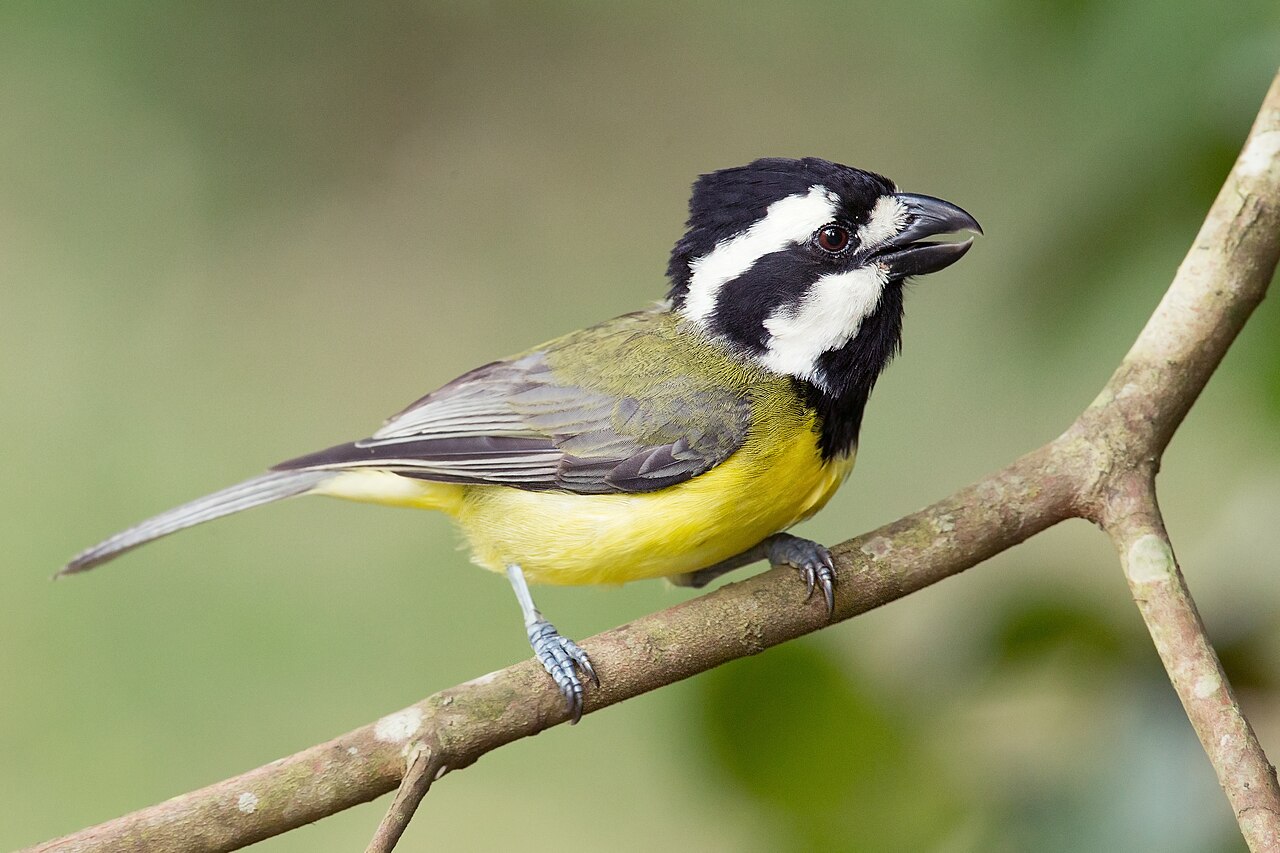
The Northern Shriketit is one of the least-observed songbirds in Australia: a bird with a boldly black-and-white striped head, a short crest and a heavy hooked bill, living somewhere in the eucalypt savanna of the Kimberley and the Top End and very seldom found there. Anyone wanting to see it should not look but listen — not for song, but for the crackle of bark being torn from a trunk. Until recently it was treated as one species together with the eastern and western birds, and that history still determines nearly everything we know about it.
Voice
Slow, mournful whistles falling in pitch, often in a series of three or four — a sound suggesting a whistler rather than a hook-billed shriketit — and alongside that a softer churring or chattering between members of a family party. At least as important is the sound the bird makes without its voice: with that heavy bill it tears strips of loose bark from eucalypt trunks and branches, and the crackling, rustling rip carries a fair distance. In a forest where nothing else is moving, that is often the first and only sign that a shriketit is at work.
No freely licensed recording has been found for this species yet; what to listen for is described below.
Identification
A stocky songbird of about sixteen to nineteen centimetres with a notably large head, a short erectile crest and a deep, laterally compressed hooked bill that would suit a shrike or a butcherbird rather than a songbird of this size. The head is boldly marked: black crown and crest, a broad white band across the face and a black eye-stripe, so that the whole reads in the field as a black-and-white striped head. The back is olive-green, the underparts yellow, the wings dark. The male has a black throat, the female an olive-green one — that is the only reliable sex character. Northern birds are held to be smaller, with a shorter crest and less extensive yellow below than eastern birds, but the differences are slight and overlapping. The bird climbs slowly and systematically along trunks and branches, often upside down, working methodically over the bark.
Confusion species
Complete honesty is called for here: this species cannot be reliably separated from its closest relatives on appearance. The Eastern Shriketit (Falcunculus frontatus) of eastern and south-eastern Australia and the Western Shriketit (Falcunculus leucogaster) of south-western Australia were until recently treated as one species with this bird, and the stated differences — size, crest length, amount of yellow below — are small, variable and not demonstrable in the field. What does settle the identification is geography: the three ranges nowhere meet and are separated by hundreds of kilometres of unsuitable country. This species is the bird of the Kimberley, the Top End and north-western Queensland; anyone seeing one in Victoria or near Perth is looking at a different species. At a distance the bird can also recall an Australian Golden Whistler (Pachycephala pectoralis) through its yellow underparts, but that species lacks the striped head, the crest and the heavy hooked bill entirely.
Habitat
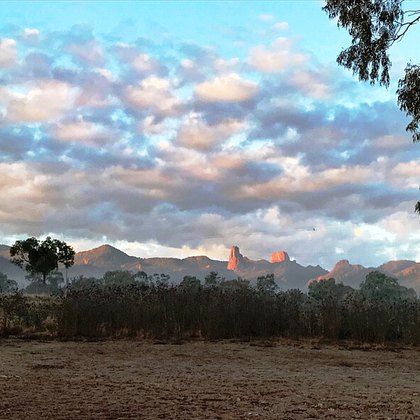
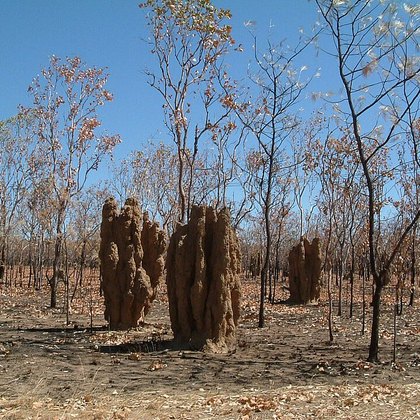
Tropical eucalypt savanna and dry eucalypt woodland of northern Australia, with a clear preference for the more heavily timbered strips: gallery woodland along creeks and rivers, the denser parts of the savanna and the edges of monsoon vine forest and vine thicket. The bird is a bark specialist: with its heavy bill it prises and tears bark from trunks and branches to reach the insects, larvae and spiders beneath, foraging slowly and thoroughly, usually in pairs or small family parties. The nest is a deep, neat cup of bark fibre and grass finished with cobweb, built high in a tree in a vertical fork, the birds stripping the surrounding twigs bare — a habit for which the genus is known.
Where the bird is most often found, arranged by main group and formation.


Range and movements
Confined to north-western and northern Australia: the Kimberley in northern Western Australia, east through the Top End of the Northern Territory into north-western Queensland. Within that area the species is exceedingly thinly and irregularly distributed; there are districts of apparently suitable woodland where no record is made for years at a time. Its distribution is accordingly one of the most poorly known of any Australian songbird, and it is not out of the question that the bird is locally commoner than the records suggest, simply because little searching is done in the right habitat. The species is sedentary and does not occur outside Australia.
- Resident
- dark = core range, pale = thinly spread
Where and when to look
In the dry season work a creek-line woodland in the Kimberley or the Top End, choose a spot with old eucalypts whose bark is lifting, and stand still. Listen for the tearing of bark and for the slow falling whistles; both carry further than the bird is visible. Once you have one in view, note everything you see — throat colour for the sex, crest length, extent of yellow — and above all the exact locality. Because the range is so poorly known, a well-documented record with place and date is worth more for this species than for almost any other Australian songbird. Do not expect to have to separate it from its relatives on appearance; in the north there is no other shriketit.
Conservation
The taxonomic list used here gives Least Concern (LC). That category should be read with caution: the splitting-off of this taxon is recent, and an assessment looking specifically at the northern birds on their own has still to follow the split. In fact this is one of the most thinly spread and least observed songbirds in Australia, whose population size, trend and even precise range limits are not well known. The likely threats are those of the northern savanna as a whole: fire that is too frequent and too late in the season, damaging the old trees with loose bark and the nest sites, grazing by stock and feral herbivores, and the spread of exotic grasses that intensify the fire regime. While the basic data are missing, more fieldwork is the most important conservation measure here.
Scientific name
Falcunculus whitei | Campbell, 1910
Archibald James Campbell described the species in 1910 in the Australian journal The Emu, from a bird taken at Napier Broome Bay in northern Western Australia. Author and year stand without parentheses, because Campbell placed the bird in Falcunculus straight away, where it still sits. That genus name is the Latin diminutive of falco, 'falcon', and refers to the heavy hooked bill, which for a songbird of this size does indeed look raptorial. The epithet whitei is in all likelihood a tribute to Henry Luke White, the Australian collector and patron with whose collection and support Campbell was working in those years. The English name Northern Shriketit, the Dutch noordelijke harlekijndikkop and the Spanish silbador cabezón norteño all name the position of the range, and that is well chosen: with these three closely similar species geography is the only genuinely usable distinction. The harlequin in the Dutch name refers to the boldly black-and-white striped head.