All species › Passerines › Old World orioles › Green Oriole
Green Oriole | Oriolus flavocinctus
Mangrovewielewaal | Oropéndola verdosa
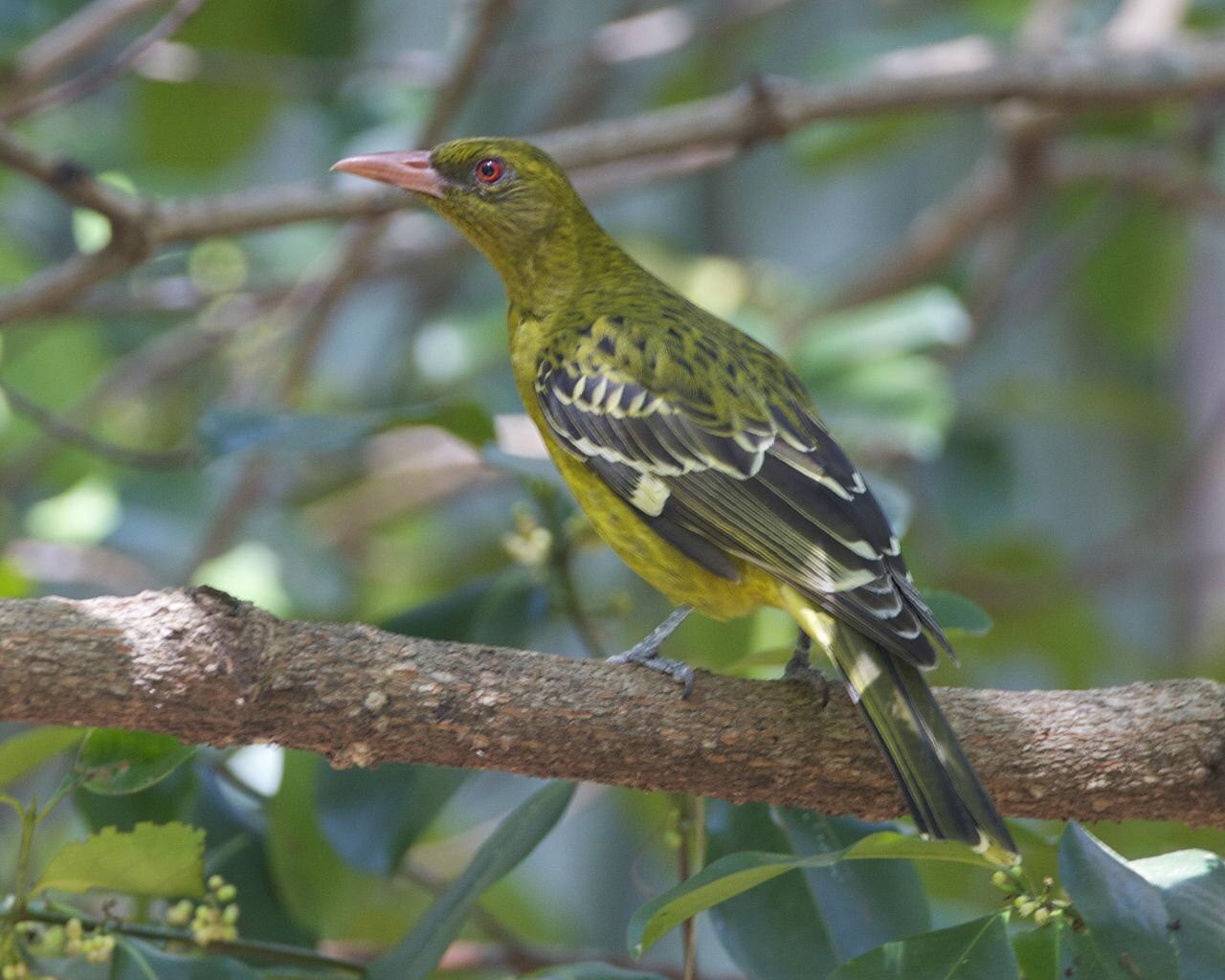
The Green Oriole is the oriole of the wettest forest in tropical northern Australia: mangrove, monsoon rainforest and the swamp forest along creeks. It is yellow-green from head to tail and finely dark-streaked over the whole underside, with a bright red eye and a pink-red bill that glow against the green. In the field it draws attention by voice rather than by colour — a full, bubbling yodel that ranks among the most characteristic sounds of the northern monsoon forest.
Voice
A loud, rich, liquid yodel of three or four bubbling syllables, often rendered 'orry-orry-ol', with a distinctly watery, almost boiling quality that cuts through dense forest. The bird repeats it at an unhurried pace, regularly answered by a neighbour, so that in the early morning it sounds like a conversation across the forest. Alongside it come a hard nasal 'quark' and a thinner, plaintive call. The yodel is the best means of finding the species, for the bird itself all but vanishes into the canopy.
No freely licensed recording has been found for this species yet; what to listen for is described below.
Identification
A stout, heavy songbird of nearly thirty centimetres and well over a hundred grams, uniform yellow-green to olive-green above with a pattern of pale streaks and fringes on the wing. The underparts are a lighter greenish yellow and covered across their whole width with fine, sharp dark streaks, from throat to flanks. The eye is bright red and the heavy, slightly curved bill pink to coral red — two characters that give the bird away at once in good light. Male and female are alike; young birds are duller, with a dark eye, a dark bill and coarser streaking. The bird moves slowly through the canopy and, despite its size, is remarkably hard to see among green leaves.
Confusion species
The only real candidate is Olive-backed Oriole (Oriolus sagittatus), which occurs locally in the same country in the north. The difference lies in the ground colour of the underparts and in the weight of the streaking: Olive-backed is white to greyish white below with broad black arrow-shaped streaks standing out sharply on that white ground, whereas Green Oriole is greenish yellow below with much finer, less contrasting streaks — the difference between black on white and dark on green. Habitat separates them too: Green Oriole keeps to mangrove, monsoon forest and swamp forest, Olive-backed to drier eucalypt forest and woodland. Australasian Figbird (Sphecotheres vieilloti) belongs to the same family and is the same size, but the male has a black head with bare red eye-skin and is unstreaked; the female and young bird are browner and more coarsely streaked and are in fact the ones confused with an oriole — look then at the bare skin around the eye and at the absence of the red bill.
Habitat
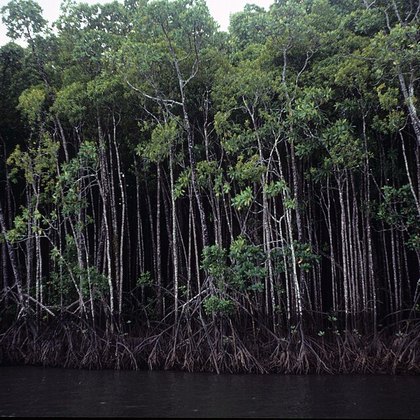
The wettest forest of the tropical north: tall mangrove, monsoon rainforest and vine thicket, melaleuca swamp forest, and gallery forest along creeks and rivers. The bird forages high in the canopy and lives largely on fruit — figs above all — supplemented by insects, caterpillars and the occasional robbed egg or nestling of small songbirds. Where fig trees are in fruit, several birds gather. Dry open woodland and savanna are avoided; the species stays where the leaf is green and the canopy closed.
Where the bird is most often found, arranged by main group and formation.


Range and movements
The tropical northern rim of Australia, in a band running from the Kimberley in Western Australia across the Top End of the Northern Territory and its islands to Cape York Peninsula and the wet coastal strip of north-eastern Queensland. Outside Australia the species occurs in New Guinea and on a few neighbouring islands. These are residents: there is no seasonal migration, though they wander within their district after fruiting trees and then appear temporarily outside their usual forest.
- Resident
- dark = core range, pale = thinly spread
Where and when to look
Let the voice lead you and stand in the early morning at the edge of a mangrove stand or a patch of monsoon forest — the fringes of Darwin and the creeks of Kakadu are classic. Then search the canopy for movement rather than for colour: the bird merges entirely into green foliage and often gives itself away only by a shaking branch. When you find it, look at the eye and the bill; red and pink-red against green are unmistakable, and the fine streaking on a greenish-yellow rather than white belly separates it at once from Olive-backed Oriole.
Conservation
Least Concern (LC). The species is common in its habitat, and most of the northern monsoon forest and mangrove on which it depends is still largely intact and to a great extent protected or barely accessible. Concerns do exist in the long term and apply more to the forest than to the bird: monsoon forest and vine thicket lie as small isolated patches in a landscape where too-frequent and too-hot fires eat at the margins, and where cattle and feral pigs destroy the understorey and the regeneration of young trees. In time that could thin out the fig trees on which this bird lives.
Scientific name
Oriolus flavocinctus | (King, 1826)
Phillip Parker King described the species in 1826 as Mimetes flavocinctus, from material in the Northern Territory. The genus Oriolus goes back through medieval Latin to aureolus, 'golden', after the Eurasian Golden Oriole. The epithet flavocinctus combines Latin flavus ('yellow') with cinctus ('girdled'), hence 'yellow-girdled'. The English name was long Yellow Oriole but was changed to Green Oriole because the former already belongs in America to an entirely different bird — a good example of how an English bird name shifts under the pressure of the world list. The Dutch Mangrovewielewaal and the Spanish oropéndola verdosa each take a different character: the habitat and the colour.