All species › Passerines › Old World orioles › Olive-backed Oriole
Olive-backed Oriole | Oriolus sagittatus
Olijfrugwielewaal | Oropéndola estriada
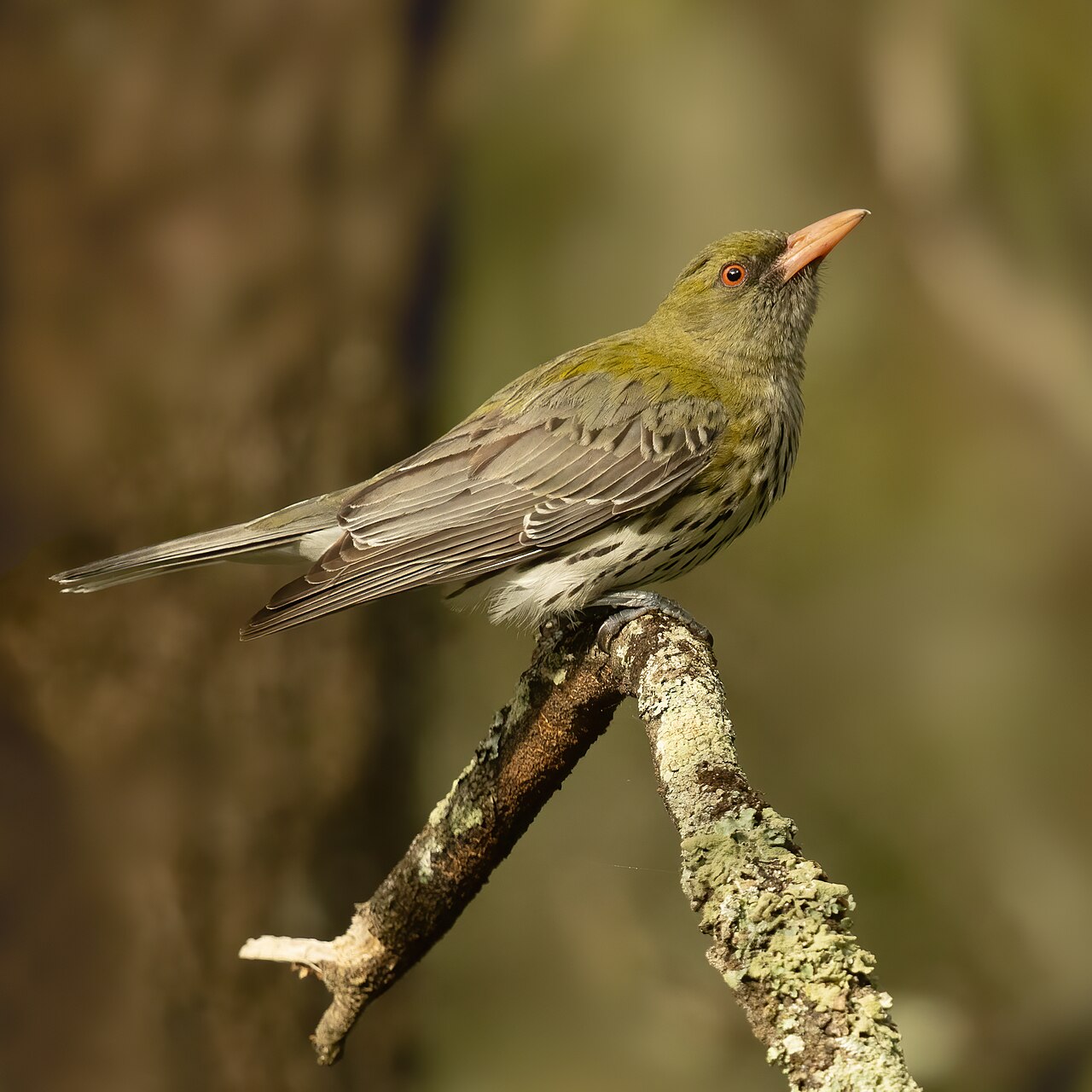
The Olive-backed Oriole is Australia's widespread oriole: a stout olive-green bird with sharply black-and-white streaked underparts, a red eye and a pink bill, found in eucalypt forest and woodland from northern to south-eastern Australia and not shy of town parks and gardens. Its rolling call — the 'orry-orry-ol' on which the English name rhymes — belongs to the background sound of the Australian bush. It is besides a good mimic and weaves the calls of its neighbours into its quiet subsong.
Voice
The familiar call is a full, rolling, clearly whistled 'orry-orry-ol' of three or four syllables, carrying far and often delivered from a high, hidden perch. The bird also has a soft, prolonged subsong that is a pleasant surprise at close range: a strung-together babble in which it imitates the calls of other birds, sometimes dozens of species in succession. The alarm is a harsh, cat-like 'myeah'. Once the rolling call is known, this species is heard far more often than it is seen.
Recording: Andrew Galbraith — CC BY-NC-SA 4.0 · Quandong Park (near Ashgrove), Brisbane City, Queensland, Australia · xeno-canto
Identification
A stout songbird of over a quarter of a metre with a heavy, slightly curved bill. The upperparts are olive-green, with a pattern of pale fringes on the wing that suggests fine streaking on a perched bird. The underparts are the signature: white to greyish white and covered across their full width with broad black arrowhead streaks, visible at a distance through their sharp contrast. The eye is bright red, the bill pink to coral red, the legs blue-grey. Male and female are nearly alike, the female slightly duller. Young birds are browner above, have a dark eye and a dark bill, and are more coarsely and warmly streaked below.
Confusion species
The direct counterpart is Green Oriole (Oriolus flavocinctus) of the tropical north: that species is greenish yellow rather than white across the whole underside, and its streaking is much finer and less contrasting — dark on green against black on white. Where the two occur side by side in the north, habitat separates them as well: Green Oriole keeps to mangrove, monsoon forest and swamp forest, this species to drier eucalypt forest and woodland. The hardest confusion, though, is with Australasian Figbird (Sphecotheres vieilloti), and above all with the female and young bird, which are likewise white with dark streaks below: those birds have bare reddish or grey-green skin around the eye, a dark rather than pink-red bill and a shorter, stockier silhouette, and they like to sit in small parties, which the oriole seldom does. The adult male figbird, with black head and unstreaked green breast, cannot be confused.
Habitat
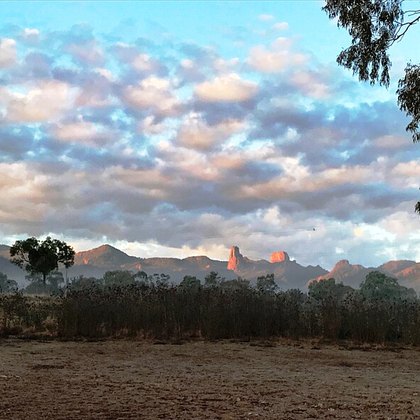
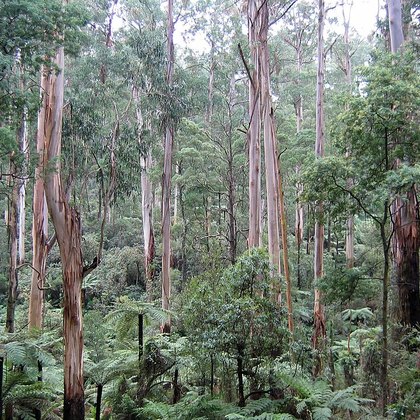
Open eucalypt forest and woodland in all its forms: dry woodland, wet eucalypt forest, the riverine forest along inland creeks, and at the northern edge monsoon forest and vine thicket as well. The bird keeps to the canopy and lives mainly on fruit — figs, lantana, mistletoe and the fruits of planted shrubs — supplemented by insects and caterpillars. That very taste for fruiting shrubs makes it a regular visitor to gardens, town parks and orchards, where in summer it often stays for days in a single bearing tree.
Where the bird is most often found, arranged by main group and formation.


Range and movements
By far the most widely distributed oriole in Australia: from the Kimberley in the north-west across the Top End and the Gulf of Carpentaria to Cape York, and from there south along the whole east coast into Victoria and the far south-east of South Australia, reaching well inland into the wooded interior. The northern birds are residents. In the south-east the species is partly migratory: many birds leave the southern breeding grounds in autumn and move north, returning in spring, so that in Victoria it is chiefly a summer bird while numbers in Queensland rise in winter.
- Resident
- Breeding (summer)
- dark = core range, pale = thinly spread
Where and when to look
Look for it in the canopy of eucalypt forest and check the broad black streaks on a white belly — that pattern is recognisable at fifty metres and is the fastest separation from Green Oriole. If you find a fruiting fig, stay put: orioles and figbirds gather there together, and it is precisely in that company that comparing the two is most instructive. In the breeding season listen for the quiet subsong from a few metres away; it is one of the few occasions on which an Australian bird sings you a list of its neighbours.
Conservation
Least Concern (LC). The species is common over a very large range and is one of the Australian forest birds that have adapted well to the landscape people have reshaped: it uses gardens, parks, orchards and roadside plantings, and locally even profits from introduced fruiting shrubs. There is no national decline. Locally, the loss of old woodland with fruiting trees and of the riverine forest along inland creeks does matter, for in dry country those strips form the connection between wooded areas on which the species depends for its movements.
Scientific name
Oriolus sagittatus | (Latham, 1801)
John Latham described the species in 1801 as Coracias sagittata, from a bird taken near Sydney; because the species now stands in Oriolus, author and year are in parentheses. The genus Oriolus goes back through medieval Latin to aureolus, 'golden', after the Eurasian Golden Oriole, which is far yellower than its Australian relatives. The epithet sagittatus is Latin for 'marked with arrows' and refers to the arrowhead black streaks on the underparts — the best field character of the species and thus an unusually useful scientific name. The English name Olive-backed Oriole and the Dutch Olijfrugwielewaal take the back, the Spanish oropéndola estriada takes the streaking instead; both characters serve well in the field.