All species › Passerines › Old World orioles › Australasian Figbird
Australasian Figbird | Sphecotheres vieilloti
Grijskraagvijgvogel | Papafigos de vieillot
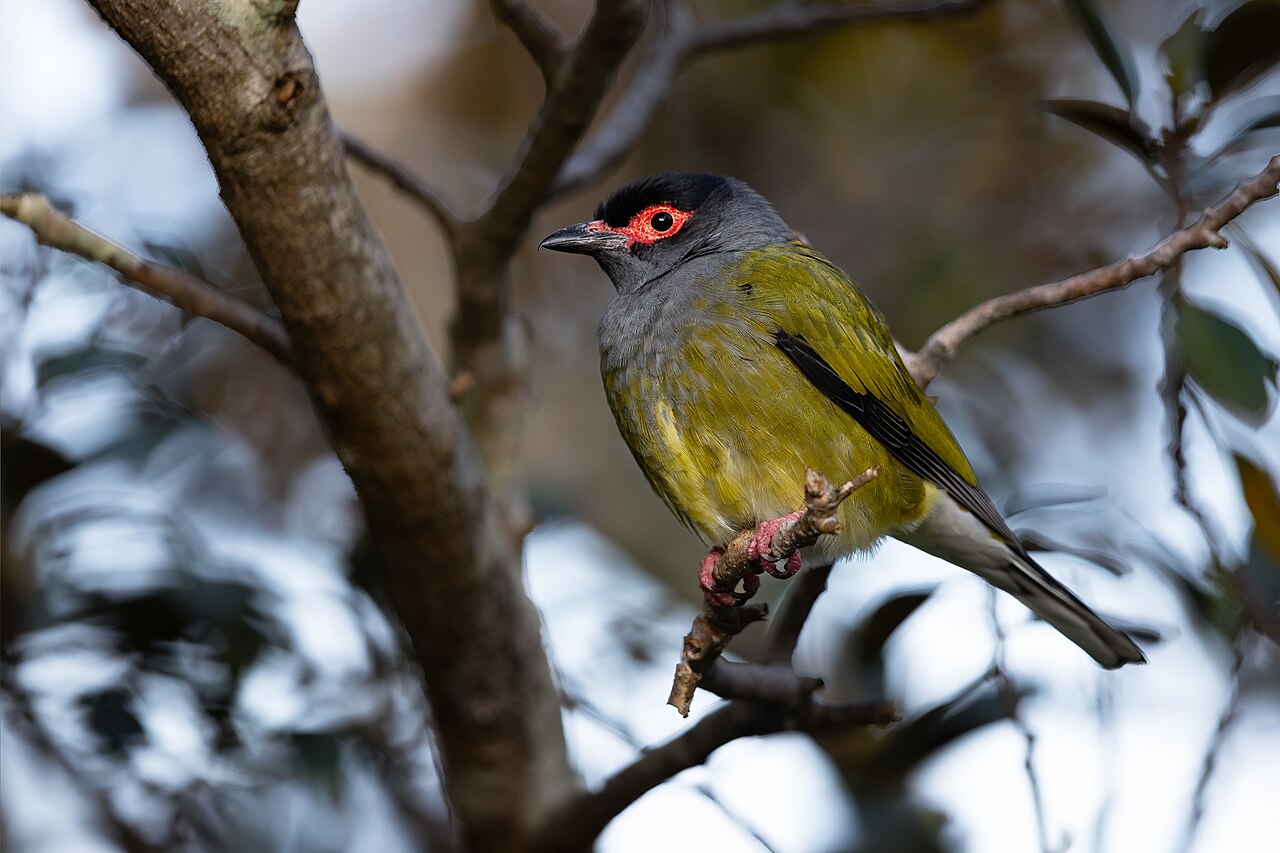
The Australasian Figbird is the oriole that lives in flocks. Where a fig tree is in fruit twenty birds hang in it at once, and within a few days the tree is stripped. The male has a black cap and a bare red mask around the eye; the female is brown and heavily streaked below, so unlike him that the two were long taken for different birds.
Voice
From the canopy comes a hoarse, slightly plaintive whistle, yoo-weet ... wee-oo, shorter and thinner than the full piping of an Olive-backed Oriole. A feeding flock keeps up a constant low grunting, crackling and chattering; you usually hear the tree before you see it. It mimics well: parrots, other orioles and the alarm calls of small songbirds all turn up in its repertoire.
Recording: James Ray — CC BY-SA 4.0 · Collins St at Botany Rd (near Beaconsfield), Council of the City of Sydney, New South Wales, Australia · xeno-canto
Identification
A stocky bird of 28 to 29 centimetres with a short tail and a heavy red-brown bill. The male is olive-green on the back and wing and black on the head and throat, with a broad bare red eye-ring; the southern form carries a grey collar below that, the northern form a yellow breast and no collar. Undertail coverts are white, the tail black with white tips to the outer feathers. The female is dull brown above, white below with heavy dark streaking, and has a grey eye-ring.
Confusion species
Olive-backed Oriole (Oriolus sagittatus) and Green Oriole (Oriolus flavocinctus) are slimmer, with a longer pink bill and a red eye, and go singly or in pairs rather than in flocks. The streaked female figbird resembles both, but the eye is dark, the bill shorter, and the streaking runs well down the flank. Young males wear an untidy mixture of brown and olive-green.
Habitat
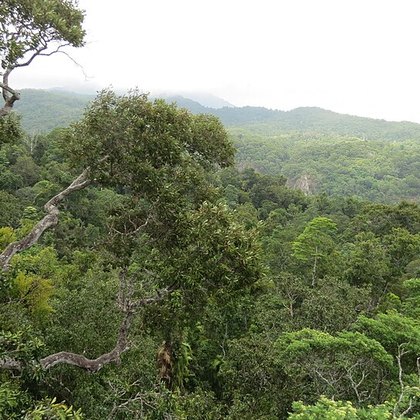
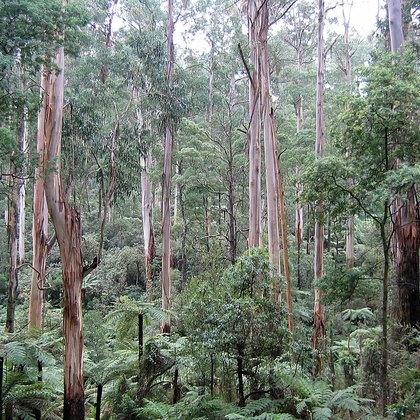
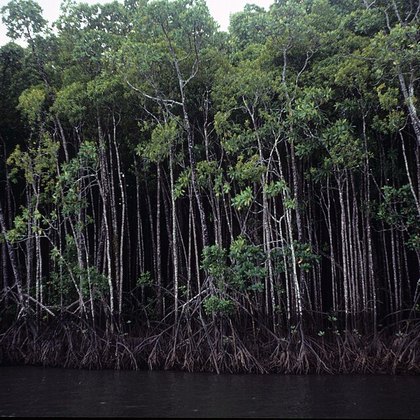
Rainforest and wet sclerophyll forest are the core, but the species is just as much at home in monsoon forest and vine thicket, along mangrove edges and in town parks with fruiting trees. Wherever a fig, a camphor laurel or a palm is in fruit it appears, in the middle of Brisbane or Cairns as readily as in the bush. Outside the fruiting season it wanders between forest blocks through open woodland.
Where the bird is most often found, arranged by main group and formation.


Range and movements
The coastal belt of northern and eastern Australia, from the Kimberley in Western Australia through the Northern Territory and Queensland to the New South Wales border with Victoria, plus southern New Guinea and the Kai Islands. It does not migrate but it does wander: in summer, from December to February, groups turn up well to the south wherever trees are bearing. It avoids the dry interior altogether.
- Resident
- dark = core range, pale = thinly spread
Where and when to look
Do not look for the bird, look for the tree. A fig in fruit in a park or along a creek will produce a flock within the hour; stand underneath and look up, because the falling fruit gives them away. On every male check where the black cap meets the breast: the grey collar of the southern form and the yellow breast of the northern form meet around Townsville, where intermediates occur.
Conservation
Least Concern (LC). The species profits from the planting of figs and other fruiting trees in gardens, parks and streets, and has become more numerous in the eastern cities over the past half century. Locally the loss of coastal rainforest hurts, but the bird moves readily onto planted trees. In soft-fruit orchards it is regarded here and there as a pest.
Scientific name
Sphecotheres vieilloti | Vigors & Horsfield, 1827
Vigors and Horsfield described the bird in 1827 as Oriolus vieilloti, among the orioles; because it later moved to another genus, author and year stand in parentheses. The genus Sphecotheres was introduced by Vieillot in 1816, from Greek sphex, sphekos, wasp, and theras, hunter: wasp hunter. vieilloti honours that same Vieillot. The species was split from Sphecotheres viridis, which now holds only Timor and neighbouring islands.