All species › Passerines › Whistlers and allies › Bower's Shrikethrush
Bower's Shrikethrush | Colluricincla boweri
Grijsruglijsterdikkop | Picanzo de Bower
Bower's Shrikethrush is the shrikethrush of the upland rainforests of tropical north-eastern Queensland and occurs nowhere else on earth. It is an unobtrusive grey-brown forest bird with a heavy, slightly hooked bill and a surprisingly powerful, clear whistling voice — anyone who finds it usually hears it first. From its widespread relative, the Little Shrikethrush, it is barely separable by eye; what defines it is where it stands: on the Atherton Tableland and the surrounding massifs, and above them the country runs out.

Voice
A loud, rich, clearly whistled voice that carries far through the rainforest and ranks among the most conspicuous sounds of the Wet Tropics: series of full, rounded notes, often with a rising or falling turn at the end, delivered at an unhurried pace. Between them come hard dry clicks and a rasping, almost angry call note. The pattern varies from bird to bird and from district to district, so a given phrase seldom repeats in quite the same way; what is recognisable above all is the full, flute-like timbre, which has nothing shrill or squeaky about it.
No freely licensed recording has been found for this species yet; what to listen for is described below.
Identification
A robust forest bird of about nineteen centimetres with a conspicuously heavy dark bill, slightly hooked at the tip. Head and back are grey to grey-brown — the grey back to which the Dutch name refers — running into the wings without a sharp boundary. The underparts are warm cream to pale ochre, with a fine but clearly visible dark streaking on throat and breast. The eye is dark, the legs sturdy and grey. Male and female look alike. The bird moves deliberately through the middle storey of the forest, hopping from branch to branch and pausing often — quite unlike the restless fantails that share the same woods.
Confusion species
The only real candidate is Little Shrikethrush (Colluricincla megarhyncha), which occurs in the same region but lower down, in lowland rainforest and monsoon forest. That species is smaller and more lightly built, has a warmer rufous to olive-brown back instead of grey, a lighter and slimmer bill, and is plainer below — the fine dark streaking on throat and breast that Bower's carries is largely absent. In practice altitude is the most usable character: above roughly six hundred metres almost every shrikethrush of this size is Bower's, in the lowlands almost every one is Little, and only on the intervening slopes is care required. The much larger Grey Shrikethrush (Colluricincla harmonica) is paler grey, unstreaked below and has a whitish face with a dark lore; it also avoids closed rainforest. Grey Whistler (Pachycephala simplex) shares the rainforest and the inconspicuous colours, but is considerably smaller, has a far finer bill and a thinner, different voice.
Habitat
Tropical upland and hill rainforest of the Wet Tropics, centred between roughly three hundred and fifteen hundred metres. The species favours closed, humid forest with a rich understorey and forages mainly in the middle and lower storeys, gleaning insects, spiders and small vertebrates from trunks, branches, vines and leaves, and searching epiphytes and leaf clusters. At the rainforest edge it penetrates a short way into adjoining wet eucalypt forest, but closed forest remains the core. It is absent from dry forest and open woodland.
Where the bird is most often found, arranged by main group and formation.
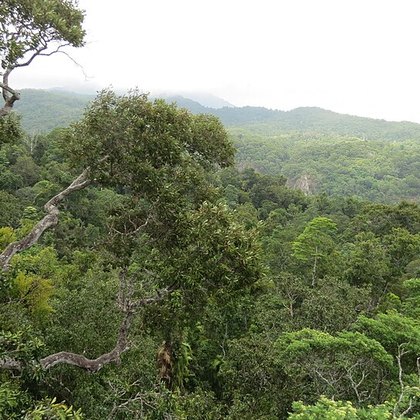
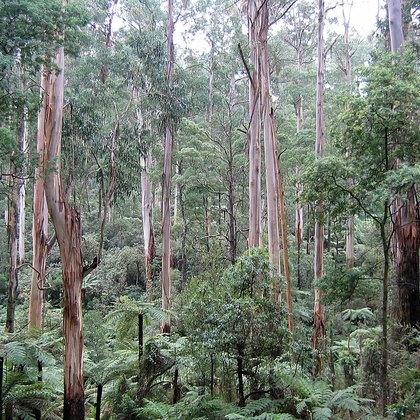
Range and movements
Endemic to the Wet Tropics of north-eastern Queensland, a narrow band of upland forest between roughly Cooktown in the north and Paluma, north of Townsville, in the south. The best-known sites lie on and around the Atherton Tableland, with Mount Lewis, the Bellenden Ker and Carbine massifs and the forest around Paluma alongside them. The total range is small and, moreover, divided among separate massifs isolated from one another by low, drier country. There is no migration; the birds stay in the same forest all year, though a few drop a little lower in winter.
- Resident
- dark = core range, pale = thinly spread
Where and when to look
Work with the voice. Walk slowly along a forest track or a road through rainforest above six hundred metres — the Mount Lewis Road and the forests at Paluma are classic — and wait for the clear whistled bursts; the bird itself often sits still and against the light in the middle storey. When you see it, check the heavy dark bill and the fine streaking on the breast, and note the altitude you are standing at: in practice that fact separates this species from Little Shrikethrush faster than any plumage character.
Conservation
Vulnerable (VU). The entire world range of the species consists of one small, fragmented upland forest region in north-eastern Queensland; there is no second population elsewhere to absorb a setback. It is precisely that extreme confinement that makes the bird sensitive to climate change: the forest it inhabits is tied to cool, humid elevations, and as that zone shifts higher up the mountains it grows smaller and becomes further fragmented across separate summits. The forest itself is largely protected as World Heritage and is no longer logged on any scale, so timber extraction is no longer the principal threat; the threat is now mainly climatic and correspondingly harder to reverse. Little is firmly known about the size of the population or how fast it is changing.
Scientific name
Colluricincla boweri | Ramsay, 1885
Edward Pierson Ramsay described the species in 1885 as Collyriocincla boweri, from material taken at Cairns. The genus Colluricincla was introduced in 1827 by Nicholas Vigors and Thomas Horsfield and sets two bird names end to end: Latin collurio for a shrike and cinclus for a thrush-like bird — exactly the double idea carried by the English name Shrikethrush and by the Dutch lijsterdikkop. The epithet boweri honours the English collector to whom the English name Bower's Shrikethrush also refers. The Dutch name Grijsruglijsterdikkop picks the plumage character that separates the species from its nearest relative, the grey rather than rufous back; the Spanish picanzo de Bower follows the English.