All species › Passerines › Whistlers and allies › Grey Shrikethrush
Grey Shrikethrush | Colluricincla harmonica
Grijze lijsterdikkop | Picanzo gris
The Grey Shrikethrush is an unremarkable grey bird with one of the finest voices in Australia: rich, rolling whistled phrases that differ from forest to forest. It is everywhere, from Tasmanian rainforest to mulga to the back garden, and it is tamer than its family suggests, often coming within a few metres to see who is standing in its territory.

Voice
A loud, warm run of whistles with a strong rolling r through them, pip-pip-pip-hoee or pur-pur-pur-kwee-yew, differing in shape from district to district but always round and resonant. There is also a sharp, almost angry call written down as yorrick. Pairs sing right through the year, including the middle of the day, and the female sings nearly as much as the male.
Recording: Yvonne Phillips — CC BY-SA 4.0 · Woondum National Park, Australia · xeno-canto
Identification
A solid, short-legged songbird of 22 to 25 centimetres with a big head and a straight bill lightly hooked at the tip. It is grey above, browner-backed in the north and west, and pale grey to off-white below. The male has a white lore and a black bill, the female a finely streaked breast and a greyish bill. Young birds show rusty edges to the wing coverts. The stance is upright and unhurried; it sits still in one place for long spells.
Confusion species
Sandstone Shrikethrush (Colluricincla woodwardi) is longer and longer-tailed, cinnamon below and tied to sandstone cliffs. Rufous Shrikethrush (Colluricincla megarhyncha) is smaller and rufous and keeps to rainforest on the northern and eastern coasts. The female Rufous Whistler (Pachycephala rufiventris) is smaller and rounder with a shorter bill. Grey Butcherbird (Cracticus torquatus) also sings round and loud but is larger, with a heavy hooked bill pale at the base.
Habitat
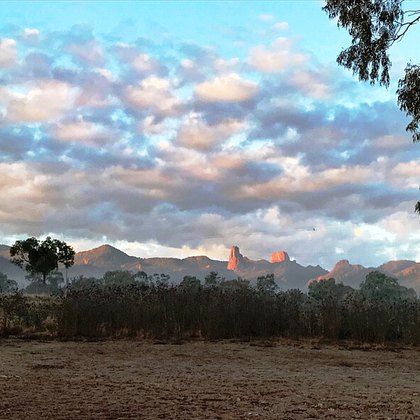
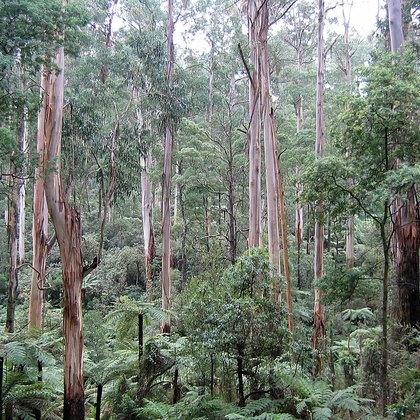
Almost any treed country: dry eucalypt forest and woodland, wet forest, creekside woodland, mallee, and beyond that gardens, parks and orchards with old trees. It feeds on the ground around fallen logs and along limbs and bark, and needs litter and dead wood for that. Only the barest desert and the closed interior of tropical rainforest stay empty.
Where the bird is most often found, arranged by main group and formation.


Range and movements
Nearly all of Australia except the driest inland deserts, Tasmania and the larger offshore islands included, plus southern New Guinea and the Torres Strait islands. Five subspecies divide the range: a brown-backed form in the north, a grey one in the east, a dark form on Tasmania and a rufous-bellied one through the west and centre. Resident; pairs hold the same territory all year.
- Resident
- dark = core range, pale = thinly spread
Where and when to look
Stand still where you hear it and wait, because it will come and look at you. Search low: it works the bottom three metres of the trunks and picks about among fallen timber. Early spring, August and September, is best for song, but it is the one Australian singer that keeps going through a hot January afternoon. Use the breast streaking to tell female from male.
Conservation
Least Concern (LC) and common across the continent. Around towns and through the farming districts of the west it has clearly declined, because it needs the litter, dead wood and dense understorey that get tidied away there. Where forest is fragmented it drops out of the smallest remnants; larger blocks hold it. Feral cats and foxes count too, since it spends much of its time on the ground.
Scientific name
Colluricincla harmonica | (Latham, 1801)
Latham described the bird in 1801 as Turdus harmonicus, among the thrushes; because it later moved to another genus, author and year stand in parentheses. The genus Colluricincla was introduced by Vigors and Horsfield in 1827, from Greek kollurion, a name for the shrike, and cinclus, used in ornithology for thrush-like birds. harmonica means harmonious and refers to the song. The type locality lies in New South Wales.