All species › Passerines › Whistlers and allies › Little Shrikethrush
Little Shrikethrush | Colluricincla megarhyncha
Arafuralijsterdikkop | Picanzo chico
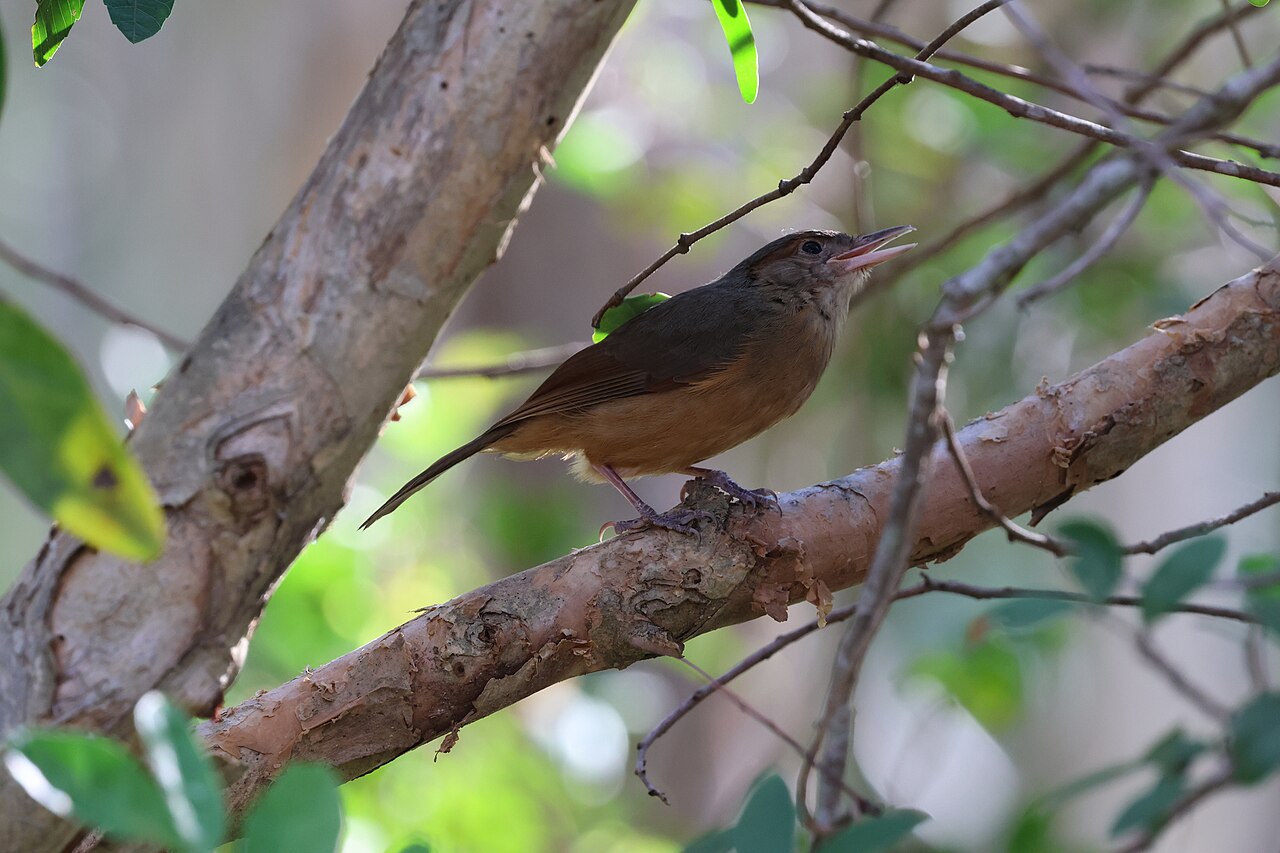
The Little Shrikethrush is the textbook bird you will never find on colour and never miss on sound. To look at it is almost nothing: a plain brown forest bird without markings, carrying a heavy bill hooked at the tip. Its voice, by contrast, is among the finest of the northern rainforest — a run of clear, rolling whistles that carries through the whole wood. It is widespread from the Aru Islands and southern New Guinea into tropical Australia.
Voice
One of the most arresting voices of the tropical forest, and wholly at odds with the unremarkable plumage. The song consists of short series of loud, pure whistles with a rich, rolling tone, often starting with a few even notes and then driving upward — a motif frequently rendered chop-chop-chop-whit. The bird sings all year, in the middle of the day and in the rain, when the rest of the forest has fallen quiet. There is also a sharp, upward tchip as a contact note.
No freely licensed recording has been found for this species yet; what to listen for is described below.
Identification
A medium-sized, thickset forest bird with a strikingly heavy head and a thick grey bill hooked at the tip — the equipment of a bird that takes not only insects but snails, small lizards and eggs. The upperparts are warm olive-brown to rufous-brown, without streaking or spotting; the underparts are paler, cinnamon to dull buff, at most with a vague, diffuse streaking on the breast. The lore is pale, the eye dark, the legs sturdy and grey. The sexes are alike. Appearance varies considerably across the range: northern Australian birds are greyer and paler, rainforest birds more rufous. There is no single striking feature; it is precisely that complete flatness, together with the heavy bill and the upright, unhurried posture, that one remembers.
Confusion species
The decisive pairing is with Bower's Shrikethrush (Colluricincla boweri), which is clearly greyer on the back and carries neat, sharp streaking below where this species has at most a faint wash. In practice, though, range and above all elevation settle it: boweri is confined to the uplands of the Wet Tropics in north-eastern Queensland, roughly above six hundred metres, while the Little Shrikethrush occupies the widespread lowland forest. Anyone seeing a shrikethrush in that small upland block must therefore check back and breast streaking; elsewhere the confusion does not arise. Beyond that, Grey Shrikethrush (Colluricincla harmonica) is much larger, grey above and white below, with a white lore. Grey Whistler (Pachycephala simplex) shares the plain, unmarked plumage but is smaller and finer-billed. Females and immatures of other Pachycephala species are also plain brown, but are in every case more lightly built and less heavily billed.
Habitat
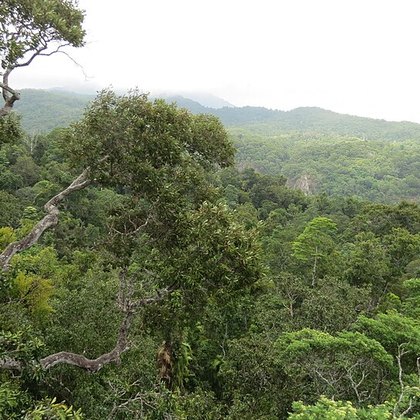
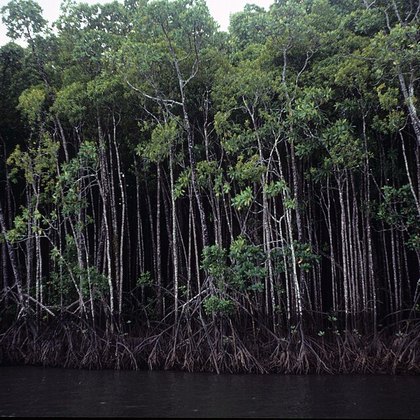
Rainforest, monsoon forest and vine thicket, gallery forest along creeks, and mangrove — anywhere the canopy closes and the understorey is dense. The bird works slowly and methodically through the middle and lower storey, searching leaves, bark and tangles of vine, and descending to the ground as well. Unlike most songbirds of its size it regularly takes small vertebrates alongside insects and raids nests, which is what the heavy bill is for. In the north of the range mangrove is a habitat in its own right and not a fallback.
Where the bird is most often found, arranged by main group and formation.


Range and movements
The range extends over the Aru Islands, southern New Guinea and tropical northern Australia, with the Top End, the Gulf Country and Cape York Peninsula as the Australian strongholds; under the broader circumscription of the species it continues down the Queensland coast. Everywhere the bird is resident and site-faithful; there is no seasonal migration. The Australian population is large and unfragmented as long as the forest itself remains continuous.
- Resident
- dark = core range, pale = thinly spread
Where and when to look
Learn the voice first and leave the eye out of it. In northern rainforest this species is often the loudest singer of the morning, and the rolling, driving motif cannot be confused with anything else. Follow the sound to the middle storey and look there for a quiet brown bird with a heavy head. If you are in the uplands of the Wet Tropics, check back and breast: grey with sharp streaking means Bower's Shrikethrush, plain brown with at most a wash means this species.
Conservation
In the AviList edition consulted for this guide the species is entered as Not Evaluated (NE), and without a range statement. That is not because anything is wrong with its numbers — the forest it lives in is still intact across most of tropical Australia and southern New Guinea, and the bird is common there — but because the species limits are in flux (see below). Pending a settled arrangement there is no separate Red List assessment. For comparison: the closely related Bower's Shrikethrush is assessed, and as Vulnerable (VU), on account of its very restricted range in the Wet Tropics uplands.
Scientific name
Colluricincla megarhyncha | (Quoy & Gaimard, 1832)
Jean René Constant Quoy and Joseph Paul Gaimard described the bird in 1832 as Muscicapa megarhyncha, from material taken at Dorey — present-day Manokwari — on the Vogelkop of New Guinea. The epithet megarhyncha combines Greek megas ('large') and rhunkhos ('bill') into 'big-billed', and that is exactly what marks the bird. The genus Colluricincla joins Greek kollurion (a kind of shrike) to kinklos (a wagtail-like bird), fixing in one name what the English shrikethrush also says: a bird with the bill of a shrike and the bearing of a thrush. There is no agreement on species limits: the complex formerly treated as a single widespread 'Little Shrikethrush' has been split by various lists into a series of species, with the name megarhyncha staying with the Arafura birds under one view and with the New Guinean birds under another. The Dutch name arafuralijsterdikkop follows the first view; the English Little Shrikethrush and the Spanish picanzo chico, as used in this guide, follow the broader one.