All species › Passerines › Whistlers and allies › Sandstone Shrikethrush
Sandstone Shrikethrush | Colluricincla woodwardi
Rotslijsterdikkop | Picanzo roquero
The Sandstone Shrikethrush belongs to the sandstone the way a rock wallaby belongs to the gorge: it lives on the cliffs, ledges and boulder fields of the tropical north and rarely leaves them. It is one of Australia's finest songsters, and its clear whistled phrases bounce off the walls so hard that a single bird fills a whole gorge.
Voice
A series of loud, rounded whistles that climb in pitch and then fall away, choo-choo-choo-weet ... hoo-weer, with long silences between and an echo off the sandstone that doubles the sound. Pairs answer one another across the gorge in a question-and-answer exchange. There is also a sharp, short chak as an alarm and a soft grumbling between partners at close range.
No freely licensed recording has been found for this species yet; what to listen for is described below.
Identification
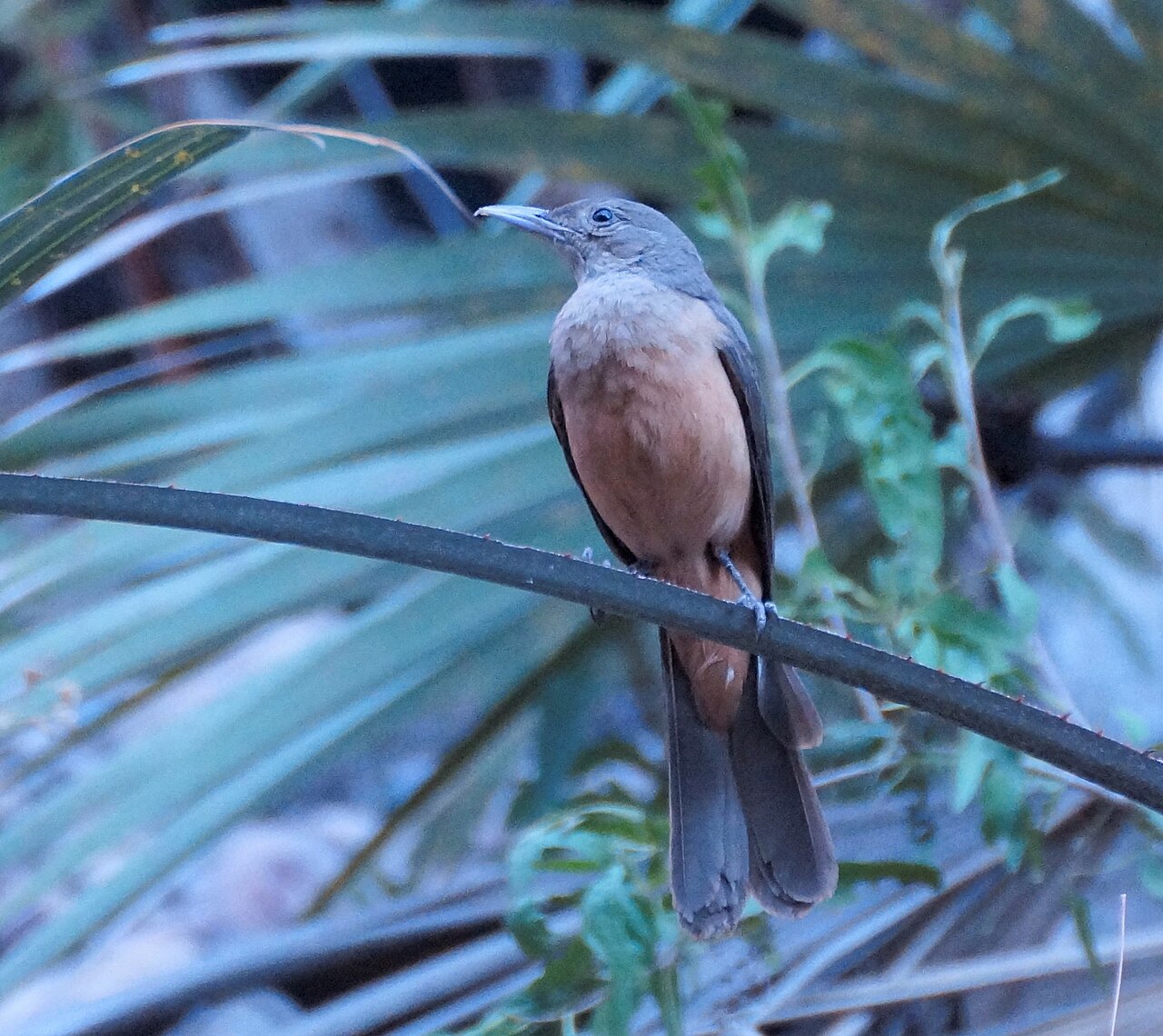
A slender shrikethrush of 24 to 26 centimetres with a long tail and a straight, powerful bill. Head and mantle are grey-brown, back and rump a warmer brown, the flight and tail feathers dark grey. Throat and lores are pale buff, the underparts cinnamon with fine dark streaking on breast and flank. The male has a black bill and a greyer head, the female a grey bill and a browner head. The legs are strong; it walks and hops over rock like a thrush.
Confusion species
Grey Shrikethrush (Colluricincla harmonica) overlaps in the Northern Territory and the Kimberley but is plain grey to olive-brown, lacks the cinnamon underparts and the fine streaking, and sits in woodland rather than on rock. Rufous Shrikethrush (Colluricincla megarhyncha) is smaller, more rufous and tied to monsoon forest and vine thicket. On song alone the two big shrikethrushes can be confused: both whistle loud and round, but the sandstone bird sounds higher and sharper.
Habitat
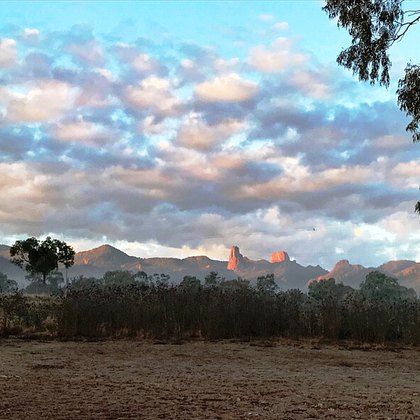
Sandstone cliffs, escarpments, ledges and scree, preferably in river gorges where water stands. It forages almost entirely on the ground and on rock, among the spinifex hummocks that grow out of the stone, and dips into the narrow strips of monsoon forest and vine thicket that hold on at the foot of the gorges. The adjoining dry eucalypt woodland it enters at the edge at most.
Where the bird is most often found, arranged by main group and formation.


Range and movements
Endemic to tropical northern Australia, from the Kimberley in Western Australia through the sandstone country of Arnhem Land and the Top End of the Northern Territory and east along the Gulf of Carpentaria coast to just over the Queensland border. Its distribution south of the gulf is poorly mapped. It neither migrates nor wanders; each pair stays in its own system of gorges.
- Resident
- Winter
- dark = core range, pale = thinly spread
Where and when to look
Stand at the foot of an escarpment early in the morning, at Burrungkuy or Gunlom in Kakadu or on the Mitchell Plateau, and listen first: the song carries hundreds of metres and places the bird before you see it. Then work along the upper lip of the rock ledges, where it moves in the shade of boulders. In winter, in June and July, it sings most in the cool early hours.
Conservation
Least Concern (LC). The species lives in a landscape that suffers little from farming or logging: the sandstone plateau is too rough to use. The main risk is a change in the fire regime, with late hot fires damaging the spinifex and the small pockets of monsoon forest in the gorges. The population is thought small but stable; the bird is nowhere numerous and is not seen away from the escarpments.
Scientific name
Colluricincla woodwardi | Hartert, 1905
Hartert described the bird in 1905 directly in Colluricincla, so author and year carry no parentheses. The genus was introduced by Vigors and Horsfield in 1827 and is built from Greek kollurion, a name for the shrike, and cinclus, used in ornithology for thrush-like birds: a shrike-thrush. woodwardi honours Bernard Henry Woodward, director of the Western Australian Museum, whose collectors brought together the northern material.