All species › Passerines › Whistlers and allies › Gilbert's Whistler
Gilbert's Whistler | Pachycephala inornata
Zwartteugelfluiter | Silbador de Gilbert
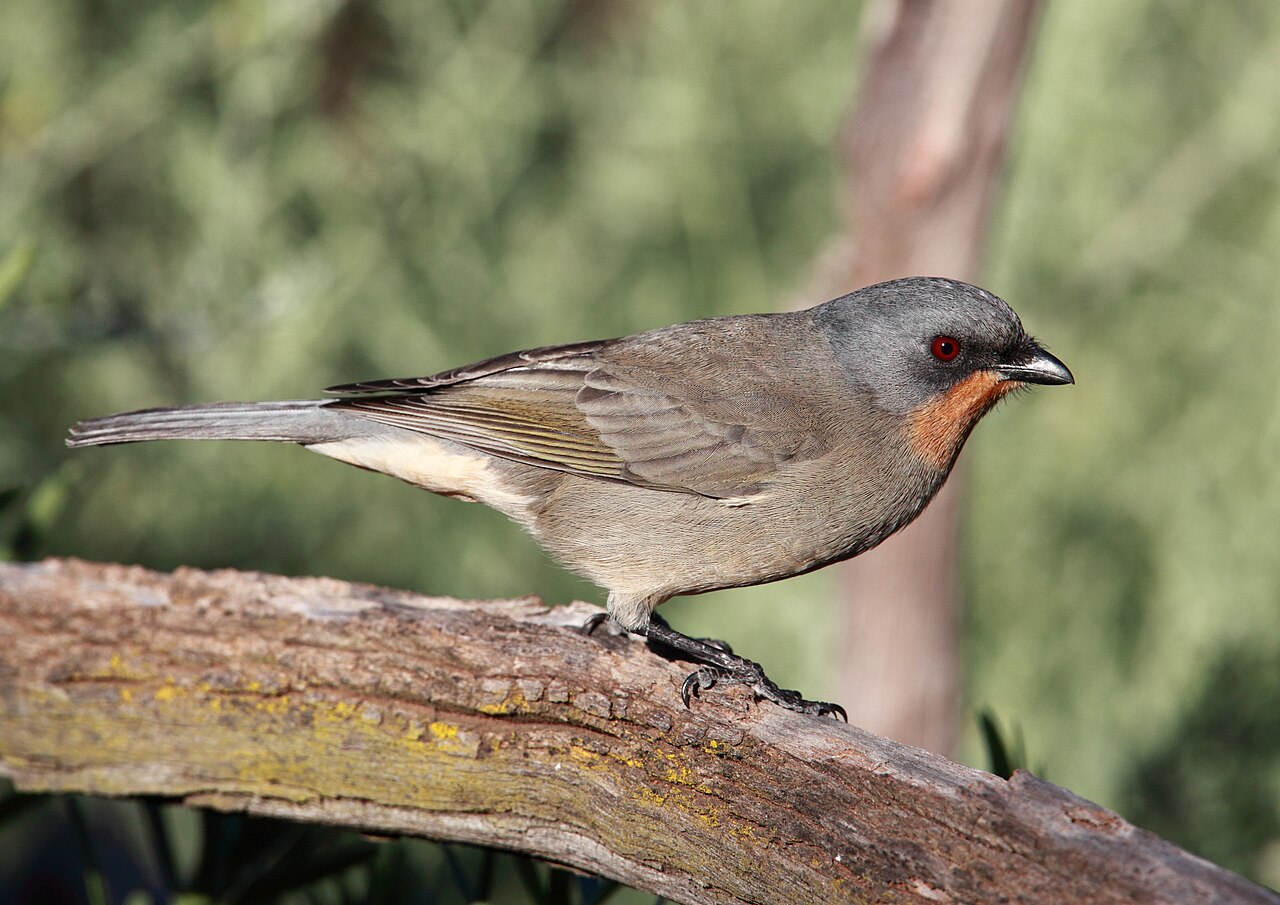
Gilbert's Whistler is the whistler of Australia's dry southern interior: a heavy grey bird of mallee and cypress woodland that is heard far more often than it is seen. Its song is among the loudest sounds of the semi-arid scrub — a deep, carrying call that cuts through the heat — while the bird itself, still and slow in the gloom of the understorey, slips the eye without effort. The black lore between bill and eye gives it its Dutch name and separates it from its rarer red-lored counterpart.
Voice
An exceptionally loud, resonant voice for a twenty-centimetre songbird. The best-known motif is a run of even, deep whistled notes that accelerates and ends in a struck clap — often rendered as a drawn-out joak-joak-joak followed by a sharp tschk. There is also a single, rousing ee-chong that carries hundreds of metres. The voice is markedly ventriloquial: the bird always seems to be somewhere other than where it actually is, which makes tracking it by ear treacherous despite the volume.
No freely licensed recording has been found for this species yet; what to listen for is described below.
Identification
A stout, short-tailed, big-headed bird with a heavy bill hooked at the tip. The male is uniform blue-grey over head, back and breast, with a narrow but crisp black lore running from the base of the bill to the eye, and a warm orange-rufous chin and throat patch that lights up against the grey. The belly is pale grey, the underwing dull. The female lacks both the black and the orange: she is grey-brown and flat, with a faintly marked throat and an inconspicuous pale eye-ring, and so reads as a nameless brown bird. Juveniles show a rusty fringe in the wing. The posture is also characteristic: upright, motionless, minutes at a time on one branch.
Confusion species
The decisive species is Red-lored Whistler (Pachycephala rufogularis), which occupies the same mallee country and at distance looks all but identical: in that species the lore is rufous rather than black, and the throat colour continues into a vague dark breast band. Without a view of the lore there is no identification — this is a case where doubt is more honest than a name. Both belong to the wider group of eight Australian Pachycephala whistlers in this guide, in which throat and breast pattern is always the key: Rufous Whistler (Pachycephala rufiventris) has a white throat with a black band and a rufous belly, Australian Golden Whistler (Pachycephala pectoralis) and Mangrove Golden Whistler (Pachycephala melanura) are bright yellow below, and Olive Whistler (Pachycephala olivacea) is a rainforest bird with a finely streaked throat. Habitat helps: dry interior for Gilbert's and Red-lored, mangrove for White-breasted Whistler (Pachycephala lanioides), moist forest for Olive. Finally, Grey Shrikethrush (Colluricincla harmonica) is also grey and heavy-billed, but clearly larger, longer-tailed and without black lore or orange throat.
Habitat
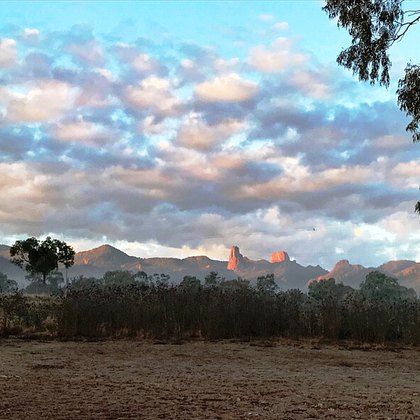
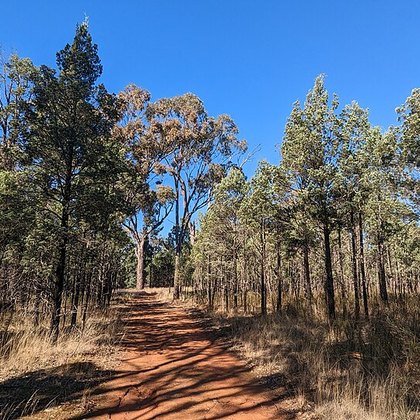
Semi-arid scrub and open woodland of the southern interior: mallee with a dense understorey, broombush, and above all stands of native cypress (Callitris) and belah. The bird favours ground where the shrub layer is closed but the canopy open — a structure that returns only many years after fire, which makes the species sensitive to burning that is too frequent. It forages slowly and methodically in the shrub layer and on the ground, gleaning insects and larvae from bark and litter.
Where the bird is most often found, arranged by main group and formation.

Range and movements
Southern Australia, from the country between Yalgoo and Hyden in the south-west eastward through South Australia — the Murray mallee and Eyre Peninsula — to north-western Victoria and central and north-eastern New South Wales. The range is large but badly fragmented: the species is absent from broad stretches between the occupied cores. There is no migration; pairs hold the same territory year-round.
- Resident
- dark = core range, pale = thinly spread
Where and when to look
Find this bird with your ears. Walk a track through old mallee or cypress woodland early in the morning and stop at the first deep, clapping motif; then follow it patiently, because the ventriloquial quality sends almost everyone the wrong way the first time. When the bird comes into view, look at once at the space between bill and eye: black or rufous settles the name. Females and immatures often cannot be named with certainty without the male alongside.
Conservation
Not globally threatened (LC), but the regional picture is less comfortable: in New South Wales the species is listed as vulnerable and in parts of Victoria it has declined sharply. The causes are known and connected: clearing of mallee and cypress woodland for cropping, and a fire regime that gives the dense, old understorey the bird depends on no time to recover. Long-lived, site-faithful species like this one disappear quietly, without there ever having been much of them.
Scientific name
Pachycephala inornata | Gould, 1841
John Gould described the species in 1841, from material taken in 'the belts of the Murray' in South Australia. The genus Pachycephala goes back to Ancient Greek pakhus ('thick') and kephalē ('head'), hence 'thickhead' — the heavy, rounded skull is indeed the first thing one notices. The epithet inornata is Latin for 'unadorned, plain', which Gould evidently applied to the grey male. The English name Gilbert's Whistler honours John Gilbert, Gould's collector in Australia, who was killed in 1845 on Leichhardt's expedition. The Dutch zwartteugelfluiter takes precisely the character that separates the species from its nearest relative, and the Spanish silbador de Gilbert follows the English.