All species › Passerines › Whistlers and allies › White-breasted Whistler
White-breasted Whistler | Pachycephala lanioides
Krabbenfluiter | Silbador pechiblanco
The White-breasted Whistler is the heaviest-built whistler of the Australian mangroves: a solid black, white and chestnut bird with an enormous deep-black hooked bill, with which it takes small crabs and snails from the mud and cracks them open. It occurs nowhere but in the mangrove belt of the northern and north-western coast, and at low tide its loud whistled performance carries the length of a creek.
Voice
A powerful, full voice that booms across the mudflats and among the mangrove roots. The song consists of clear, rich whistles that build in strength and end in a loud ringing final note; alongside it come single sharp calls and a soft rattling sound while foraging. Pairs call to one another across the creek, the answer following almost at once — low tide, when the birds are feeding out on the mud, is the best time to hear them.
No freely licensed recording has been found for this species yet; what to listen for is described below.
Identification
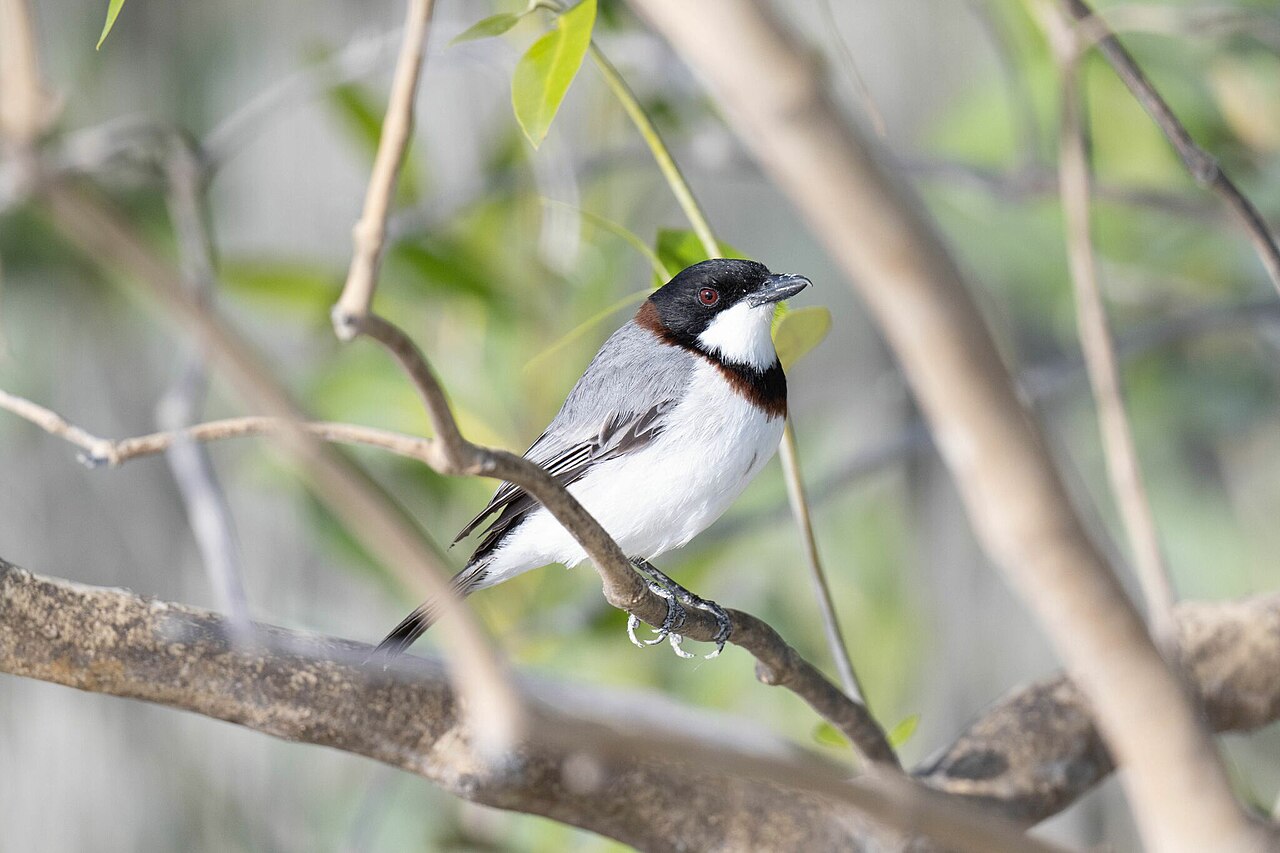
A stout, short-tailed whistler of seventeen to nineteen centimetres whose head, and above all whose bill, catches the eye at once: that bill is deep, broad, glossy black and strongly hooked at the tip — the heaviest tool in the genus, and decisive in itself. The male has a black head and black breast band, a broad clean white throat and white underparts, with a warm chestnut to rufous zone between the black band and the white belly; the back is grey. The female is grey-brown above and whitish below, finely dark-scalloped across chest and flanks, and carries the same unmistakably massive bill.
Confusion species
Mangrove Golden Whistler (Pachycephala melanura) shares the mangrove and likewise has a black head with a black breast band, but is smaller, much lighter-billed, and golden-yellow rather than white and chestnut below the black. Rufous Whistler (Pachycephala rufiventris) also has a black breast band over a white throat, but is rufous across the whole belly instead of white, is far slimmer-billed, and inhabits dry woodland rather than mangrove. The female is the greater challenge: those of Grey Whistler (Pachycephala simplex) and Mangrove Golden Whistler are likewise muted and scalloped on the chest, but both are clearly smaller and lack the heavy bill, which in this species is fully developed in the female too.
Habitat
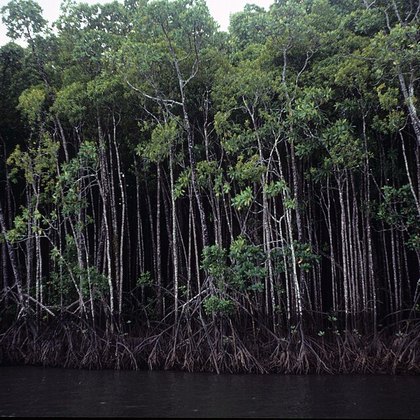
Mangrove and nothing else, and within it chiefly the taller, closed stands with a dense canopy over muddy ground that dries at low tide. The bird forages low, regularly out on the exposed mud and among the stilt roots, taking crabs, molluscs, snails and large insects and hammering them apart against a branch or root. Adjacent saltmarsh and monsoon forest are used at the edges at most.
Where the bird is most often found, arranged by main group and formation.
Range and movements
The tropical and subtropical coast of northern and north-western Australia, from Shark Bay in Western Australia along the Pilbara and the Kimberley, across the Northern Territory coast, into the Gulf of Carpentaria and on east to Cape York Peninsula. The distribution is purely a line along the coast: where there is mangrove there is the bird, and where the mangrove stops the bird stops. There is no migration; pairs hold the same stretch of creek all year.
- Resident
- dark = core range, pale = thinly spread
Where and when to look
Go at low tide, when the birds come down onto the mud. Work along a mangrove creek by boat or on foot and listen for the heavy whistles; then search low, at root level, not in the canopy. If you see a whistler in mangrove, look at the bill first: if it is outsized, the identification is settled, even when the bird is otherwise a dull grey-brown.
Conservation
Least Concern (LC). The species has a long, continuous coastal range and is locally common within mangrove. Because it depends utterly on one habitat type, however, the threat is sharply defined: loss of mangrove to port construction, mining infrastructure and aquaculture along the north-west coast, and in the longer term change in the mangrove belt through sea-level rise and through the severe cyclones that strike this coast every year.
Scientific name
Pachycephala lanioides | Gould, 1840
John Gould described the species in 1840 from a bird taken on the north-west coast of Australia; Gregory Mathews restricted the type locality in 1920 to Derby in the Kimberley. The epithet lanioides means 'shrike-like', from the genus Lanius plus the Greek suffix -oides ('resembling'), and was chosen for the heavy hooked bill. The genus Pachycephala was introduced in 1827 by Nicholas Vigors and Thomas Horsfield, from Ancient Greek pakhus ('thick') and kephalē ('head'). The English White-breasted Whistler and the Spanish silbador pechiblanco take the white breast; the Dutch Krabbenfluiter ('crab whistler') alone goes by the diet.