All species › Passerines › Whistlers and allies › Mangrove Golden Whistler
Mangrove Golden Whistler | Pachycephala melanura
Zwartstaartfluiter | Silbador colinegro
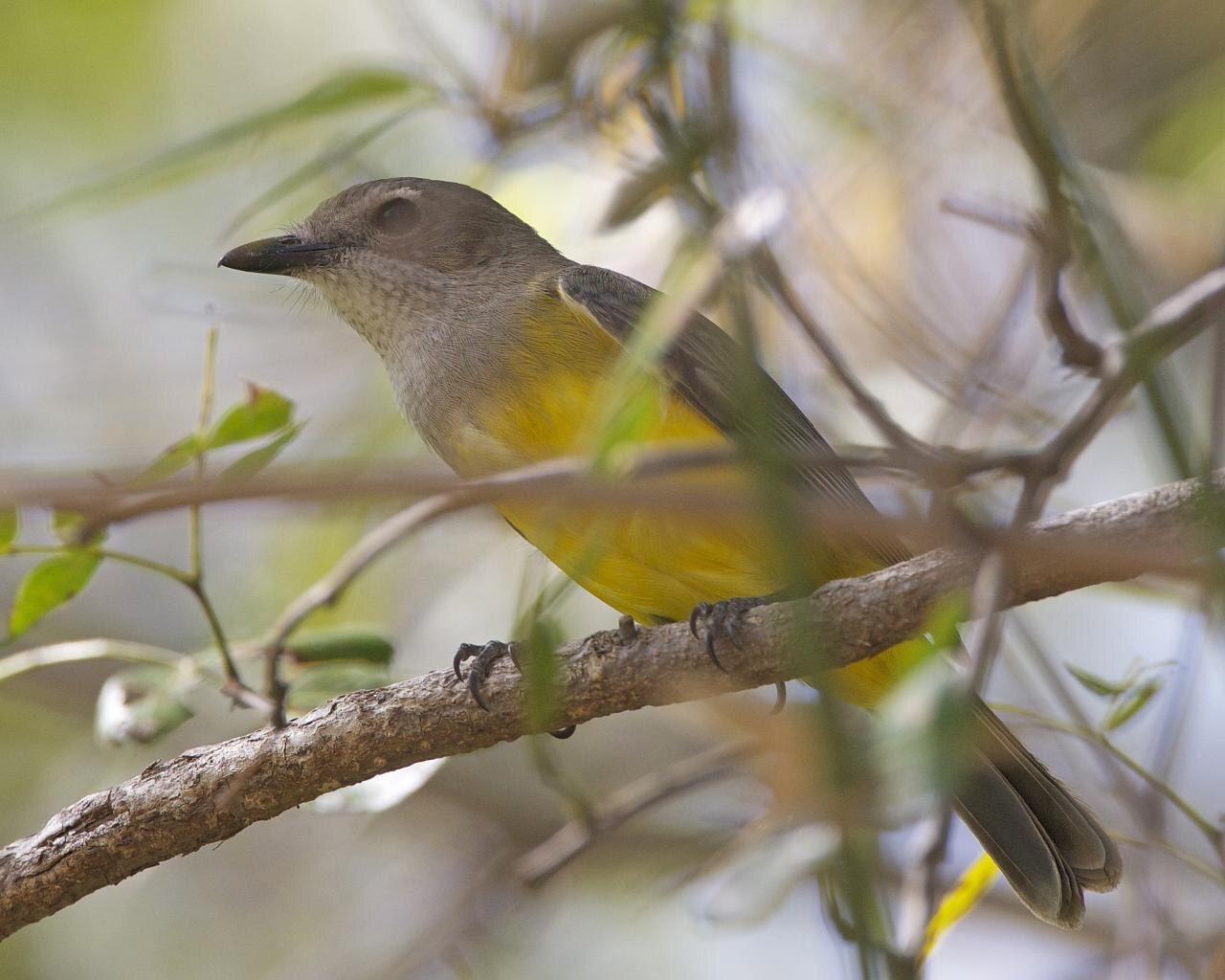
The Mangrove Golden Whistler is the mangrove counterpart of the Australian Golden Whistler: a compact, heavy-billed bird whose male wears the same black head, white throat, black breast band and golden-yellow underparts, but with a shorter tail and a broader yellow nape collar. It is tied almost entirely to the mangrove belt of the northern coast, and in the field that habitat is the quickest way to separate it from its more famous relative.
Voice
A loud, clear whistled series strongly recalling that of the Australian Golden Whistler, but shorter, faster and with a less drawn-out run-up: a few rising notes followed by a sharp final note. The sound carries well across a mangrove creek and is usually delivered from the closed canopy, where the bird itself stays out of sight. Alongside it come single plaintive notes and a soft throaty call between members of a pair.
No freely licensed recording has been found for this species yet; what to listen for is described below.
Identification
A compact whistler of fifteen to seventeen centimetres with a proportionally heavy, long bill and a short tail. The male has a black head, a white throat patch, a broad black breast band and deep golden-yellow underparts, with a yellow nape collar broader and more saturated than in the Australian Golden Whistler and running almost down to the black breast band; the white throat patch, by contrast, is smaller. The back is olive-green and the wings and tail are black — that black tail gave the species its scientific name. The female is a muted grey-brown to olive-grey, but with a clearly yellowish belly and yellow undertail coverts, yellower than in most other muted female whistlers.
Confusion species
Australian Golden Whistler (Pachycephala pectoralis) is the only real candidate, and the overlap is small but real in northern Queensland. Look at the nape collar: broad and deep yellow here, so that it almost meets the black breast band, narrower with more black between in the Australian Golden Whistler. Then check proportions — shorter tail and heavier bill here — and habitat, which in practice decides fastest: mangrove against eucalypt forest. White-breasted Whistler (Pachycephala lanioides) shares the mangrove and the black head pattern, but is far larger, has an enormous bill and is white and chestnut instead of yellow. The female resembles that of Grey Whistler (Pachycephala simplex), which is smaller and has less yellow under the tail.
Habitat
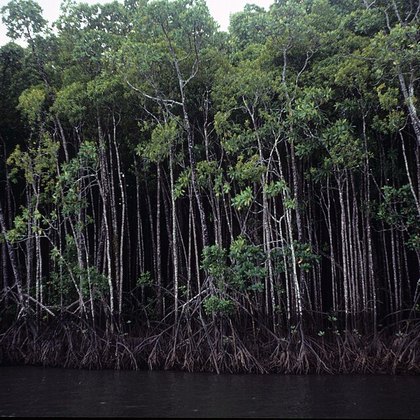
Mangrove, and to a lesser degree the adjoining monsoon forest and vine thickets immediately behind the coast. Within the mangrove the bird sits higher than White-breasted Whistler: in the closed canopy and the upper half of the trees, gleaning insects and spiders from leaf and twig. On some islands and along narrow coastal strips the species also ventures into coastal scrub and gardens just behind the mangrove.
Where the bird is most often found, arranged by main group and formation.

Range and movements
The northern and north-western coast of Australia, from the Pilbara and the Kimberley in Western Australia across the Northern Territory coast to the Gulf of Carpentaria and the western side of Cape York Peninsula, together with the islands of Torres Strait. Beyond Australia the species occurs in New Guinea and the Indonesian archipelago. There is no migration; birds hold the same stretch of mangrove all year.
- Resident
- dark = core range, pale = thinly spread
Where and when to look
Look for it where the Australian Golden Whistler does not go: in closed mangrove, preferably from a boat or a jetty that lets you see the canopy side-on. Listen first — the short, quick whistled series gives the bird away at tens of metres — and then check the nape collar. For the female one rule serves: a muted whistler in mangrove with clear yellow under the tail is almost certainly this species.
Conservation
Not Evaluated (NE) under the taxonomy followed here, because the species has only recently been separated as an independent taxon in the split of the golden whistler group; under the broader species concept it counted as Least Concern. The bird is locally common within its habitat, but that habitat is narrow and vulnerable: mangrove loss to ports, mining infrastructure and aquaculture along the north-west coast, cyclone damage, and in the longer term a shifting mangrove belt under sea-level rise.
Scientific name
Pachycephala melanura | Gould, 1843
John Gould described the species in 1843 from a bird taken on the north coast of Australia; Gregory Mathews restricted the type locality in 1920 to Derby in the western Kimberley. The epithet melanura comes from Ancient Greek melas ('black') and oura ('tail'). The genus Pachycephala was introduced in 1827 by Nicholas Vigors and Thomas Horsfield, from pakhus ('thick') and kephalē ('head'). The Dutch Zwartstaartfluiter and the Spanish silbador colinegro follow the Latin and take the black tail, while the English Mangrove Golden Whistler takes the habitat — in practice the most useful of the three characters.