All species › Passerines › Whistlers and allies › Olive Whistler
Olive Whistler | Pachycephala olivacea
Bruine fluiter | Silbador oliváceo
The Olive Whistler is the large, dark whistler of the cool south-east: a heavy olive-brown bird with a white, finely scalloped throat that keeps to the dense understorey of wet mountain forest, fern gullies and subalpine heath. You almost always hear it before you see it, because the song carries far through the forest while the bird itself stays low and hidden.

Voice
One of the finest voices of the Australian mountain forest: loud, clear, plaintive whistles that roll slowly across the bush, often a long rising note followed by a short sharp crack. The bird repeats its phrase patiently from cover, and the sound is so round and ventriloquial that the direction is hard to fix. Dialects differ audibly between the separate ranges: the phrase sounds different in Tasmania from the mountains of New South Wales.
No freely licensed recording has been found for this species yet; what to listen for is described below.
Identification
A heavy whistler of a little over twenty centimetres with a stout black bill and a proportionally long tail. The upperparts are dull olive-brown, head and neck grey, and against that stands a white throat finely scalloped with grey. That scalloped throat, set off below by a plain grey breast band, is the decisive character and occurs in no other Australian whistler. Belly and flanks are warm ochre to orange-buff. The female is duller, with a less sharply drawn throat and a browner head. There is no black cap, no black breast band and no yellow: everything about this bird is muted.
Confusion species
The female Australian Golden Whistler (Pachycephala pectoralis) is likewise inconspicuously olive-grey, but is clearly smaller and slimmer, lacks the scalloped throat pattern, and often shows faint streaking on the chest and a hint of yellow under the tail. The female Rufous Whistler (Pachycephala rufiventris) is finely but distinctly dark-streaked below and has a rusty wash on the flanks, never the plain ochre of this species. Grey Shrikethrush (Colluricincla harmonica) shares the forest and the heavy bill, but is larger, uniformly grey and shows no throat pattern at all. Grey Whistler (Pachycephala simplex) is muted enough in colour, but is much smaller and occurs only in the tropical north; the ranges do not meet.
Habitat
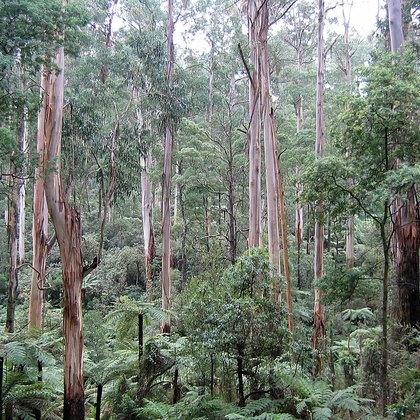
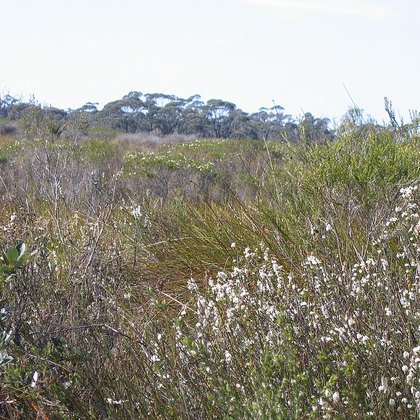
Wet eucalypt forest with a dense, damp understorey, cool temperate rainforest with southern beech, fern-filled gullies, and higher up the subalpine shrub-heath above the treeline. The bird forages low, in the bottom few metres and regularly on the ground, searching litter and ferns for insects and berries. Open, dry forest is avoided; the density of the understorey decides where the species sits.
Where the bird is most often found, arranged by main group and formation.

Range and movements
South-eastern Australia, in three separated blocks: the McPherson Range on the Queensland–New South Wales border, the Great Dividing Range of New South Wales and Victoria together with the Otway Ranges, and Tasmania. On the mainland it is mainly a bird of above five hundred metres; in Tasmania it reaches sea level. There is no true migration, but in winter many birds drop down the slopes into lower, more sheltered forest.
- Resident
- dark = core range, pale = thinly spread
Where and when to look
Use your ears. Walk slowly through a damp gully or along a forest edge at altitude and stop the moment the long whistled phrase sounds; then wait, because the bird often drops a branch lower out of curiosity. Put the binoculars on the lowest shrub layer, not the canopy, and look for the white throat: in good light the fine grey scalloping on it shows at once.
Conservation
Least Concern (LC). The range is large and the species is still common in suitable forest. The vulnerability lies in the habitat itself: the bird depends entirely on dense, damp understorey, and that is exactly what large, hot bushfires remove and what recovers slowly afterwards. The northern population in the McPherson Range is small and cut off from the rest, and is therefore the most exposed to a single severe fire.
Scientific name
Pachycephala olivacea | Vigors & Horsfield, 1827
Nicholas Vigors and Thomas Horsfield described the species in 1827, in the same work in which they introduced the genus Pachycephala. That generic name combines Ancient Greek pakhus ('thick') with kephalē ('head'), for the heavy, broad head of these birds. The epithet olivacea is Latin for 'olive-coloured'. They gave no type locality; Gregory Mathews designated Tasmania in 1920. The English name Olive Whistler and the Spanish silbador oliváceo follow the olive tone, while the Dutch Bruine fluiter ('brown whistler') takes the browner impression the bird makes in the field.