All species › Birds of prey › Kites, Old World vultures, eagles and hawks › White-bellied Sea-Eagle
White-bellied Sea-Eagle | Icthyophaga leucogaster
Witbuikzeearend | Pigargo oriental
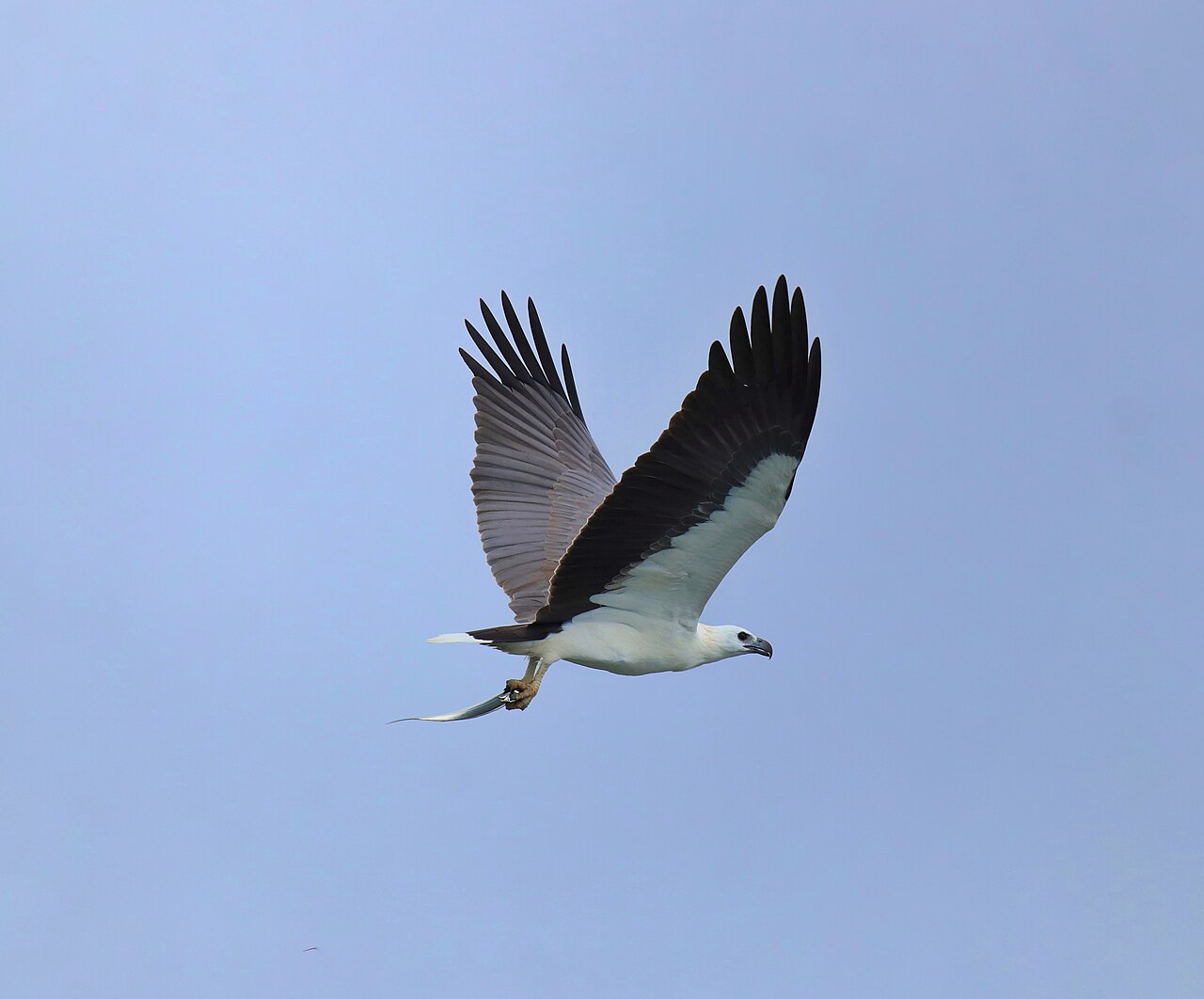
At close to a metre long and with a wingspan of up to two metres, the White-bellied Sea-Eagle is one of the two largest raptors in this region, and along any Australian coast the first bird a watcher learns: snow-white head and underparts against slate-grey wings, with a short white wedge tail. It sails with its wings in a markedly sharp V.
Voice
A loud goose-like series of honking notes that carries over the water: ank-ank-ank, often in duet by the pair from the nest tree or in flight. The male calls higher and faster than the female. In the breeding season, May to October, it is one of the most characteristic sounds of an Australian river mouth or bay; outside it the bird calls less, but the duet remains the mark of an occupied territory.
No recording with a suitable Creative Commons licence has been found for this species yet; what to listen for is described below.
Identification
A very large eagle. The adult has a white head, breast, belly and underwing coverts, dark grey back and upperwings, and black flight feathers that form a sharp border with the white beneath the wing. The tail is short and wedge-shaped, grey at the base and broadly white at the tip. The bill is large, hooked and grey with a darker tip, the eye dark brown, and the legs cream-white and — importantly — bare, unfeathered right to the toes. It sails with the wings in a clear sharp V. Young birds are mainly brown and gain white over four to five years; they already show the short wedge tail and the bare legs. The female is larger and heavier.
Confusion species
Wedge-tailed Eagle (Aquila audax) is the only real rival for size: as large or larger, but wholly dark, with a far longer wedge tail and legs feathered right down to the toes. Young White-bellied Sea-Eagles are also brown and are regularly taken for Wedge-tailed Eagles — the short tail and the bare legs settle it. Against the kites, size itself is the character: Whistling Kite (Haliastur sphenurus), Black Kite (Milvus migrans) and Brahminy Kite (Haliastur indus) are none of them much over half a metre and barely reach half its wingspan; a sea eagle hanging beside a party of kites over the same creek fixes the difference at once. Osprey (Pandion haliaetus) shares the coast and the fish diet, but is clearly smaller, with long kinked wings and a dark eye-stripe across a white head.
Habitat
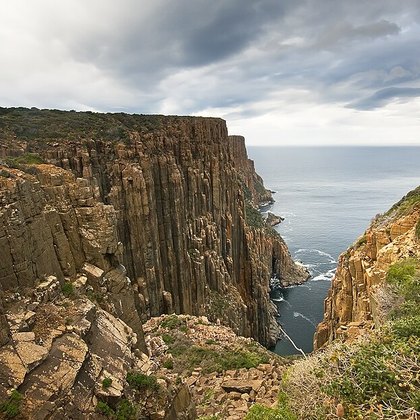
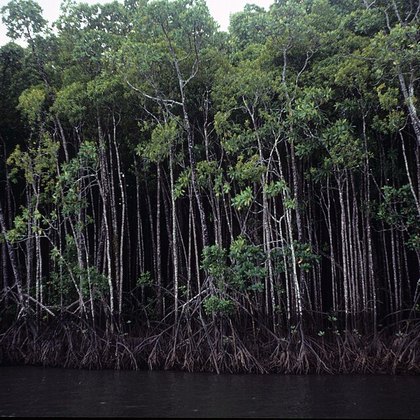
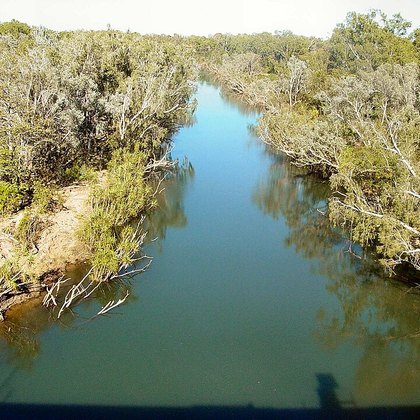
Coast and near-coast: sea and continental shelf within sight of land, rocky shores and sea cliffs, tidal flats and estuaries, mangrove and river mouths. Beyond that it follows large rivers and lakes far inland, especially along the Murray-Darling system and over inland reservoirs. It hunts fish — catfish, barramundi — sea snakes and turtles, and beyond those waterfowl, seabirds, reptiles and small mammals; it takes carrion without hesitation, and chases smaller raptors until they drop their prey. The nest is a large stick structure, up to thirty metres high in a tree but locally also on a rock ledge or simply on the ground on an island, and is used for many seasons in succession.
Where the bird is most often found, arranged by main group and formation.



Range and movements
Along the whole Australian coast and the major waterways, from Queensland south through New South Wales, Victoria and South Australia to Tasmania and its offshore islands, and round the whole tropical north and the west coast. Locally it is abundant, as at Corner Inlet in Victoria and on Kangaroo Island in South Australia. Inland it reaches the rivers and reservoirs of eastern Australia. There is a single record for Norfolk Island and one from Lord Howe Island. It does not breed in New Zealand; a few unconfirmed reports exist, no more.
- Resident
- dark = core range, pale = thinly spread
Where and when to look
Stand at a river mouth, a bay or a large reservoir and search the treeline on the skyline: it likes to perch high and clear on a dead branch overlooking the water, for hours at a time. In flight the sharp V can be read at long range, before the white shows at all. In the southern winter half of the year, listen for the goose-like honking of the duet — it marks an occupied territory and so a nest tree nearby.
Conservation
Least Concern (LC) at world scale, with a population put at ten thousand to a hundred thousand birds, but in south-eastern Australia the picture is poorer and regional listings apply. Tasmania holds fewer than a thousand adult birds and lists it as Vulnerable under state law; Victoria lists it as Threatened with fewer than a hundred breeding pairs, and South Australia as Vulnerable. The pressure points are always the same: disturbance at the nest by recreation and building work, loss of old coastal nest trees, shooting and poisoning, and collision with powerlines. Because a pair uses the same nest for decades, the loss of a single nest tree cuts deep.
Scientific name
Icthyophaga leucogaster | (Gmelin, 1788)
Gmelin described the species in 1788 as Falco leucogaster, from specimens taken at Princes Island off Java during Cook's last voyage; the later move to another genus puts author and year in parentheses. The bird stood long in Haliaeetus, but in current treatment is placed in Icthyophaga, a genus Lesson introduced in 1843 from Greek ikhthus 'fish' and phagos 'eating' — the fish-eaters among the sea eagles. leucogaster comes from leukos 'white' and gaster 'belly'. The type locality was afterwards fixed on Java; the English and Dutch names translate the epithet directly.