All species › Birds of prey › Kites, Old World vultures, eagles and hawks › Little Eagle
Little Eagle | Hieraaetus morphnoides
Australische dwergarend | Aguililla australiana
The Little Eagle is Australia's smallest eagle: compact and powerfully built, with legs feathered to the toes like trousers, a short crest on the nape and a pale letter M across the upperwing. It soars in tight small circles on flat wings, quite unlike the shallow V of the Wedge-tailed Eagle.

Voice
In the breeding season it is strikingly noisy for an eagle: a run of clear, quickly repeated whistles, whit-whit-whit-weeoo, delivered from high over the woodland, and besides that chattering, whining and sharp squealing around the nest. Away from the breeding territory it is rarely heard.
Recording: Iain Woxvold — CC BY-NC-SA 4.0 · Goldie, Macedon Ranges Shire, Victoria, Australia · xeno-canto
Identification
Forty-five to fifty-five centimetres, with a wingspan of just over a metre; the female is larger and darker than the male. There are two colour morphs: the common light morph has pale creamy underparts with a dark leading edge to the wing and a dark primary tip, the dark morph is uniform rufous brown. In both the legs are feathered to the toes, the perched bird carries a short crest on the nape, and the tail is square-cut and faintly barred. Across the upperwing coverts runs a pale diagonal band which, on both wings together, makes an M.
Confusion species
Wedge-tailed Eagle (Aquila audax) has the same shape but is almost twice the size, holds its wings in a shallow V when soaring and has a long tapering wedge of a tail against the short square tail of the Little Eagle. Whistling Kite (Haliastur sphenurus) is about the same size and also shows a pale diagonal wing band, but has longer and narrower wings, unfeathered legs, a pale rounded tail and a loose, rocking flight where the Little Eagle soars tight and purposeful. Black-breasted Buzzard (Hamirostra melanosternon) of the interior is heavier, broader-winged and shows big round white patches in the primaries.
Habitat
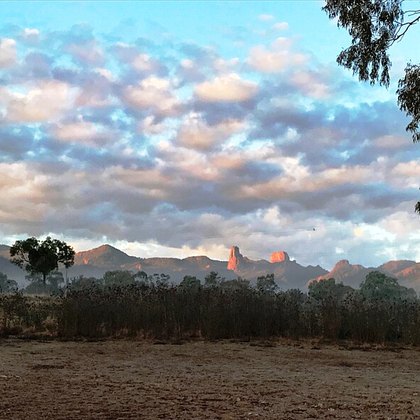
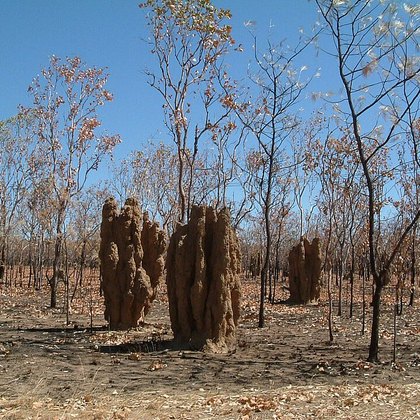
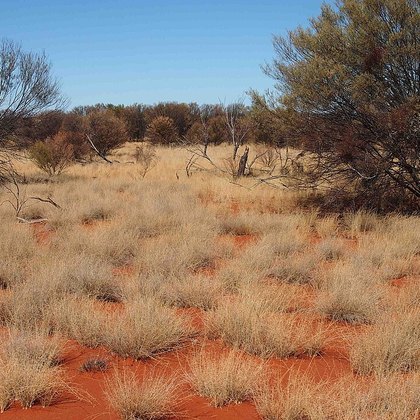
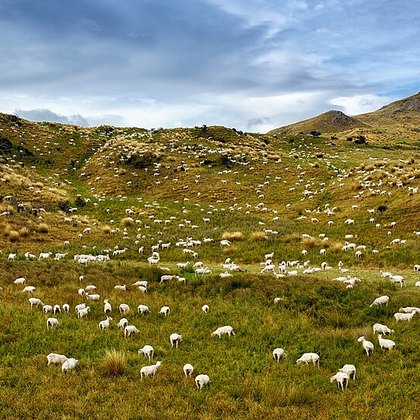
Open eucalypt woodland and savanna, mulga (acacia scrub of the dry interior, dominated by Acacia aneura) and acacia scrub, riverine woodland along creeks and grazed rangeland far into the dry zone. It avoids rainforest and closed wet forest, but for the nest it needs a tall tree, usually in a strip of timber along a watercourse or on a wooded hill slope.
Where the bird is most often found, arranged by main group and formation.

Range and movements
Across nearly all of mainland Australia, from the tropical savanna to the south, except the densest coastal forests; it is absent from Tasmania and New Zealand. The New Guinea birds once counted with this species are now treated as a species of their own, so the Little Eagle stands as an Australian endemic. Adults hold a fixed territory; young birds wander widely, and part of the southeastern population moves north in winter.
- Resident
- dark = core range, pale = thinly spread
Where and when to look
In the middle of the day, when the thermals are up, watch soaring raptors over a wooded ridge: flat-held wings with a short square-cut tail point to this species and separate it at once from the Wedge-tailed Eagle. In spring listen for the persistent clear whistling — no other Australian eagle calls as much.
Conservation
Least Concern (LC) globally on the strength of its range, but in southeastern Australia the decline is serious: in the Australian Capital Territory numbers have fallen by more than seventy per cent in twenty years, and in New South Wales and Victoria it is listed as vulnerable. The causes run together: loss and fragmentation of woodland, the collapse of the rabbit as a main prey after calicivirus, competition and displacement by the much larger Wedge-tailed Eagle, and disturbance at the nest tree.
Scientific name
Hieraaetus morphnoides | (Gould, 1841)
Gould described the species in 1841 as Aquila morphnoides; because it was later moved to another genus, author and year stand in parentheses. The genus Hieraaetus was introduced by Kaup in 1844 and is built from Greek hierax, 'hawk', and aetos, 'eagle' — exactly the middle ground this small eagle occupies. morphnoides means 'resembling Morphnus', the genus of the Crested Eagle, whose name goes back to Greek morphnos, in Aristotle a dark-coloured eagle. The type locality is Yarrundi on the upper Hunter River in New South Wales.